
Following a high-level working visit by Dr. Peter Boamah Otokunor, the Director of the Presidential Initiative on Agriculture and Agribusiness (PIAA), to audit critical water assets in the Garu District, the Upper East Region has become the focus of a major infrastructural revival, as the state moves to bridge the gap between subsistence farming and commercial agribusiness.
At the center of this inspection was the Tamne Dam, a massive engineering project that has come to symbolize both the potential and the historical frustrations of northern agricultural development. For the farmers of Garu, the visit brought confidence that the dormant giant in their backyard may finally be put to work.
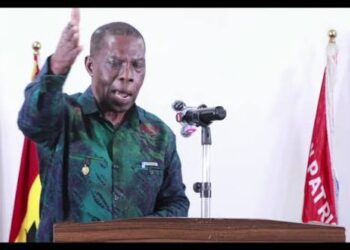
“As part of my working visit to the region, I toured the Tamne dam. The construction of the dam, which commenced in 2015 under the John Dramani Mahama administration, was later abandoned by the previous administration. The project is currently 75% complete and has the capacity to irrigate over 1000ha of agricultural land”
Dr. Peter Boamah Otokunor, Director of the Presidential Initiative on Agriculture and Agribusiness
Dr. Otokunor noted that the project’s subsequent abandonment by the previous administration led to years of stagnation. Today, despite being tantalizingly close to its operational goal, the ambitious project still requires a final, decisive push to bring its waters to the fields of the Garu District and fundamentally transform the regional economy.
As a centerpiece of Ghana’s climate-resilient farming strategy, the significance of 1,000 hectares of irrigated land cannot be overstated in a region where rainfall patterns are increasingly erratic. For decades, farmers in the Upper East have been locked into a single-season farming cycle, leaving them vulnerable to the harsh realities of the dry season.

The completion of the Tamne Dam would effectively collapse this seasonal limitation, allowing for a 365-day production cycle. Dr. Otokunor’s inspection focused heavily on the engineering readiness of the facility, as the Presidential Initiative views large-scale irrigation as the primary defense against food insecurity and the poverty trap of rain-fed agriculture.
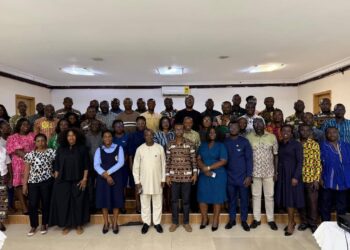
Beyond the technical specs, the Director’s visit served as an opportunity to engage directly with the primary stakeholders of the project: the farmer groups of Garu. These conversations revealed a complex web of challenges that go far beyond the mere availability of water.
The farmers shared their concerns regarding the state of agricultural production in the district, pointing to a dual crisis of agronomic shortcomings and structural market failures. While the dam promises water, the farmers were quick to point out that water alone is not a panacea if they lack the modern inputs and the commercial pathways to sell their produce.
Value Chain Deficit
During these deliberations, Dr. Otokunor emphasized that the Presidential Initiative is moving away from the “produce-only” model of the past.
The new strategy focuses on the entire value chain, recognizing that northern farmers often face a harvest curse where a bumper crop leads to a price collapse due to a lack of processing and storage. The Director shared various measures currently being undertaken by the government to mitigate these hurdles.
With the marketing challenges mentioned by the Garu farmers being particularly acute in the north, where transportation costs and a lack of cold-chain infrastructure often result in massive post-harvest losses, Dr. Otokunor mentioned a strategic shift toward value chain development, where the state facilitates links between rural farmers and industrial agro-processors.
He explained that the government’s commitment to delivering modern irrigation is tethered to a broader plan for agribusiness hubs.

Through the establishment of processing closer to the source of production – the irrigated fields of the Tamne Dam – the government aims to ensure that farmers are not just growing more food, but are also capturing a greater share of the economic value.
Dr. Otokunor used the platform to reiterate the commitment of the current administration to completing the legacy projects of the Mahama era, framing the completion of the Tamne Dam not just as a matter of finishing a construction project, but as a moral and economic obligation to the people of the Upper East.
The promise of “modern irrigation agriculture” is now a central pillar of the government’s 2026 economic agenda, intended to accelerate the achievement of national food security goals while stabilizing rural incomes.
The Presidential Initiative is positioning itself as the bridge between large-scale infrastructure and ground-level farming success, by identifying the specific agronomic issues – ranging from soil health to seed quality – that are plaguing farmers and taking a data-driven approach to agricultural support.
For the Garu District, this involves deploying technical experts to work alongside the irrigation projects, ensuring that when the Tamne Dam finally reaches 100% completion, the farmers are ready to utilize it to its maximum efficiency.
The working visit to the Tamne Dam marks a significant milestone in the revival of the Upper East’s agricultural prospects and Ghana’s food security goals. The transition from 75% to 100% completion represents more than just the final 25% of a construction contract; it represents the difference between a district in waiting and a district in production.
As Dr. Otokunor moves forward with his regional audit, the message to the northern farming community is one of renewed urgency and structural support. The Tamne Dam is no longer being viewed as an abandoned relic of a previous administration, but as a live asset in the nation’s agribusiness portfolio.

If the government can successfully marry the 1,000-hectare irrigation capacity with the value chain development promised by the Presidential Initiative, the Garu District could become a blueprint for northern transformation.
READ ALSO: GNPC, PPA Intensify Efforts to Enhance Oil and Gas Supply Chain