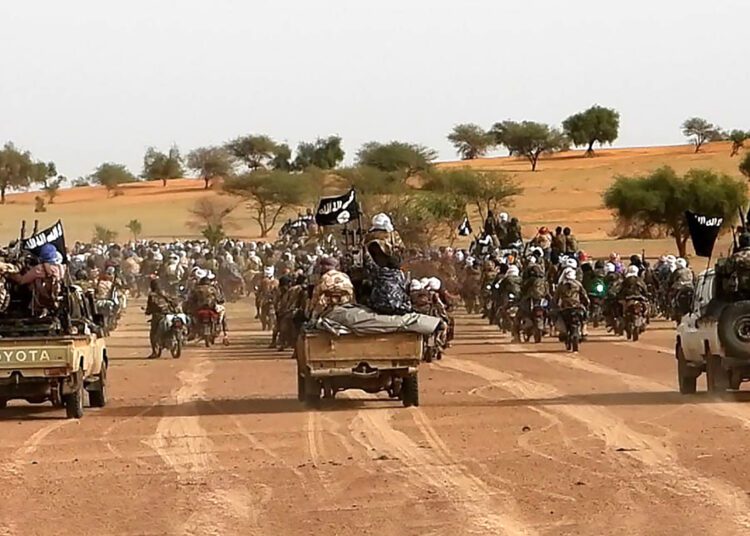
Jihadist fighters in Mali have called for a nationwide uprising against the country’s military rulers, escalating tensions as they tighten pressure on the capital, Bamako.
The appeal comes days after coordinated attacks on junta positions and coincides with the start of a blockade on key roads into the city, raising fears of further instability in a country already grappling with years of conflict.
The call was issued by the Group for the Support of Islam and Muslims (JNIM), an al-Qaeda-linked alliance, which urged a broad coalition of Malian society to unite against the military leadership that has been in power since 2020.
The statement followed joint weekend attacks by jihadist fighters and Tuareg separatists targeting government forces, signalling a growing level of coordination among armed groups.“We call on all sincere patriots, without exception, to rise up and unite our forces in a common front,” JNIM declared.
According to the jihadist fighters, its objective was to “bring down the junta” and pursue what it described as a “peaceful and inclusive transition,” appealing to political parties, the armed forces, religious authorities and traditional leaders.
At the same time, JNIM has begun enforcing a blockade on roads leading into Bamako and the nearby town of Kati, a key military stronghold. The group warned of severe reprisals against anyone attempting to travel along these routes, effectively restricting movement and disrupting supply lines into the capital. “The only concession is being made for those already in Bamako to allow them to leave,” a JNIM spokesperson stated.
The impact of the blockade is already being felt. Transport operators report that hundreds of passenger and goods vehicles have been stranded at entry points into the city, particularly along routes linking Mali to regional trade hubs such as Conakry, Abidjan and Dakar critical corridors for the landlocked country’s economy. Road traffic into Bamako has thinned in recent days, although air travel remains unaffected.
Elsewhere, reports from the road to Sikasso suggest a worsening security situation, with accounts of violent incidents and unverified claims that some drivers may have been killed.
The escalation comes as Mali continues to face overlapping security and political challenges, with armed groups intensifying pressure on the state while authorities struggle to maintain control over key routes and urban centres.
Mali Holds Tribute for Slain Defence Minister
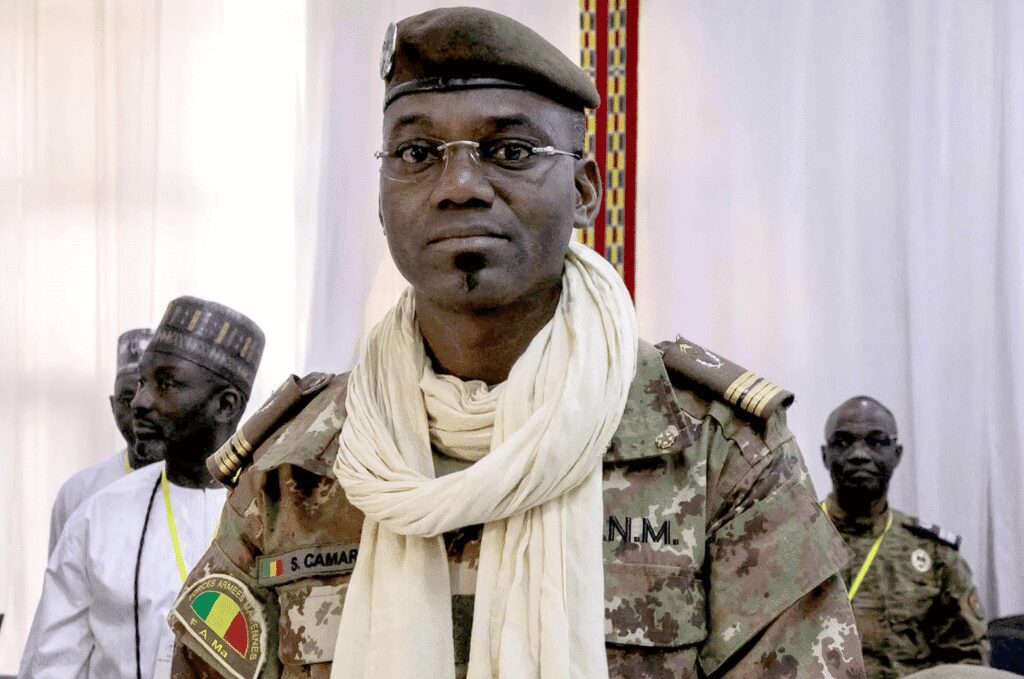
Meanwhile, Mali held a heavily guarded tribute ceremony in the capital, Bamako, for assassinated Defence Minister Sadio Camara, underscoring the scale of the country’s deepening security crisis following a wave of coordinated attacks by armed groups.
Camara, a central figure in Mali’s military leadership, was killed over the weekend in a car bomb attack at his residence in Kati, a key garrison town near Bamako that houses several senior junta officials.
His death came as fighters from the Group for the Support of Islam and Muslims (JNIM), alongside Tuareg separatists from the Azawad Liberation Front, launched large-scale assaults on strategic positions controlled by the ruling junta.
Thousands of mourners, including senior government officials, military personnel, and foreign dignitaries, gathered at the military engineering battalion grounds in central Bamako for the ceremony.
Among those present was junta leader Assimi Goita, who paid tribute by bowing before the coffin, which was draped in the national flag.Security was visibly heightened throughout the capital. Armed soldiers were deployed in large numbers, while checkpoints and barricades blocked access to roads leading to the venue.
Entry to the ceremony was tightly controlled, reflecting concerns over further attacks following the weekend violence.The government declared two days of national mourning after Camara’s death, highlighting his prominence within the administration.
Widely regarded as a key architect of Mali’s recent strategic shift toward closer ties with Russia, the 47-year-old minister had played a central role in reshaping the country’s defence and foreign policy direction.
Relatives, friends, and officials from across the region attended the ceremony, including defence ministers from neighbouring Niger and Burkina Faso. Mali, along with its regional allies, has in recent years distanced itself from former colonial power France, strengthening military and political cooperation through the Alliance of Sahel States.
The attacks that led to Camara’s death have intensified concerns over stability in the Sahel nation.
According to official figures, at least 23 civilians and soldiers were killed in the coordinated assaults, which targeted multiple junta-controlled locations.
The violence has further exposed the fragile security environment, as jihadist groups and separatist movements continue to challenge state authority.
READ ALSO : Ramaphosa Announces November 4 for Local Government Elections