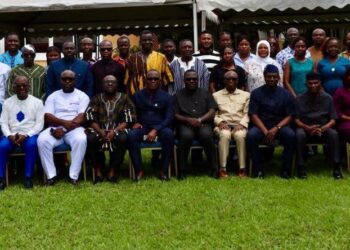

Ghana’s maritime sector has entered a new epoch of decentralized governance as the Ministry of Fisheries and Aquaculture Development (MoFAD) formalized its recent “co-management” doctrine with a multi-stakeholder engagement workshop held at the La Palm Royal Beach Hotel in Accra.
Hon. Emelia Arthur, the Sector Minister, signaled the end of the state’s monopoly on maritime policing, highlighting MoFAD’s new strategic alliance with Blue Ventures Conservation, which is poised to dismantle the traditional top-down hierarchy that has historically failed to curb the depletion of national fish stocks.
“The programme marks a shift toward co-management – an approach that brings together government, communities, and partners to jointly manage fisheries resources. Sustainable fisheries cannot be achieved by the government alone”
Hon. Emelia Arthur, Minister for Fisheries and Aquaculture Development
In an aggressive pivot toward community-led stewardship, the Ministry noted that the shift constitutes a fundamental restructuring of the Blue Economy, designed to transform artisanal fishers from passive subjects of regulation into active guardians of the ocean’s biological capital. The workshop arrives at a critical juncture for Ghana’s maritime narrative.
Following the recent implementation of the Fisheries and Aquaculture Act, 2025 (Act 1146), and the historic declaration of the nation’s first Marine Protected Area (MPA) at Greater Cape Three Points, the government is under pressure to prove that these legal frameworks can translate into tangible stock recovery.
The presence of international heavyweights, academia, and development partners in Accra underscored the global interest in Ghana’s experiment. Hon. Arthur explained that through the MoU with Blue Ventures Conservation, Ghana is leveraging international expertise to bridge the persistent data gap that has long hampered effective fisheries management in West Africa.
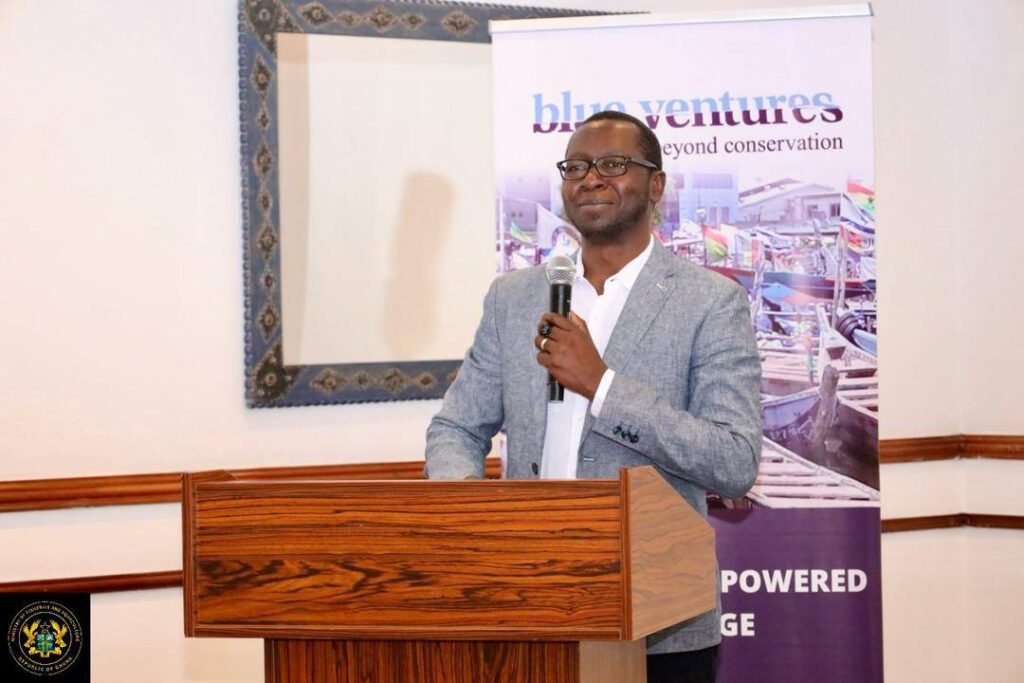
The Minister’s keynote address served as a manifesto for a new era of shared responsibility, unapologetic in its assessment that the era where the central government acted as the sole arbiter of the seas has passed.
Under the “co-management” model, the Ministry will devolve significant powers to coastal communities, granting them a formal seat at the table in the management of marine resources. This strategy recognizes that the biological health of Ghana’s waters is inextricably linked to the socio-economic health of its coastal dwellers.
The government aims to create a self-policing environment where Illegal, Unreported, and Unregulated (IUU) fishing becomes socially and economically unacceptable at the local level.
The Minister’s call to action was structured around a tripartite responsibility framework. The government provides the legislative leadership and the macro-policy environment; international partners like Blue Ventures provide the technical and financial scaffolding; and the communities themselves must provide the “boots on the ground” stewardship.
The Data-Driven Sea
Central to this transformation is the technical prowess of Blue Ventures Conservation. Under the leadership of CEO Ebrima Saidy, the organization is deploying a suite of programs designed to rebuild tropical fisheries through improved transparency and community-owned data.
According to MoFAD, Blue Ventures represents the engine of the reform, as their programs in West Africa are specifically tailored to empower marginalized groups – particularly women and youth – by providing them with the tools for monitoring, surveillance, and digital data collection.
This “democratization of data” guarantees that the Ministry’s decisions henceforth are informed by the real-time realities of the ocean, rather than outdated bureaucratic estimates.

“The CEO of Blue Ventures reaffirmed the organisation’s commitment to supporting Ghana’s fisheries sector and called for deeper collaboration between stakeholders to ensure alignment of priorities and sustained impact”
Ministry of Fisheries and Aquaculture Development
Ebrima Saidy’s commendation of the Ghanaian leadership reflected a growing international consensus that Ghana is “ready” for large-scale maritime reform. He noted that the partnership focuses on building financial resilience through alternative livelihoods and savings schemes, effectively decoupling from the immediate pressures of the daily catch.
Through this diversification of income streams for coastal families, the partnership reduces the desperation that often leads to destructive fishing practices. This is the “Blue Economy” in its most practical form: protecting the environment by strengthening the household balance sheet.
The workshop placed a significant emphasis on the role of women and youth as the “hidden stakeholders in fisheries.”
While the act of fishing is often seen as a male-dominated endeavor, the processing, marketing, and financial management of the sector are largely handled by women, and the Ministry’s new priorities explicitly target these groups, aiming to amplify their voices in governance and protect their resource rights.
This inclusive approach is a strategic necessity, as a fisheries policy that ignores the majority of its value chain participants is destined for failure.
Beyond immediate livelihoods, the workshop focused on the restoration of fish stocks as a national security priority. Hon. Arthur outlined five key anchors for this: governance and enforcement, data accuracy, community empowerment, ecosystem protection, and sustainable livelihoods.
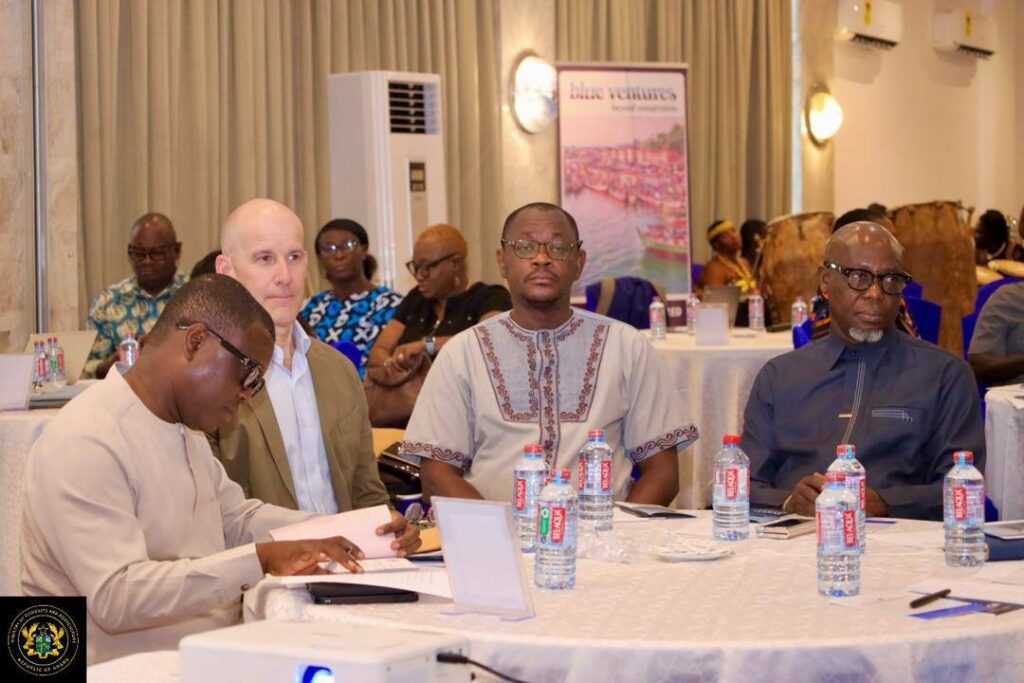
This holistic framework will move Ghana beyond the “closed season” as a singular event and toward a permanent culture of conservation. As the engagement concluded, the consensus among stakeholders was clear: the journey toward a resilient coastal economy has finally transitioned from theory to practice.
The implementation phase of this MoU will be the ultimate test of the “co-management” vision. It will require a level of transparency and trust between the state and the artisanal sector that has rarely existed in the past.
However, for MoFAD, with the backing of Blue Ventures and the clear-eyed leadership of Hon. Emelia Arthur, the path toward restoration is more visible than ever.
READ ALSO: “No Man of God” Concert and Book Launch Set This Saturday