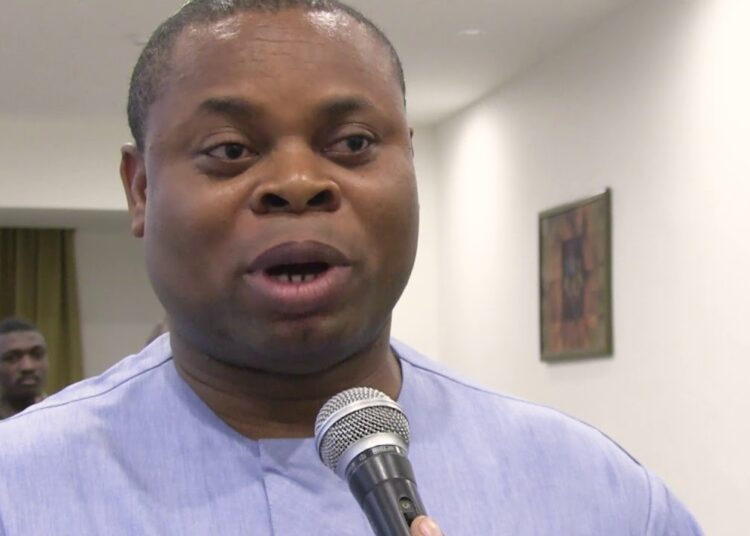
IMANI Centre for Policy and Education Founding President and CEO Franklin Cudjoe has called for cases involving the theft of millions in public funds to be concluded within two months, with courts sitting daily and through judicial vacations to achieve it.
He set out the position as the dispute over vacation sittings between the Ghana Bar Association and the Judiciary widened into a constitutional challenge at the Supreme Court.
Mr Cudjoe argued that accused persons should not be permitted to fund delaying tactics with the money they are alleged to have taken, and warned that prolonged litigation buys time for political change that can end a prosecution through executive or prosecutorial discretion.
His intervention places him alongside anti-corruption advocates who have pressed for statutory deadlines on graft trials, among them Professor Stephen Kwaku Asare.
Two months to conclude a case
Mr Cudjoe put a specific deadline on trials involving large sums taken from the public purse. “I believe cases involving the theft of public funds amounting to millions should be concluded within two months,” he said.

The mechanism he proposes goes further than the warrants currently under challenge. “To achieve this, courts should sit daily, including during judicial vacations, to ensure the swift administration of justice,” he said.
That prescription answers the Bar’s position directly. Where the Association has argued that trials should ordinarily pause between 1 August and 30 September, Mr Cudjoe treats the vacation as time the justice system cannot afford to lose on cases of this kind.
Stolen money funding the defence
His second argument concerns who pays for the delay, and it carries an accusation about how prolonged litigation is financed. “Individuals accused of such offences should not be allowed to use allegedly misappropriated funds to finance legal tactics aimed at delaying proceedings through frivolous applications and procedural obstacles,” he said.
The point turns the usual framing of due process on its head. Interlocutory applications and preliminary objections are ordinary features of criminal defence, available to any accused person. Mr Cudjoe’s complaint is not that defendants use them, but that in this category of case the resources deployed may themselves be the subject of the charge.
“Far too often, prolonged litigation creates opportunities for political changes that may ultimately result in the discontinuation of prosecutions through executive or prosecutorial discretion. Let us end the circus now.”
Franklin Cudjoe, Founding President of IMANI Centre for Policy and Education
The concern is not hypothetical. Trials that run across a change of government have repeatedly ended without verdicts, and the power to enter a nolle prosequi rests with an Attorney-General who serves at the pleasure of whichever party wins.

A demand anti-corruption advocates have pressed for years
Mr Cudjoe’s call restates a position campaigners have advanced through successive administrations.
Professor Stephen Kwaku Asare, a Fellow at CDD-Ghana, has argued that the fight against corruption cannot be won without judicial reform and has proposed dedicated Corruption Courts with a clear mandate to adjudicate corruption cases within a strict timeframe of a few months, citing Kenya, Uganda, Tanzania and several Asian countries as having implemented similar measures.
He has also described the current system as weaponised to frustrate prosecutions through endless adjournments and frivolous interlocutory appeals, and has called for a transition to a fast justice system.
Professor Asare has made the argument from the other direction as well. Reviewing prosecutions that had spent at least seven years in the system before being discontinued, he asked whether cases that run nearly a decade without a conviction serve justice, and said the measure of a legal system is not the length of its prosecutions but its ability to deliver fair, timely, and legally sound outcomes.
Where the argument meets the current dispute
The timing places Mr Cudjoe on one side of a confrontation that has escalated through August. The Ghana Bar Association wrote to Chief Justice Paul Baffoe-Bonnie on 10 August after three law firms received notices requiring their lawyers to appear before judges designated to continue part-heard criminal cases during the vacation.

The Chief Justice answered in Sunyani, saying a judge ready to sit cannot be stopped because counsel has made other arrangements. Ofoase-Ayirebi MP Kojo Oppong Nkrumah has since filed a writ at the Supreme Court, arguing that selecting some criminal cases for vacation hearing while others wait amounts to selective justice.
That suit and Mr Cudjoe’s demand describe the same practice from opposite ends. One treats the selection of cases as a constitutional problem. The other treats the pace of every other case as the problem, and vacation sittings as the beginning of a remedy rather than the whole of it.
A two-month deadline would require more than a willing bench. Prosecutors must be ready, disclosure complete, witnesses available and defence counsel able to prepare in the same window.
Neither Mr Cudjoe nor Professor Asare has specified what happens when a deadline passes without a verdict, which is the question any statutory timeline eventually has to answer. A rule that dismisses a case on expiry protects defendants, but rewards delay. One that carries no consequence protects nobody.
READ ALSO: Ghana’s Economy Shifts from Inflation-led to Consumer-led Growth