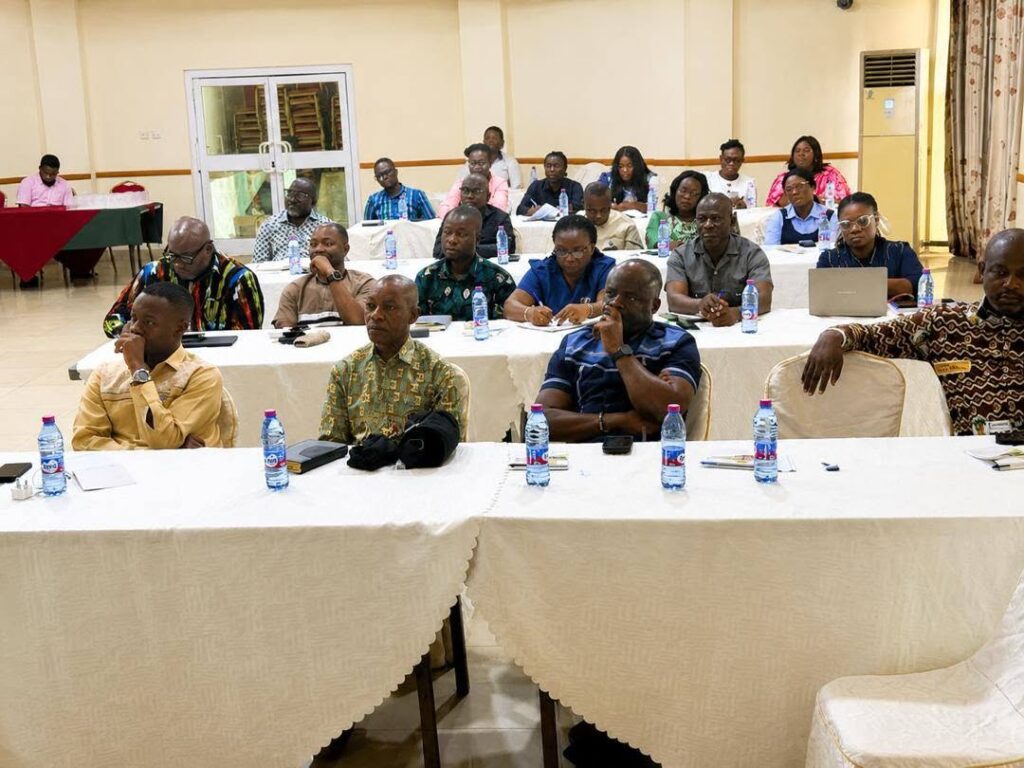
Regional Managers of the Cocoa Health and Extension Division and the Seed Production Division participated in a high-level briefing in Kumasi on the provisions and implications of the Ghana Cocoa Board Bill, 2026.
The engagement, facilitated by the Public Affairs Department of COCOBOD, was aimed at ensuring that key officials are fully abreast of the new legislation so they can provide accurate information to cocoa farmers and industry stakeholders at the regional, district and grassroots levels.
Senior officials from both divisions received detailed explanations of the Bill’s key provisions, with particular focus on how the legislation seeks to address long-standing structural and human-induced challenges in the cocoa sector. The briefing also served as a platform to align messaging across regions ahead of nationwide sensitization.
Presenting the key provisions of the Bill, Deputy Head of Public Affairs, Mr. Benjamin Larweh, expressed concern over the increasing spread of misinformation and disinformation surrounding the new legislation. He noted that false narratives circulating in the media and on social platforms risk confusing farmers and undermining trust in the reforms.
“Clear, consistent and fact-based communication is critical at this stage; our role is to ensure that farmers understand what the Bill actually contains, not what is being speculated. We must take the lead in restoring clarity.”
Deputy Head of Public Affairs, Mr. Benjamin Larweh
He addressed several misconceptions that have gained traction in recent weeks, explaining the intent behind specific clauses and how they relate to farm management, input distribution, and industry regulation. He urged CHED and SPD Regional Managers to serve as credible sources of information within their jurisdictions.

The Deputy Head of Public Affairs emphasized that effective communication will be a major determinant of how well the Bill is received and implemented. He called on officials to engage traditional authorities, farmer groups, and local media to ensure that the right messages reach intended audiences.
New Legislation Targets Human-Induced Challenges
Reinforcing the importance of the engagement in the Cocoa Sector, Executive Director of CHED, Dr. Richard Adu Acheampong, said the briefing was in the best interest of the cocoa sector and the livelihoods of more than 800,000 cocoa farmers nationwide.
According to Dr. Acheampong, the Ghana Cocoa Board Bill, 2026 has been designed to tackle persistent challenges that have historically undermined efforts to build a resilient and sustainable cocoa industry.
He cited issues such as poor agronomic practices, side selling, illegal mining on cocoa farms, and weak extension service delivery as areas the new law seeks to address.
“The sector cannot continue with business as usual, this Bill provides the legal and institutional framework to strengthen our operations, improve productivity, and protect the future of cocoa farming in Ghana.”
Executive Director of CHED, Dr. Richard Adu Acheampong
Dr. Acheampong noted that CHED and SPD are at the frontline of implementation because they interact directly with farmers. He charged Regional Managers to translate the technical provisions of the Bill into simple, practical messages that farmers can understand and act on.
He added that the Bill also seeks to enhance collaboration between COCOBOD and other stakeholders, including input suppliers, research institutions, and farmer-based organizations, to ensure a coordinated approach to sector development.
COCOSHE Pledges Support for Farmer Sensitization
The Ashanti Regional Secretary of the Cocoa, Coffee and Shea Nut Farmers Association, Nana Appiah David, who attended the briefing, welcomed the Bill and called on COCOBOD to intensify public education on its provisions.
Nana Appiah David observed that some misconceptions about the legislation are spreading rapidly in farming communities, leaving farmers anxious and uncertain about what changes to expect. He said such confusion could affect compliance and reduce the intended impact of the reforms.
“As farmers, we need to know exactly what this Bill means for us on the farm,” COCOSHE is ready to work with COCOBOD to take the message to the grassroots so that our members are not misled.”
Ashanti Regional Secretary of the Cocoa, Coffee and Shea Nut Farmers Association, Nana Appiah David
He pledged the association’s support in organizing community durbars, radio programs, and farm visits to sensitize farmers on the Bill. He also urged the government to ensure that the implementation of the law goes hand-in-hand with improved access to inputs, credit, and extension services.
The COCOSHE representative further noted that farmer trust is essential for any policy to succeed. When farmers understand a policy, they own it. When they are confused, they resist it. That is why this education drive is so important.
The meeting was also attended by the Deputy Executive Directors of CHED and SPD, alongside other senior officials from both divisions. Discussions centered on strategies for cascading information from the regional level down to District Cocoa Officers, Extension Agents, and ultimately to farmers in the communities.
Officials agreed that a unified communication plan is needed to avoid contradictory messages. The Public Affairs Department is expected to provide briefing materials, FAQs, and talking points to support Regional Managers in their engagements.

They believe that by equipping senior officials early, COCOBOD aims to ensure that accurate information precedes speculation and deploy field staff to support the sensitization drive. They emphasized that extension officers, who visit farms regularly, are best placed to explain how the Bill will affect day-to-day farming activities.
Dr. Acheampong stressed that a sustainable industry requires not only good policies but also disciplined implementation and farmer cooperation. He urged all actors to see the Bill as an opportunity to reset the sector and address gaps that have persisted for decades.
He concluded the session by reminding officials that their communication must be proactive, not reactive. As Ghana’s cocoa sector faces pressures from climate change, aging farms, and global market dynamics, officials say the Bill represents a critical step toward building a more resilient, transparent, and productive industry for current and future generations of cocoa farmers.
READ ALSO: Mahama Unveils Five-Year Plan to Cut Ghana’s Dependence On Imported Medicines