Defence Chiefs from Japan and the Philippines have expressed renewed alarm over what they called China’s intensifying coercive actions in disputed waters.
This came as Japanese Defence Minister Shinjiro Koizumi held talks with his Philippine counterpart, Gilberto Teodoro Jr.
Koizumi told a press conference with Teodoro after their closed-door talks in Manila, “Secretary Teodoro and I reaffirmed our strong opposition to any unilateral attempts to change the status quo by force or coercion in the East China Sea and the South China Sea.”
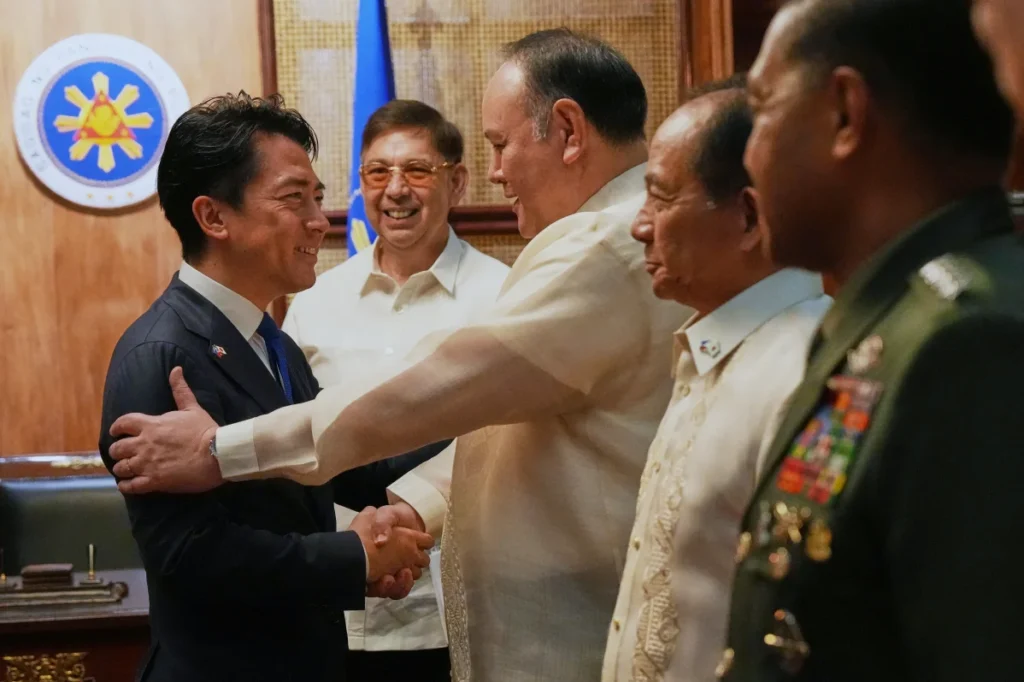
In a joint statement, Koizumi and Teodoro expressed their serious concern over China’s intensifying “coercive activities” in both disputed offshore areas. Chinese officials did not immediately comment on their remarks, but have previously accused the Philippines of allowing countries led by the US to “gang up” against China and contain its rise.
On Wednesday, Koizumi will be among representatives from 17 countries, including India and Australia, who will travel to Paoay, in northwestern Philippines, for an annual combat exercise called Balikatan in which US, Philippine, Japanese and Canadian firepower will be used in a mock allied assault to sink a ship about 40 kilometers (25 miles) off the coast.
During the Paoay drills, Japanese forces will fire two volleys of Type 88 missiles to sink a decommissioned World War II-era Philippine navy warship. The Philippine President plans to watch the live-fire maneuvers via video in Manila.
“Tomorrow (Wednesday), together with Secretary Teodoro, I will observe ‘Balikatan’ 26. I very much look forward to seeing with my own eyes this new step forward in the rapidly advancing Japan-Philippines defense cooperation.”
Shinjiro Koizumi
The location for the live-fire drill faces the disputed South China Sea, which has been claimed virtually in its entirety by Beijing. The Philippines, Vietnam, Malaysia, Brunei and Taiwan have also been involved in the long-simmering territorial standoffs, but confrontations have spiked in recent years between Chinese and Filipino coast guard and naval forces.
Japan and China have separate disputes over uninhabited East China Sea islands known as Senkaku in Japan and Diaoyu in China.
The Philippines and Japan signed a pact in 2024 allowing their forces to stage large-scale combat drills. The Reciprocal Access Agreement paved the way for Japan to deploy 1,400 military personnel to become regular participants in the exercises called Balikatan.
US, Filipino and other allied forces annually take part in Balikatan — the Tagalog word for shoulder-to-shoulder — to brace for security contingencies and deter China’s increasing assertiveness in the region.
Japan, Philippines Agree On Talks Concerning Weapons Transfer Pact
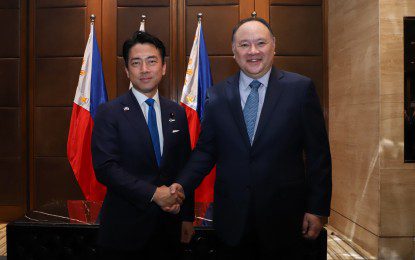
The Defence Chiefs agreed to start talks on a weapons transfer pact that will allow Tokyo to provide used destroyers to Manila’s navy. The details of the potential exchange have yet to be negotiated.
Japanese Defense Minister Shinjiro Koizumi held separate talks with his Philippine counterpart, Gilberto Teodoro Jr., and President Ferdinand Marcos Jr. in Manila to broaden defense ties between the two nations, which are both treaty allies of the United States.
Japan has bolstered its offensive capability with long-range missiles to attack enemy targets from a distance, a major break from its post-World War II principle limiting the use of force to self-defense.
Japan scrapped a ban on lethal weapons exports on April 21, another major change in its postwar pacifist policy as Japan seeks to build up its arms industry in response to growing Chinese aggression in the region.Lifting the ban allows Japan to consider the transfer to the Philippines of up to six used Japanese destroyers of the Abukuma-class, which can be utilized for patrols and detecting aerial, sea surface and undersea threats, Hernandez said. The details of the potential exchange have yet to be negotiated.
While allies led by the U.S. and Australia welcomed Japan’s updated policy, China criticized the change.China’s Foreign Ministry spokesperson Guo Jiakun said last month that the global community, including China, will “resolutely resist Japan’s reckless moves toward a new type of militarism.”
For his part, Teodoro thanked Koizumi for his visit, which coincides with the 70th anniversary of diplomatic relations between the two countries.“And he came here to personally witness the first-ever exercise participated in by Japan as a SOVFA (Status Of Visiting Forces Agreement) partner and as a resilient, converged partner of the Philippines,” he said.Teodoro also affirmed the points raised by his Japanese counterpart.“We thank Japan once again for its review of the Three Principles on the Transfer of Defense Equipment and Technology and its Implementing Guidelines. And we were very happy to work with Japan in creating demonstrable results at the soonest possible time,” he added.
The DND chief also expressed gratitude for Japan’s assistance during disasters.
READ ALSO: Mike Fraser Hints Efforts to Secure Long-Term Lease Approval for Tarkwa Mine