The European Union has approved a tariff deal with the United States to cap tariffs on most EU exports at 15%.
The agreement puts the bloc on track to meet Trump’s 4 July deadline for ratification of the deal.
The EU’s Trade Negotiator, Maroš Šefčovič, said the final push to approve the deal came after five hours in “an intensive night” of trilogue discussions between the European Council, European Parliament and the EU’s executive, the European Commission.

“Collective effort. Strong result. Meaningful work. After more than five hours of intensive negotiations … the EU has shown that we are a reliable trading partner, while standing firm in defending the interests of European stakeholders.”
Maroš Šefčovič
He said that when the political agreement is formally adopted by lawmakers in the coming weeks, “this outcome will reinforce stability in EU-U.S. trade and open the door even wider to constructive cooperation on many issues of strategic importance.”
It means the agreement struck last July can now enter into force, removing import duties on most US goods entering the EU. The European Commission President, Ursula von der Leyen, welcomed the pact.
“This means we will soon deliver on our part. Together, we can ensure stable, predictable, balanced and mutually beneficial transatlantic trade.”
Ursula von der Leyen
In the European Parliament, legislators threatened to block the trade agreement that European Commission President Ursula von der Leyen had struck last July with United States President Donald Trump at his Turnberry golf course in Scotland, following months of bargaining in the wake of his administration’s global fusillade of tariffs.
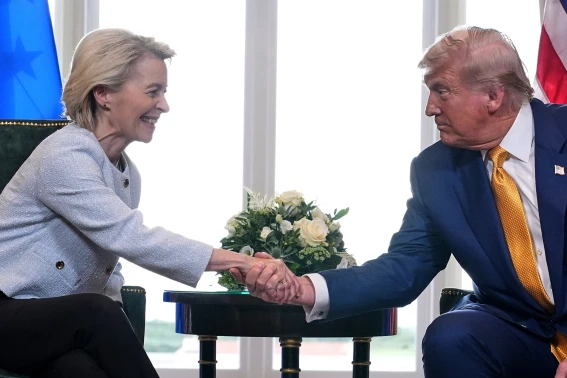
The agreement between von der Leyen and Trump initiated months more of negotiations over details between Washington and Brussels, just as criticism within Europe of the deal spiked after Trump threatened to take control of Greenland, a semi-autonomous territory of Denmark. He has backed away from the threat, at least for now.
In a significant victory, Members of the European Parliament forced the insertion of a clause warning that the EU could reinstall tariffs on American products such as motorbikes if the US did not drop tariffs on steel derivatives; products involving an element of steel, by the end of the year.
Bernard Lange, the head of the parliamentary trade committee said, that European lawmakers had successfully insisted on adding protections to the deal in case the U.S. backtracks or wavers on details. “If there is something going wrong, of course, we are self-confident to act on that,” he said.
The rough outlines of a deal indicate a 15% tariff cap on most European imports, while tariffs on US industrial goods would be reduced to zero. While the deal burdened consumers and businesses with a tariff increase from the previous average of 4.8%, it also gave businesses certainty so they could plan ahead, a factor credited with helping Europe avoid a recession last year.
With the continued closure of the Strait of Hormuz driving up prices as the war in the Middle East rages on, interest rates and inflation from Latvia to Louisiana, proponents of the EU-U.S. deal argue that settling trade between them is crucial in a time of global economic fragility.
American Chamber of Commerce Welcomes EU Consensus On Tariff Deal
The American Chamber of Commerce in Brussels said in a statement that it was “relieved” to see the EU reach a consensus on the deal. “The trilogue agreement is a sign that the EU is honouring its commitments under the deal,” it said, allowing Washington and Brussels to “move beyond tariffs” to tackle thorny issues like critical supply chains.
However, there is concern in Europe that the White House may not be able to follow through on the deal after the U.S. Supreme Court this year ruled against the legal authority Trump had used to impose that tax. This left Trump looking for substitute authorities, and his administration has imposed a 10% tax while investigating trade imbalances and national security issues, to impose new tariffs to make up for lost revenue.
In May, a federal court said that Trump had overstepped the tariff power that Congress had allowed the president under the law, making the new tariffs “invalid″ and “unauthorized by law.”
That would potentially include tariffs Trump threatened to levy on EU cars and trucks in a social media post where he also criticized the EU over the deal for not “as usual” sticking to it, without detailing the source of tensions.
Bernard Lange, the Head of the parliamentary trade committee noted that after the EU had pushed the deal through its internal democratic processes, it now awaits a positive reaction from Washington.
READ ALSO: Xi, Trump Agree To New Orientation For U.S.-China Relations