United Nations sexual and reproductive health agency, UNFPA, has warned that women and girls in Lebanon are paying an increasingly heavy price as renewed violence, displacement and attacks on healthcare facilities continue despite ongoing ceasefire efforts, leaving thousands without access to critical medical and protection services.
According to the UN Agency, escalating tensions in Beirut and intensified military operations across southern Lebanon have forced many families into repeated displacement, creating a worsening humanitarian emergency that is hitting women and children particularly hard.
UNFPA highlighted that recent airstrikes damaged a primary healthcare centre and a women and girls’ safe space that it supports in southern Lebanon. The facility had been among the few remaining locations providing essential reproductive healthcare, psychosocial support and protection services to vulnerable communities in the area.
Another attack reportedly damaged a public hospital that was providing maternal healthcare services.
The latest wave of displacement has affected an estimated 13,500 pregnant women, including around 1,500 expected to give birth within the next month. Humanitarian agencies fear many could face serious complications if access to medical care continues to deteriorate.
UNFPA estimates that approximately 1,500 women remain trapped in southern Lebanon without reliable access to skilled birth attendants or safe delivery facilities.
UNFPA Representative in Lebanon Anandita Philipose, “when maternity wards and hospitals are damaged and destroyed, it is pregnant women who cannot get life-saving services.”
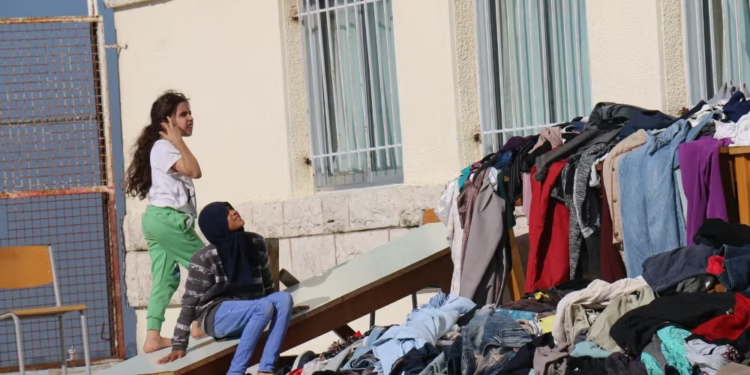
The UN agency also raised concerns about conditions inside displacement shelters, where overcrowding and inadequate facilities are exposing women and girls to additional risks.
Safety assessments conducted in temporary shelters revealed poor lighting, a lack of privacy and unsafe sanitation facilities. Aid workers warn that such conditions increase the likelihood of gender-based violence and exploitation, particularly for adolescent girls, pregnant women, female-headed households and people living with disabilities.
Despite the challenges, UNFPA continues to operate mobile maternal healthcare services, psychosocial support programmes and protection initiatives through local partners and Lebanese authorities.
The agency’s emergency appeal remains significantly underfunded, prompting fresh calls for international support.
Without additional resources, humanitarian organizations fear that thousands of women could lose access to skilled maternal healthcare and emergency medical assistance.
“If funding continues to fall short, thousands of pregnant women could lose access to skilled birth attendance and emergency maternal healthcare, and mobile teams serving hard-to-reach communities may be forced to scale back or stop operations entirely,”
Anandita Philipose
She added that the consequences would extend beyond healthcare, affecting protection services for women and girls across the country.
“Scaling down our operations means cutting off more than 75,000 women from critical gender-based violence protection, case management, and safe spaces at the exact moment that they need it the most.”
Anandita Philipose
Medical Services Disrupted as Conflict Drives Surge in Attacks on Lebanese Hospitals
Meanwhile, the worsening situation has also raised alarm within the World Health Organization (WHO), which highlighted that attacks on healthcare infrastructure are severely undermining access to essential services.
According to preliminary information from Lebanese authorities, at least 86 people, including healthcare workers, were injured in strikes targeting Jabal Amel Hospital in southern Lebanon.
WHO Representative in Lebanon, Dr Abdinasir Abubakar, noted that the attack caused extensive damage to critical parts of the hospital. “The attacks caused significant damage to the emergency department and intensive care unit,” he added.
Moreover, WHO data indicates that nearly 190 attacks on healthcare facilities have been verified during the past three months alone. These incidents have killed 128 healthcare workers and injured another 332. Eleven attacks were recorded in the last week.
“These attacks kill and maim, and they also deprive people of the health services they need.”
Dr Abdinasir Abubakar
Healthcare facilities in the Tyre district have suffered particularly severe impacts from recent tensions between Israeli forces and Hezbollah fighters.
Two of the district’s three hospitals, Jabal Amel and Hiram Hospital, have sustained damage, while the remaining facility is struggling to cope with an increasing number of casualties arriving for treatment.
The strain on healthcare infrastructure has left access to medical services severely restricted in many parts of southern Lebanon. Patients are reportedly facing delays of up to 48 hours in reaching referral hospitals capable of providing specialised treatment.
“Six hospitals have not yet resumed maternity delivery services and are currently providing only emergency room care. For pregnant women and newborns, delays in care can mean the difference between life and death.”
Dr Abdinasir Abubakar
In addition, health concerns are also mounting inside shelters hosting families displaced by the conflict.
WHO estimates that around 130,000 people are currently living in temporary accommodation after fleeing violence. The number continues to rise as military operations intensify and new evacuation orders force additional communities from their homes.
Recent surveillance has identified an increase in cases of acute watery diarrhoea, raising concerns that disease outbreaks could worsen as temperatures rise during the summer months.
Humanitarian agencies continue to call for greater protection of healthcare facilities and civilian infrastructure while urging the international community to increase support for relief operations.
READ ALSO: Last-Gasp Wales Equalizer Denies Ghana First Win in Eight Months