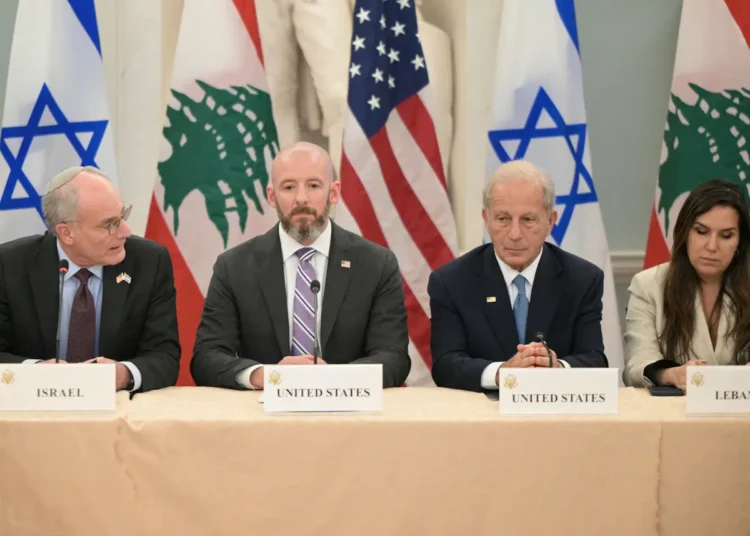
Israel and Lebanon have agreed to move forward with the implementation of a new ceasefire framework aimed at halting months of cross-border hostilities, offering a potential diplomatic breakthrough in a conflict that has displaced more than a million people and left thousands dead.
The announcement was made by the United States State Department following talks involving American, Israeli, and Lebanese officials. The proposed arrangement, however, remains conditional on a series of security commitments, most notably a complete halt to attacks by the Iran-backed armed group Hezbollah.
The agreement emerged after another day of violence that underscored the fragility of previous truce efforts. Israeli strikes across southern Lebanon reportedly killed at least nine people, while Hezbollah launched rockets and drones towards northern Israel, further testing a partial ceasefire that had been announced earlier in the week.
In a statement, the US State Department noted that all parties had reaffirmed that Lebanon’s future should be determined exclusively by its sovereign institutions.
“All countries reaffirmed that the future of the relationship between Israel and Lebanon must be decided by the two sovereign governments. They rejected any attempt, by any state or non-state actor, to hold Lebanon’s future hostage.”
US State Department
Under the proposed framework, Hezbollah fighters would be required to withdraw from the area between the Litani River and the Israeli border. The agreement also envisions the creation of pilot security zones where the Lebanese Armed Forces would exercise exclusive authority without the presence of armed non-state groups.
According to Washington, the United States will help oversee the establishment of these areas as part of a broader effort to strengthen Lebanese state control in the country’s south.
The latest development builds on a more limited arrangement reached earlier this week that sought to prevent an escalation around Beirut.
Lebanese officials indicated that understanding involved Israel refraining from major strikes on the Lebanese capital in exchange for Hezbollah halting attacks on Israeli territory.
Further negotiations are scheduled for 22 June, when the parties are expected to meet again in an attempt to transform the current framework into a more comprehensive and lasting agreement.
Despite the diplomatic progress, significant obstacles remain.
Hezbollah is yet to officially endorse the new arrangement, and senior figures within the movement have openly questioned the legitimacy of the ongoing negotiations.
Meanwhile, a member of Hezbollah’s political council, Mahmoud Qamati, said earlier this week that the organisation did not consider itself bound by discussions taking place between Lebanese and Israeli representatives in Washington.
“We think these negotiations do not concern us, nor do we recognise their findings or decisions, because we have rejected them on principle.”
Mahmoud Qamati
The group has also disputed descriptions of the earlier agreement as a ceasefire. “There was no ceasefire agreement, just the protection of Dahieh,” Qamati stated, referring to Beirut’s southern suburbs, a Hezbollah stronghold that has been repeatedly targeted during the conflict.
Lebanon Ceasefire Faces Test as Deadly Strikes Continue
The renewed diplomatic push comes amid growing concern that continued conflict in Lebanon could derail broader efforts to ease tensions across the region.
US Secretary of State Marco Rubio expressed optimism ahead of the announcement, stating he hoped negotiations would produce “an action plan on a track for security in [Lebanon], independent from Hezbollah.“
Washington has been attempting to contain multiple crises unfolding simultaneously across the Middle East, including ongoing tensions involving Iran, Israel and US forces in the Gulf.
The conflict in Lebanon intensified dramatically when Hezbollah launched rockets into Israel following an Israeli strike that killed Iran’s supreme leader. Israel responded with a major air campaign and later expanded operations into southern Lebanon.
Since then, the war has evolved into one of the deadliest chapters in the long-running confrontation between Israel and Hezbollah.
According to Lebanon’s Health Ministry, at least 3,516 people have been killed since the conflict began, while nearly 10,400 others have been wounded. The figures however, do not distinguish between civilians and combatants.
The humanitarian toll has also been severe. United Nations agencies estimate that more than one million people have been displaced across Lebanon, with Israeli evacuation orders now covering more than one-eighth of the country’s territory.
Lebanese media also reported extensive Israeli strikes across southern Lebanon. The Health Ministry emphasised that six people, including four Syrians and two Palestinians, were killed in a strike near the coastal city of Tyre.
The Ministry also reported that two paramedics were killed and another seriously injured when an ambulance belonging to the Risala Scouts Association was struck in the Chehour area.
According to the Ministry of Health, about 128 healthcare workers and paramedics have been killed during the past three months.
READ ALSO: Algeria Narrowly Edge The Netherlands in Pre-World Cup Friendly