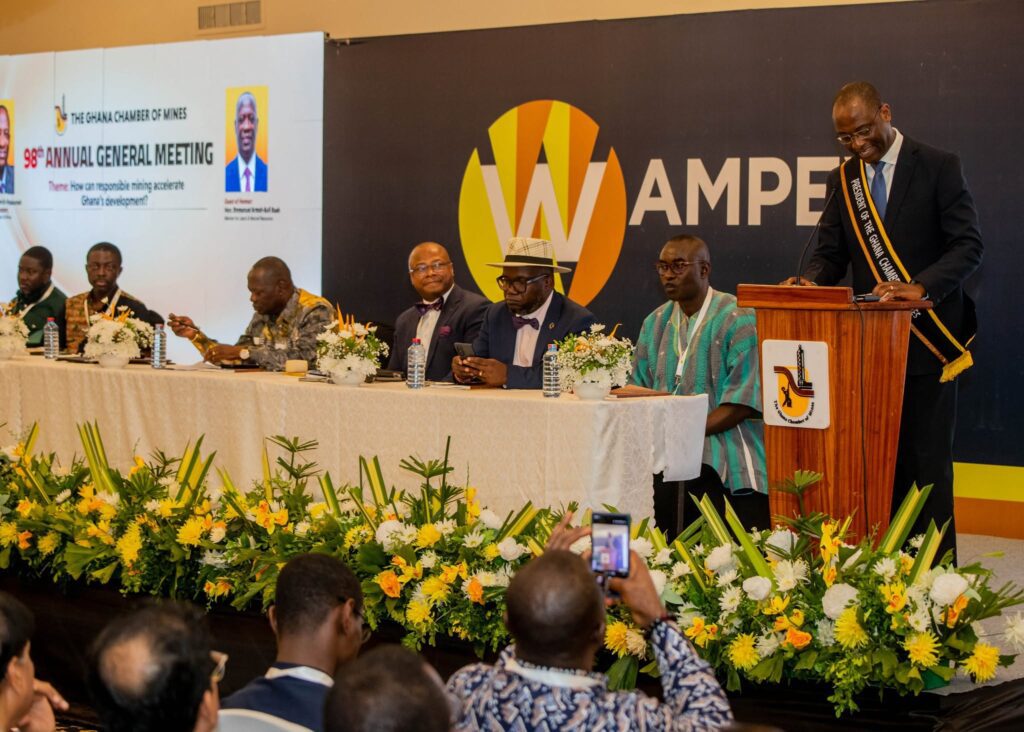
Ing. Fred Attakumah, the Executive Vice President of Asante Gold Corporation, has assumed the presidency of the Ghana Chamber of Mines, stepping into the leadership role to guide the nation’s primary minerals industry association.
He takes over the mantle of leadership from Gold Fields, which was represented by Micheal Edem Akafia, following the successful completion of its scheduled tenure at the helm of the organization.
This institutional transition underscores the robust governance framework of the Chamber, which has consistently facilitated seamless power handovers among its primary corporate stakeholders since its inception in 1928.
“Ing. Fred Attakumah, Executive Vice President of Asante Gold Corporation, has assumed the presidency of the Ghana Chamber of Mines, succeeding Gold Fields (Micheal Edem Akafia) upon the completion of its term as President of the Chamber.”
Ghana Chamber of Mines

As an accomplished corporate executive and a deeply respected engineer, Ing. Attakumah steps into this apex role at a time when the domestic extractive ecosystem is actively balancing industrial modernization with deep-seated sustainability targets.



The newly appointed president brings over thirty years of specialized, multi-disciplinary experience spanning major mining engineering projects, sustainability frameworks, and corporate diplomacy across West Africa.
He previously served as the First Vice President of the Chamber, a strategic position that allowed him to work closely with his predecessor, Michael Edem Akafia, in navigating complex fiscal regimes and advocating for proactive mineral policies in Accra.
His transition from the first vice presidency to the ultimate leadership seat provides the Chamber with vital institutional continuity, ensuring that ongoing regulatory engagements with the government and international investors maintain their momentum.
Operational Excellence and Modern Asset Integrity
Under the leadership of Ing. Attakumah, the Ghana Chamber of Mines is uniquely positioned to accelerate the adoption of advanced engineering standards and operational efficiencies across its member companies.
Given his expansive background as an electrical engineer and an alumnus of the Wharton School’s Advanced Management Program, the new president is expected to champion technological integration, asset reliability, and cost-optimization initiatives within the local mining value chain.
His executive track record at Asanko Gold and AngloGold Ashanti demonstrates an unwavering focus on transforming traditional extraction techniques into smart, tech-driven systems that minimize production downtimes.
Industry analysts anticipate that his regime will heavily influence member firms to upgrade processing plants and materials handling systems, directly strengthening the global competitiveness of Ghanaian mines.
Furthermore, his technical foresight will be essential in assisting large-scale producers to effectively mitigate the current headwinds of high input costs and volatile global commodity pricing structures.
Green Transition, Clean Energy, and Sustainability Frameworks
The Ghanaian mining industry consumes a significant portion of the national grid’s electrical output, making the transition to captive renewable energy solutions a critical economic and environmental priority.
Having previously served as the Vice President of Sustainability for AngloGold Ashanti’s operations in Ghana, the incoming president understands the intricate balance between heavy energy consumption and carbon reduction targets.

His leadership is highly anticipated to catalyze institutional support for private, embedded solar and clean energy plants within mining concessions, mirroring the industrial shift toward net-zero targets.
This environmental stewardship will also play a pivotal role in strengthening the Chamber’s corporate social investments, promoting environmental reclamation, and standardizing rigorous Environmental, Social, and Governance (ESG) metrics across sub-regional operations.
Strategic Stakeholder Engagement and Fiscal Advocacy
The regulatory and economic landscape of the Ghanaian extractive sector requires sophisticated diplomatic engagement, an area where Ing. Attakumah has historically excelled.
With member companies accounting for the largest share of direct domestic fiscal revenue in the country, the Chamber must constantly negotiate complex tax structures, such as exploration levies and value-added taxes, with state agencies.

The new president’s extensive experience in corporate affairs and his past interactions with the Private Enterprise Federation equip him with the strategic leverage needed to lead these high-level state dialogues.
By fostering a collaborative atmosphere between the Minerals Commission, the Ministry of Lands and Natural Resources, and corporate executives, his administration is set to foster a highly predictable investment climate.
This balanced approach to stakeholder management will not only secure state revenues but will also safeguard investor confidence, ensuring that Ghana remains the premier destination for mineral exploration and sustainable wealth creation within Africa.
READ ALSO: Avenor Building Collapse: Two Killed, Woman Still Trapped Under Rubble