GOIL PLC has attributed its operational difficulties and financial squeeze between 2022 and 2025 to rapidly changing consumer purchasing habits and extreme market fragmentation within Ghana’s petroleum downstream sector.
The state-backed indigenous oil marketing giant encountered unprecedented hurdles as a highly aggressive operating environment disrupted its previous commercial momentum.
This period of strategic recalibration followed a highly successful operational window where the indigenous oil marketing company (OMC) set industry benchmarks before hitting structural speed bumps.
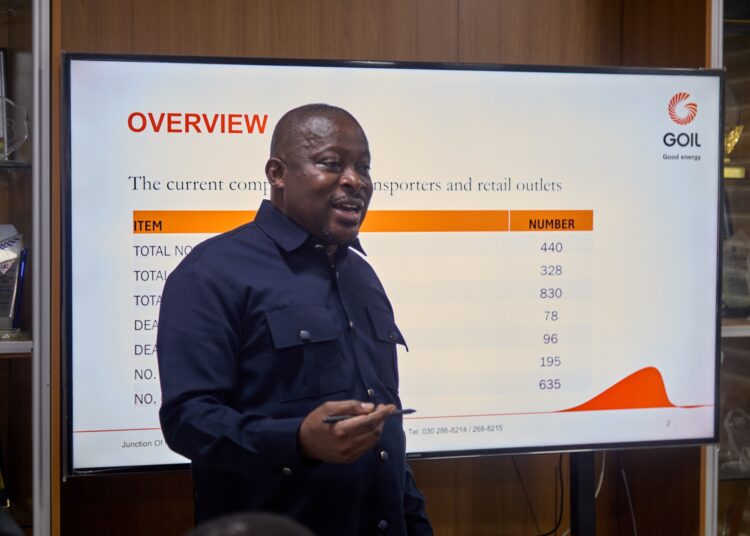
“Like many players in the industry, GOIL faced intense market pressures between 2022 and 2025 due to shifting consumer patterns, aggressive pricing initiatives, and heightened market fragmentation. During this period, strong indigenous competitors gained ground while established multinational players also shifted to a more competitive operating environment.”
GOIL PLC
Expanding on these commercial disruptions, the macroeconomic landscape across Ghana witnessed a proliferation of newly established, smaller indigenous operators that heavily fragmented the market share.
These new market entrants deployed aggressive pricing strategies that targeted the cost-conscious nature of local consumers, who shifted away from traditional brand loyalty in favor of immediate price reliefs at the pumps.

Consequently, the combination of intense cost-undercutting from domestic rivals and a renewed strategic push from major multinational players restricted GOIL’s ability to fully pass on rising operational overheads, triggering a sharp decline in its core profit margins despite maintaining its massive national retail footprint.
Market Fragmentation and Competitive Headwinds
The rapid evolution of Ghana’s downstream petroleum market sparked an aggressive expansion of independent, indigenous entities that fundamentally altered the retail landscape.
During the 2022–2025 fiscal years, the sector transitioned from a consolidated market dominated by established brands into a highly competitive, multi-player arena.
This intense structural fragmentation meant that while GOIL maintained the largest retail network across the country, its volume velocity per station faced heavy competition. Competitors optimized localized supply chains and adopted flexible tariff structures that undercut the market leader.
Simultaneously, multinational corporations restructured their Ghanaian operations to introduce premium loyalty packages, leaving GOIL compressed between discount local brands and high-incentive foreign OMCs.
Shifting Consumer Patterns and Profit Margin Squeeze
As global energy market volatility inflated local pump prices, Ghanaian fuel consumers adapted by demonstrating highly fluid and price-sensitive purchasing behaviors.
This consumer shift minimized the historical advantage of brand equity, as private and commercial drivers increasingly prioritized immediate cost-savings over long-term brand relationships.
For GOIL, this behavioral transition directly impacted operational revenues and eroded net income margins.
To combat the migration of its customer base, the company had to strategically absorb certain rising procurement costs, which severely flattened its net profit margins to near-zero thresholds in consecutive fiscal quarters.
The financial strain was further exacerbated by high operational overheads tied to maintaining over four hundred service stations during a period of reduced per-pump volume sales.
Strategic Renewal and Forward Commercial Momentum
Despite the financial setbacks recorded during the review period, the state-backed oil marketing company successfully averted structural decline by prioritizing operational resilience over short-term profitability.

The firm aggressively revitalized its nationwide retail infrastructure, turning high-traffic stations into multi-functional service hubs to attract modern consumers.
By systematically boosting product competitiveness and introducing targeted value propositions, the corporation re-anchored its commercial foundation.
The indigenous giant leveraged its extensive geographical reach to guarantee fuel accessibility in underserved regions, a strategic commitment that shielded its core volume metrics.
This comprehensive operational overhaul has effectively positioned the energy firm on a front-foot path toward sustainable long-term growth and stable market share reclamation.
READ ALSO: TCDA Partners with CRIG to Deploy Short-Gestation Seedlings for Shea Industry