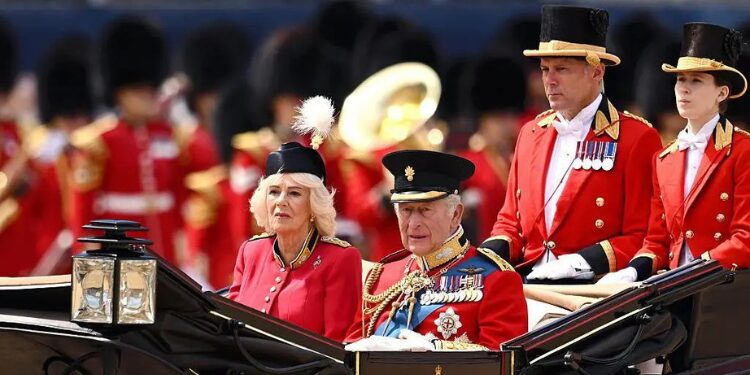
King Charles III has celebrated his official birthday with the annual Trooping the Colour ceremony in London, bringing together members of the Royal Family, thousands of spectators and more than 1,000 soldiers in one of Britain’s most enduring displays of military tradition and royal pageantry.
The event, held on Horse Guards Parade in central London, marked the fourth Trooping the Colour of Charles’s reign and showcased the ceremonial precision of the British Army’s Household Division.
The spectacle featured soldiers in scarlet tunics and bearskin hats, mounted cavalry, military bands and horse-drawn carriages moving through the heart of the British capital before culminating in the traditional appearance of the Royal Family on the balcony of Buckingham Palace and an RAF flypast.
Although King Charles’s actual birthday falls on November 14, the sovereign’s official birthday has traditionally been celebrated in June, when weather conditions are generally more suitable for large-scale outdoor ceremonies. The tradition has been observed for more than 260 years and remains one of the most important events in the royal calendar.
Crowds lined The Mall from Buckingham Palace to Horse Guards Parade to watch the royal procession, while approximately 8,000 family members of guardsmen and officers filled the stands overlooking the parade ground.
King Charles and Queen Camilla travelled in a carriage at the centre of the Sovereign’s Escort provided by the Household Cavalry Mounted Regiment. Behind them rode senior members of the Royal Family in their capacities as military colonels.
The Prince of Wales, Colonel of the Welsh Guards, rode on horseback alongside Princess Anne, Colonel of the Blues and Royals, and Prince Edward, Duke of Edinburgh, Colonel of the Scots Guards. Their participation reflected the close relationship between the monarchy and the armed forces, a connection that remains central to the ceremony’s significance.
Meanwhile, the Princess of Wales travelled in an Ascot Landau carriage accompanied by Prince George, Princess Charlotte and Prince Louis. The royal children later watched the proceedings from the former office of the Duke of Wellington overlooking Horse Guards Parade, giving them a privileged view of one of Britain’s oldest ceremonial traditions.

The route was lined for the first time by personnel drawn from all three branches of the British Armed Forces, including members of the Royal Navy, Royal Air Force and British Army. Units represented ranged from the Coldstream Guards and Royal Artillery to the Royal Lancers and RAF Regiment, highlighting the broad participation of the military in the national celebration.
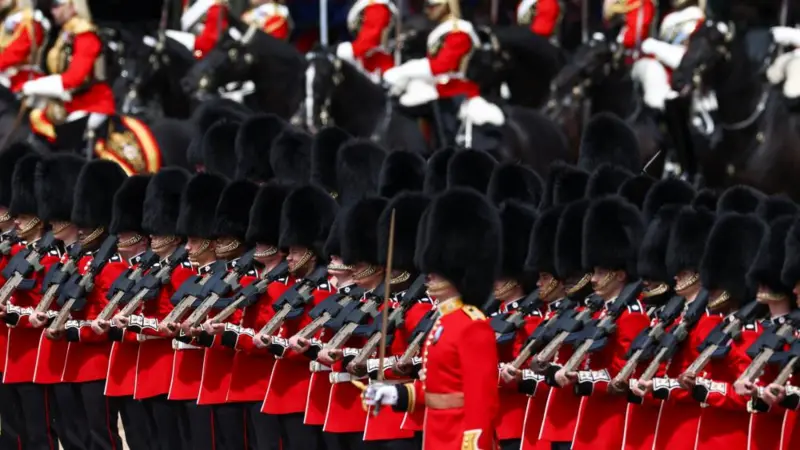
Upon arrival at Horse Guards Parade, the King carried out the traditional inspection of the troops. Accompanied by Queen Camilla, he reviewed ranks of more than 1,000 guardsmen drawn from the Grenadier, Coldstream, Scots and Irish Guards. The Welsh Guards were represented by their band because troops from the regiment are currently engaged in operational training.
The ceremony’s focal point was the trooping of the King’s Colour of the Grenadier Guards, a regimental flag presented by Charles earlier in the week during a ceremony at Buckingham Palace. The Colour was escorted by soldiers from the King’s Company, maintaining a tradition that dates back centuries when regimental flags served as vital rallying points on the battlefield.
Military precision remained at the heart of the event. Spectators watched as guardsmen marched first in slow time and then in quick time before the King, displaying skills refined through months of rehearsals and countless miles of marching practice.

As the Colour passed the royal dais, King Charles, Queen Camilla and the Princess of Wales stood in salute, underscoring the significance of the military traditions being honoured.
The event also carried special significance for the Grenadier Guards, who are marking their 370th anniversary this year. The regiment traces its origins to 1656 when the exiled King Charles II established the unit in Bruges, Belgium, to protect him during the period of Oliver Cromwell’s rule in England.
Since then, the Grenadier Guards have served in every major British conflict, from campaigns in the seventeenth century through the Napoleonic Wars, the Crimean War, both World Wars and more recent operations in Afghanistan.
Centuries-Old Tradition Continues to Link Monarchy and Military

Trooping the Colour remains one of the oldest surviving ceremonial traditions in Britain, with roots stretching back to the reign of King Charles II in the seventeenth century.
Historically, the Colours or regimental flags served as crucial rallying points during battle. To ensure soldiers could recognise their own regiment’s flag amid the confusion of combat, the Colours were regularly carried through military ranks, a process known as “trooping.”
In London, the Foot Guards performed this ritual during daily guard-mounting ceremonies at Horse Guards. Over time, the practice became associated with celebrations marking the sovereign’s birthday.
The earliest recorded reference to the Grenadier Guards celebrating the monarch’s birthday dates to 1748. Following the accession of King George III in 1760, it became established practice for military parades to mark the sovereign’s birthday, eventually evolving into the annual event recognised today.
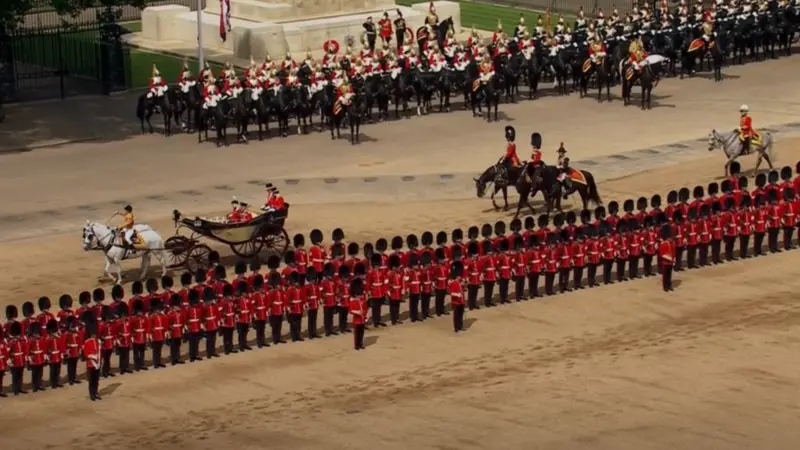
With only occasional interruptions, notably during the two World Wars, Trooping the Colour has remained a fixture of Britain’s ceremonial calendar.
Modern celebrations involve remarkable logistical coordination. More than 1,000 officers and soldiers take part in the parade alongside approximately 200 horses and over 200 military musicians from six bands and corps of drums. More than 100 separate commands are issued during the ceremony as troops execute carefully choreographed movements with precision timing.
The parade route extends from Buckingham Palace along The Mall to Horse Guards Parade before returning to the palace, where the celebrations traditionally conclude.
The event’s enduring popularity lies in its unique combination of military discipline, royal symbolism and national heritage. It provides an opportunity for the public to witness the ceremonial excellence of Britain’s armed forces while reinforcing the historic relationship between the Crown and the military.
READ ALSO: Black Sherif Ex-Manager Snap C Held in Major Fraud Probe