The Chief Executive Officer of the Minerals Commission, Isaac Tandoh, has announced that Ghana’s vast underground wealth, estimated at 3 trillion ounces of gold reserves yet to be mined, will strictly be exploited under a revised framework designed to secure maximum socio-economic equity for citizens.
Speaking at the Ghana Day event during the 2026 China Mining Conference in Tianjin, Mr. Tandoh clarified that foreign capital is welcome, but extraction rights will strictly hinge on frameworks that guarantee tangible national advancement alongside fair commercial yields for global venture partners.
“Ghana still has about 3 trillion ounces of gold on the ground, and that is why we need the best of the best to partner to ensure that whatever we mine, every ounce coming from the ground actually makes an impact in the lives of the people. This is the only condition under which this estimated 3trillion ounces would be mined”
Isaac Tandoh
Elaborating on the strategic shift before the international investor community, Mr. Tandoh emphasized that the West African nation is intentionally pivoting toward high-value corporate partnerships that directly convert underground mineral wealth into broader infrastructure, local industrial growth, and economic opportunities for host communities.
The Minerals Commission boss explained that traditional resource-extraction models which historically prioritized basic raw material exports without significant local value addition are officially being phased out in favor of comprehensive mutual-benefit agreements.
He noted that the state delegation was actively showcasing these structural policy reforms alongside Ghana’s geological potential, reassuring global financiers that the country’s updated framework provides a transparent, secure, and mutually lucrative path forward for responsible enterprise.
Strategic Shifts in Mining Policy and Value Retention
The decision to establish a stringent “new dispensation” stem directly from decades of systemic revenue leakage, environmental degradation, and structural imbalances within Africa’s premier gold producer.
Historically, resource-rich nations across the continent have struggled with low local retention ratios, where primary concessions were operated with minimal local content integration, inadequate skills transfer, and limited linkages to downstream industrial domestic markets.
By explicitly conditioning the future exploitation of its 3 trillion ounces of gold reserves on direct socio-economic impact, state regulators are moving to ensure that national wealth translates into long-term domestic capacity, job creation, and sustainable infrastructure rather than simple resource depletion.
Furthermore, this national reset aligns with broader regional initiatives across West Africa to curb illegal fronting, enhance state equity, and ensure domestic value retention through refined mineral policies.
Mining sector analysts note that by demanding “the best of the best” among global technical partners, the Minerals Commission aims to leverage advanced, environmentally sustainable extraction technologies that reduce the ecological footprint while maximizing gold capture rates.
These terms demonstrate a firm commitment to transforming the sector from a pure extraction hub into an engine of inclusive national growth.
Guaranteed Protections and Streamlined Licensing Operations
While setting firm expectations for resource distribution, Mr. Tandoh assured international venture partners that Ghana maintains one of the continent’s most secure and predictable mining investment environments.
Addressing delegates in Tianjin, he pointed out that the country’s regulatory body has implemented a streamlined, fully transparent licensing regime operating strictly on a first-come, first-served basis to eliminate bureaucratic delays and administrative bottlenecks.
He underlined that the nation’s legal architecture provides complete protection against expropriation, anchored by robust institutional oversight from the Ghana Investment Promotion Centre (GIPC) alongside clear statutory guarantees regarding title tenure.

Reaffirming the constitutional guarantees that protect capital investments, Mr. Tandoh assured prospective partners that “there is security of tenure over mining titles, with the right to pledge and alienate them freely.”
He emphasized that “everything in the country supports you as an investor,” noting that stable mine-support services, vibrant capital protection frameworks, and rule-of-law protections are fully operational to minimize sovereign risk.
This balance between rigorous local equity demands and robust legal security forms the cornerstone of Ghana’s modern extractive strategy.
Building Sustainable Win-Win Extractive Partnerships
In his concluding remarks, the Minerals Commission Chief Executive re-emphasized that Ghana’s overarching objective is to forge long-term win-win partnerships that align investor returns with societal prosperity.
Highlighting key contributions from partner state agencies including the Ghana Geological Survey Authority and the Ghana Integrated Iron and Steel Development Corporation the Ghanaian delegation demonstrated a unified state policy aimed at multi-mineral industrialization.
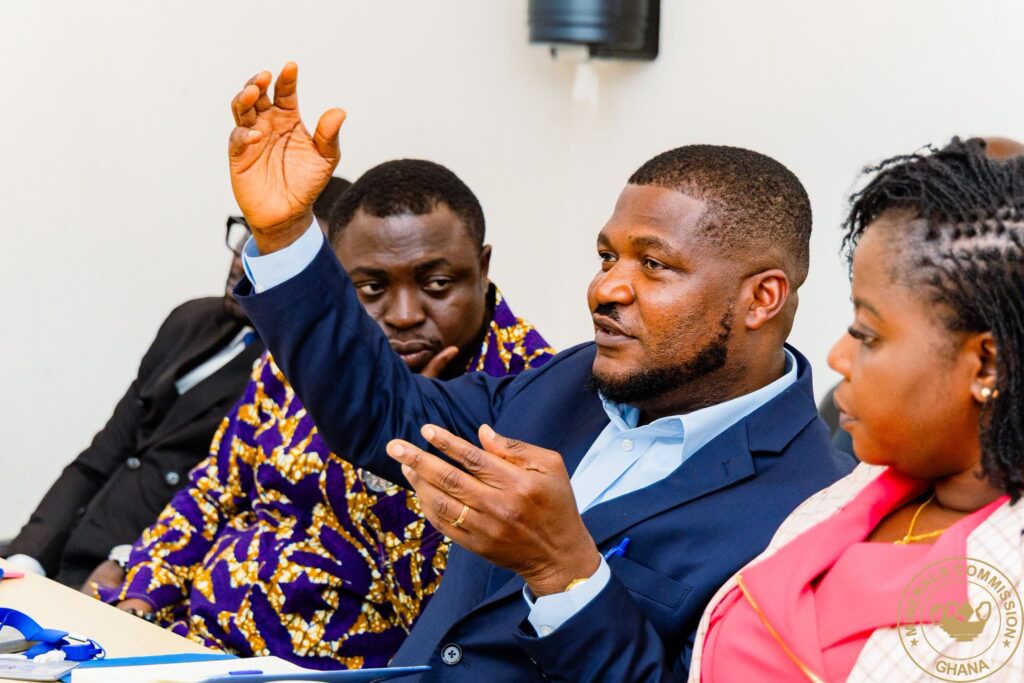
Mr. Tandoh noted that sustainable extractive growth requires mutual trust, where investors receive regulatory certainty and operational stability while the state secures skills development, livelihoods, and structural industrial transformation.
Ultimately, Ghana’s stance at the 2026 China Mining Conference sends a clear signal to global capital markets that access to the nation’s vast resource wealth requires a shared commitment to equitable development.
As regulatory frameworks tighten to prioritize local impact, the Minerals Commission has firmly established that the future of Ghanaian gold mining will be built solely on terms that honor both investor value and national sovereignty.
READ ALSO: A Quiet Exit – Examining Our Civic Engagement Habits