A new analysis from Global InfoAnalytics shows the ruling National Democratic Congress has roughly doubled its grip on first-time voters in Ghana’s key swing regions compared to its standing nationwide, raising fresh questions about the political map heading into the 2028 election.
The findings come from the firm’s June 2026 Tracking Poll, which surveyed partisan affiliation among first-time voters across the country.
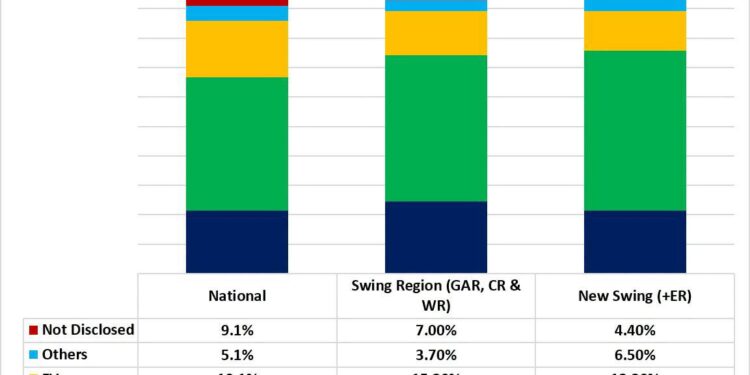
Nationally, the poll found that 45 percent of first-time voters lean toward the NDC, while 21 percent favor the New Patriotic Party and 19 percent remain undecided or floating.
Mussa Dankwa, Executive Director of Global InfoAnalytics, said the national figures tell only part of the story. “The devil is always in the details,” Mr Dankwa said. “This statement is general and you can apply it to any data published by anyone.”
Swing Regions Tell a Different Story
That detail emerges once the data is broken down by region. In Greater Accra, Central, and Western, the three regions widely regarded as Ghana’s swing territory, NDC support among first-time voters climbs to nearly 50 percent. NPP support in those same regions falls to 24 percent, according to Mussa Dankwa.
The gap is significant. Nationally, the NDC holds a 24-point lead over the NPP among first-time voters. Inside the swing regions, that lead widens even further, driven almost entirely by the surge in NDC support rather than any corresponding drop for the NPP nationally.
The renowned pollster described the regional breakdown as the point where the numbers “get tricky.” Once analysts isolate the swing regions from the national pool, the partisan lean of first-time voters becomes far more pronounced than the topline figures suggest.
Eastern Region Shifts the Picture Further
The analysis grows more complex when the Eastern Region enters the equation. Mussa Dankwa noted that Eastern’s voting behavior in the 2024 election, combined with signs that it is tilting further toward the NDC ahead of 2028, justifies treating it as part of the broader swing region rather than a separate category.
When Eastern is folded into that redefined swing bloc, NDC support among first-time voters rises again, reaching 54 percent. NPP support, by contrast, settles closer to its national average of 21 percent, essentially erasing any regional advantage the party might have claimed.

This shift carries weight beyond simple arithmetic. Eastern Region has long been considered a relatively safe zone for the oppsition New Patriotic Party, ranking behind only Ashanti as a traditional stronghold for the party.
Its movement toward swing status, and its lean toward the ruling National Democratic Congress among first-time voters, signals a deeper erosion of NPP influence in the territory it could once count on.
Warning Signs for the NPP
Mussa Dankwa framed the Eastern Region numbers as a warning rather than a footnote. Adding Eastern to the swing calculation does not help the NPP. It actively works against the party, exposing a weakness in a region it has historically dominated.
That weakness, Mussa Dankwa said, points to real trouble for the NPP heading into 2028. If current trends, according to the Global InfoAnalytics survey, hold and the party fails to reverse the slide among first-time voters in the Eastern Region, the NPP risks losing ground in a region it has relied on for decades.
In the most severe scenario, Mr Dankwa suggested, the party could lose the region outright in the next election. The pattern across all three datasets, national, traditional swing and expanded swing, points in the same direction.

Each time the geographic lens narrows toward competitive or shifting territory, the National Democratic Congress’s support among first-time voters climbs while the New Patriotic Party’s support either holds flat or declines relative to its national baseline.
For political strategists on both sides, the numbers suggest that the battle for Ghana’s youngest voters will likely be decided not in the strongholds each party already controls, but in the contested middle ground where Eastern Region’s drift now looms large.
Whether the opposition New Patriotic Party can arrest that drift before 2028, Mr Dankwa’s analysis suggests, may determine far more than the fate of a single region.
READ ALSO: Ghana Keeps Consecutive Clean Sheets at The World Cup For The First Time in England Draw