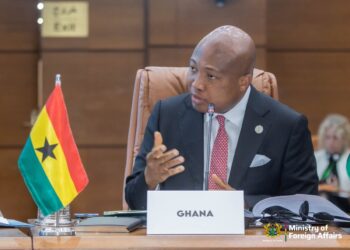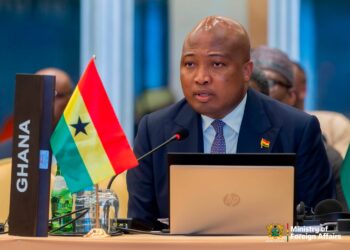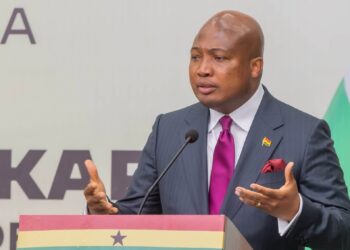
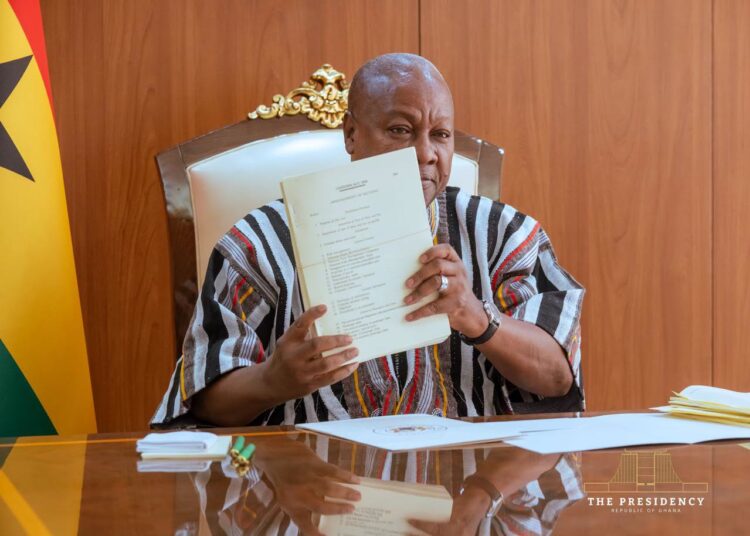
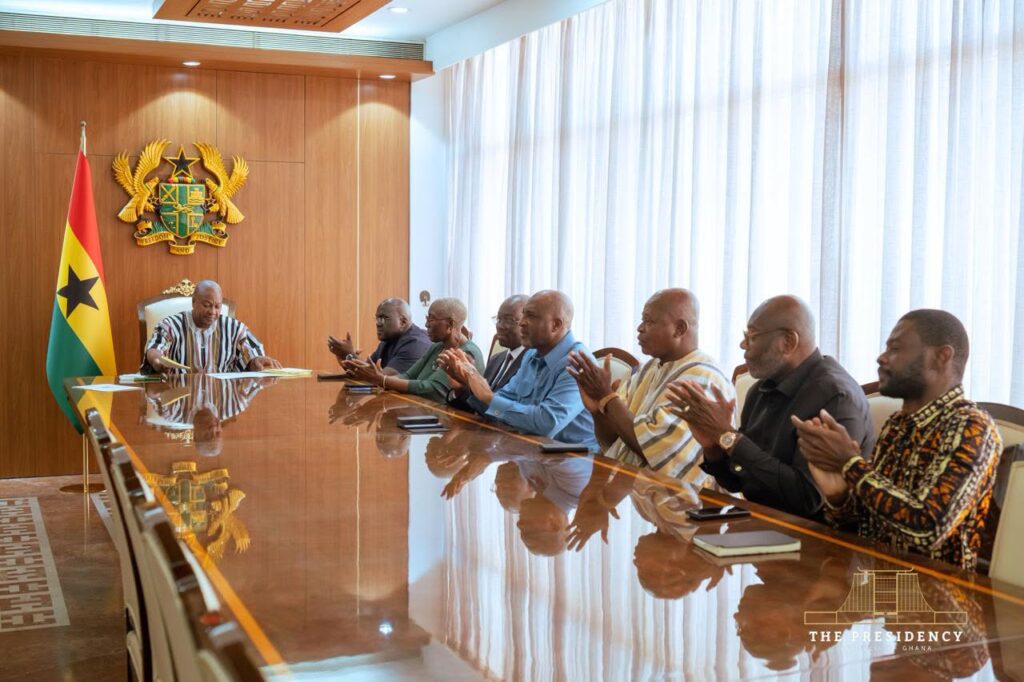
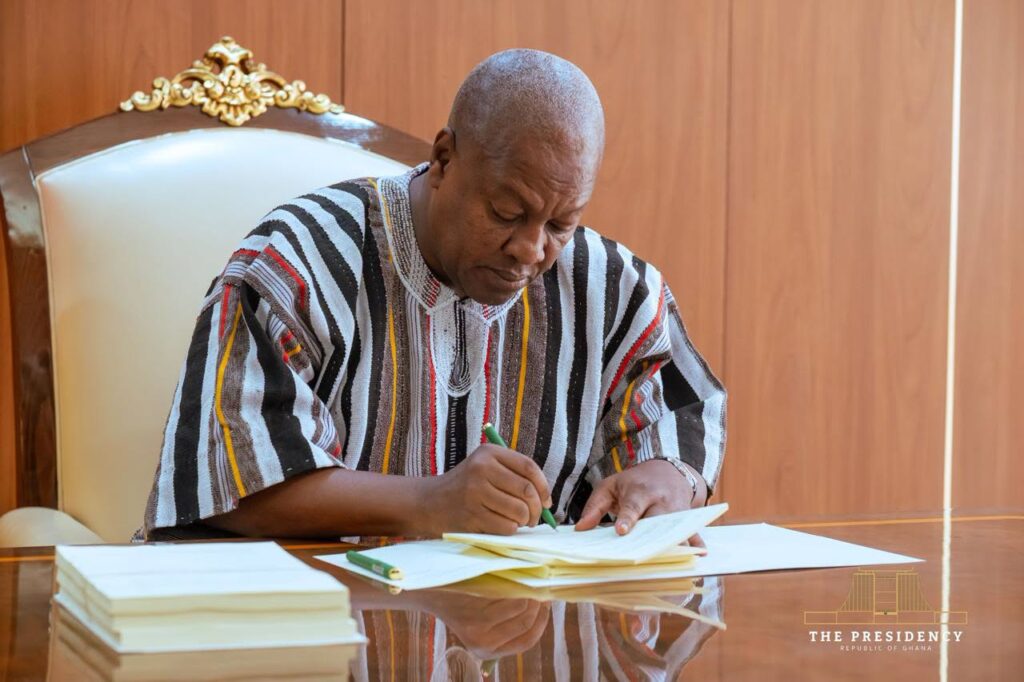
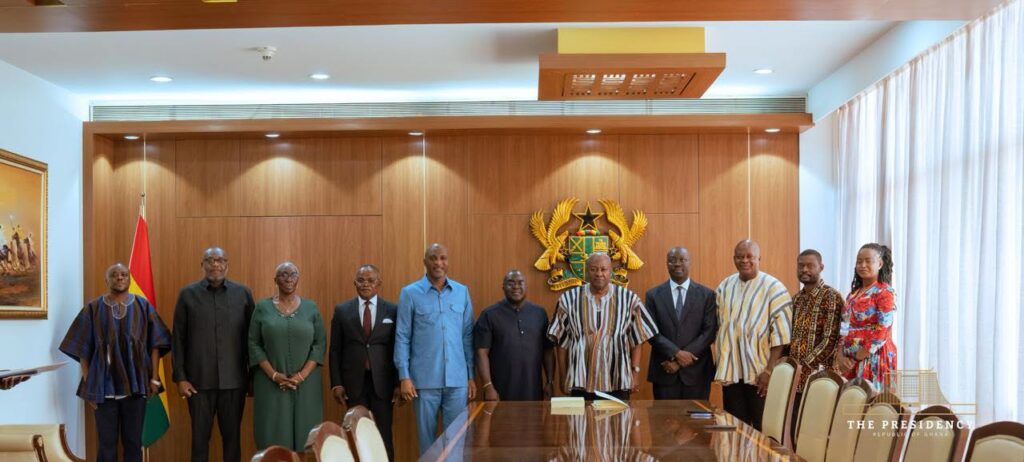
President John Dramani Mahama has assented to 10 bills at the Presidency in Accra, clearing most of the legislative backlog Parliament handed him when it rose at the end of July.
The new laws cover customs administration, criminal sentencing, the court system, maritime security, defence education, cocoa sector governance and four separate tax measures.
Parliament passed the bills during a busy final fortnight of its second meeting, with several carrying direct fiscal implications outlined in the 2026 Budget. Two of the measures reached the Presidency amid public appeals from the opposition for the President to withhold assent.
Customs Act Consolidates Years of Amendments
The President began his remarks with the Customs Act, 2026, describing it as a comprehensive law that brings together amendments made to the previous customs legislation over several years.
He said the consolidation would address gaps that had contributed to revenue losses and make customs administration more efficient. “It makes it simpler to administer and to make it more efficient,” he said, noting that the fragmented nature of the previous legislation had created challenges.
The Act also prohibits the importation of salvaged vehicles and vehicles more than 10 years old while providing incentives for local automotive manufacturers.
The Customs Act is accompanied by the Excise Act, 2026, which sets excise duty at zero for locally manufactured fruit juices and introduces new guidelines for excise collection on selected products.
Community Service Act Introduces Non Custodial Sentencing
The Community Service Act, 2026, gives the courts an alternative to imprisonment for misdemeanours and other minor offences. President Mahama linked the reform to the cost of maintaining prisoners, noting that the state currently spends money keeping people in custody for offences as minor as stealing a goat.
Under the new framework, eligible offenders can serve their sentences through community service instead of imprisonment. The measure also responds to longstanding pressure over overcrowding in Ghana’s prisons, where remand prisoners and people serving short sentences have placed significant pressure on facilities.
Tribunals Act Takes Effect Despite Opposition
The Tribunals Act, 2026, gives effect to the constitutional provision for regional tribunals and empowers the Chief Justice to establish tribunals to deal with specified categories of offences.
President Mahama noted that the Constitution already provides for the structure, with the new legislation supplying the framework required for its operation.
The assent brings to an end weeks of opposition to the legislation, with New Patriotic Party flagbearer Dr Mahamudu Bawumia having appealed to the President on July 19 to suspend the process and allow further national deliberation.
Dr Bawumia cited concerns raised by the Trades Union Congress that the proposed framework could be used to influence the administration of justice. Minority Leader Alexander Afenyo-Markin also opposed the measure as Parliament concluded its proceedings.
He referred to a recommendation by the Constitution Review Committee that regional tribunals be removed from the constitutional framework. “The President’s own reviewers told him to close this door,” he said, warning against allowing persons without legal training to adjudicate serious criminal matters.
Maritime and Defence Education Laws Become Effective
The Maritime and Related Offences Act, 2026, provides a legal framework for prosecuting offences committed at sea and domesticates provisions of the United Nations Convention on the Law of the Sea.
Ghana is a party to the convention, and the President described the new legislation as necessary to give domestic effect to its provisions and address gaps that have complicated the prosecution of maritime offences.
The National Defence University, Ghana Act, 2026, also gives statutory status to an institution established by government.
The legislation provides legal recognition for the university, accredits its courses and establishes a framework for defence and security education, research and strategic leadership development. Parliament approved the bill on July 17 as part of efforts to strengthen local capacity in defence and security education.
Tax Laws Bring Relief to Minimum Wage Earners
The Income Tax (Amendment) Act, 2026, exempts workers earning the national daily minimum wage or less from income tax.
President Mahama said the provision was straightforward, stating that anyone earning the minimum wage or below would not be required to pay income tax. The legislation also introduces simplified compliance requirements for micro and small businesses.
The Value Added Tax (Amendment) Act, 2026, removes the COVID-19 Health Recovery Levy and simplifies aspects of VAT administration in line with commitments contained in the 2026 Budget.
The Energy Sector Levies (Amendment) Act, 2026, introduces changes that have generated stronger political disagreement. It increases the Energy Sector Shortfall and Debt Repayment Levy and the Road Fund Levy on fuel oil while replacing the upfront fuel subsidy arrangement with an ex post system.
Under the new arrangement, eligible users pay the levy first and subsequently claim a refund. Finance Minister Dr Cassiel Ato Forson defended the measure on the floor of Parliament on July 31 as a reform of subsidy administration rather than the introduction of a new tax, a position rejected by the Minority during the debate.
Cocoa Board Act Replaces 1984 Legislation
The Ghana Cocoa Board Act, 2026, repeals the Ghana Cocoa Board Law, 1984, PNDC Law 81, and establishes COCOBOD as the statutory regulator of Ghana’s cocoa value chain.
The new legislation also introduces a funding model intended to support local cocoa processing, while establishing a tribunal and creating new offences under the law.
The New Patriotic Party had appealed to President Mahama to return the legislation to Parliament for further consideration. Ranking Member on Parliament’s Agriculture Committee, Dr Isaac Yaw Opoku, told a press conference on August 9 that the bill had been passed without sufficient engagement with farmers and landowners.
He also objected to provisions restricting the uprooting of cocoa trees without prior authorisation. Dr Opoku argued that farmers should not require approval to remove diseased or unproductive cocoa trees from their farms.
With presidential assent now completed, attention will turn to the implementation of the 10 laws and the subsidiary regulations required for some of them to take effect. Parliament has also been recalled for an emergency sitting running through Friday, with additional government business still before the House.
READ ALSO: Walewale MP Accuses GoldBod Of Distorting Accounts With Government Subvention