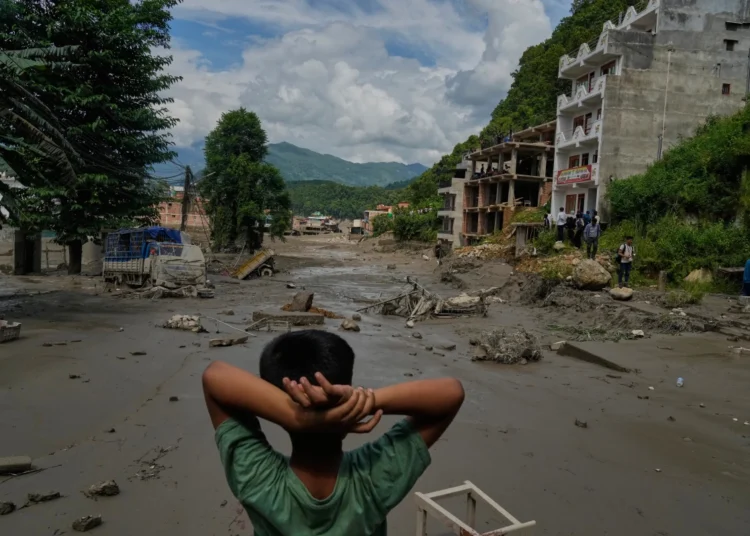
Several countries have expressed solidarity with Nepal and China following devastating flash floods that killed at least 98 people and left hundreds of tourists, workers and local residents missing in the Himalayan border region.
Australia, Britain, the European Union, Finland, France, Norway and Switzerland issued a joint statement expressing support for those affected by the disaster in Nepal.
The countries said that they stood in solidarity with communities facing the consequences of the floods and urged people in affected areas to follow official safety instructions. “We encourage all those in affected areas to follow the guidance of local authorities and official safety advisories as the situation continues to evolve,” the joint statement said.
The floods struck communities in the border regions of Nepal and China on Wednesday, triggering large-scale search and rescue operations as authorities worked to locate missing residents and foreign nationals.
Nepal’s Prime Minister’s office reported that at least 95 people had been killed. Across the border in China’s Tibet region, the state broadcaster said that a mudslide in Gyirong County had killed at least three people and left 265 others missing.
Officials in Nepal said a total of 403 people, including 341 foreign nationals, had been reported missing following the disaster. The missing include tourists and pilgrims who had travelled to the Himalayan region, where several important trekking routes and religious sites are located.
According to Sunil Sharma, a Spokesperson for Nepal’s tourism board, 133 Indian nationals travelling on pilgrimage to Mount Kailash in Tibet were among those reported missing. Mount Kailash is regarded as a sacred site by Hindus, Buddhists, Jains and followers of the Bon religion, attracting pilgrims and tourists from across Asia and other parts of the world. Sharma said that the missing also included 47 people from the United States, 34 from Australia, 33 from Britain and 24 from Canada.
South Korean government officials said that nine South Korean citizens working on the construction of a hydropower plant in Nepal were also among those reported missing.
Malaysia’s Foreign Ministry said its embassy in Kathmandu had received reports from travel agencies indicating that they had lost contact with 11 Malaysians believed to be in the flood-hit Rasuwa district.
The disaster also affected Nepali citizens and local communities in the mountainous region. Sharma said that at least 62 missing Nepali citizens were among hundreds of people trekking near Gosaikunda Lake in Rasuwa, where visitors had gathered ahead of the Janai Purnima festival on Friday.
Nepalese authorities warned residents in several districts to stay away from the banks of the Bhotekoshi, Trishuli and Narayani rivers as water levels rose sharply. The Bhotekoshi River flooded at around 9 a.m. on Wednesday, destroying villages, roads and hydropower projects, according to officials. The disaster disrupted travel and communications in some of the affected areas, making rescue operations more difficult.
Nepal has appealed to neighbouring countries for assistance as emergency teams continue searching for survivors. “We have asked both India and China to help us with the rescue efforts,” Nepali government Spokesperson Sasmit Pokharel said.
Meanwhile, Chinese authorities launched large-scale search and rescue operations in Gyirong, a Tibetan border area affected by the flooding and mudslides. Chinese President Xi Jinping ordered officials to intensify rescue efforts.
Flood Blamed On Avalanche From Glacier
Climate experts at the Kathmandu-based International Centre for Integrated Mountain Development said that an avalanche from a glacier was likely responsible for the flash flood.
The group said that the Lhende Khola River, a tributary of the Bhotekoshi, experienced severe flooding after an ice and rock avalanche from a glacier on the Nepalese side blocked the river before releasing a sudden surge of water downstream.
Saswata Sanyal, a disaster risk reduction specialist at the climate research group, said, “The Lhende Khola has flooded twice in 14 months, this time triggered by an ice rock avalanche from a glacier on the Nepal side that blocked the river and released a sudden surge downstream.”
Sanyal stressed the importance of early warning systems as climate conditions continue to change across the Himalayan region.
The disaster has drawn attention to the increasing vulnerability of communities in the Himalayan region, where steep valleys serve as important transport routes and economic corridors but are highly exposed to landslides, floods and other natural hazards.
The affected areas have experienced similar disasters in recent years. In August last year, a glacial lake in Tibet overflowed following high temperatures, killing nine people and damaging critical infrastructure, including a bridge linking Nepal and China.
With hundreds of people still unaccounted for and search operations continuing on both sides of the Nepal-China border, authorities have warned that the situation remains fluid and that the casualty figures could change as emergency teams reach more affected communities.
READ ALSO: Zelenskyy Honors Musk for Starlink Role