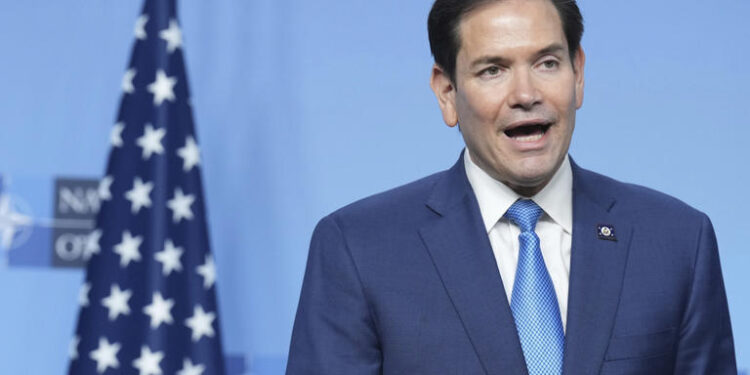
US Secretary of State Marco Rubio has warned against any Iranian tolls on ships traversing the Strait of Hormuz.
He said after joining a Gulf Cooperation Council meeting in Bahrain that “International waterways do not belong to any nation-state.”
“If in fact we accepted that you can charge money to use an international waterway because it happens to be near your territorial space, well then, this will spread throughout the world like a contagion.”
Marco Rubio
He said that there was zero support among Gulf countries for any Iranian toll on ships transiting the Strait of Hormuz.
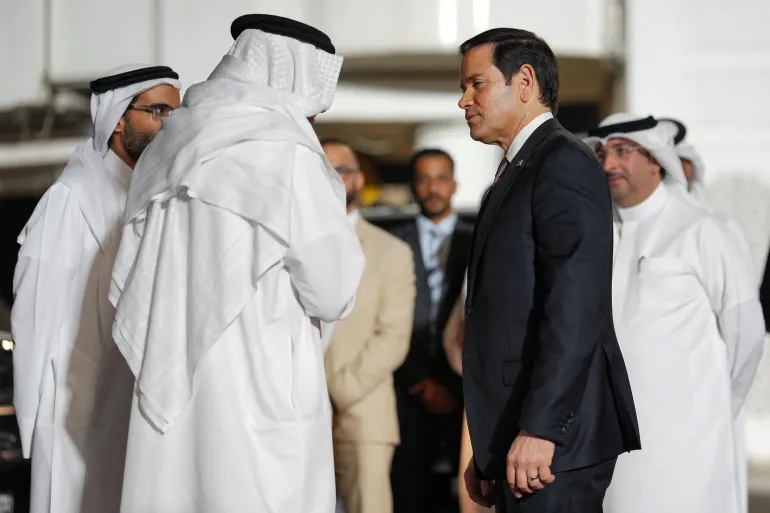
The Gulf Cooperation Council and US officials met in Bahrain. Foreign Minister, Abdullatif bin Rashid Al Zayani, welcomed recent diplomatic efforts, including the US–Iran memorandum of understanding brokered with the mediation of Pakistan and Qatar.
He welcomed the restoration of secure navigation through the Strait of Hormuz and Oman’s announcement of a temporary maritime corridor. However, he stressed Iran must fully adhere to its obligations under the deal.
Rubio’s statement also came as he wrapped up a trip to the Gulf aimed at winning support from regional allies for the United States-Iran interim deal aimed at ending their war.
Rubio’s three-day tour of the Gulf is the first high-level diplomatic mission since the US and Iran agreed on a memorandum of understanding to extend their ceasefire and to hold talks on a permanent end to the more than 100-day war, which started on February 28 with US-Israeli strikes on Iran.
He acknowledged the delicacy of his mission as he sought to win over Gulf Arab leaders, wary that excessive concessions could strengthen Tehran and reshape the region’s security balance and oil flows.
Rubio earlier told partners in the Gulf that any deal to end the US-Iran war would account for their security interests.
In Manama, he told leaders from Bahrain that the US wants to ensure any agreement with Iran takes into account the “interest of allies.” He added, “We are open for peace that is enduring and real and doesn’t undermine security and prosperity for the US or its allies.”
Rubio said during a news conference in Manama that a reconstruction fund for Iran was not discussed with Gulf countries. He said that he would not be asking regional allies to contribute to any reconstruction fund during the trip, even as the MoU with Iran suggests that countries in the region would at least be partially responsible for footing the bill.
At his previous stops in the United Arab Emirates and Kuwait, Rubio sought to assure officials that the proposed deal was not overly favourable to Iran, which attacked all the GCC states during the war. “We’re not going to do anything that undermines the security of our allies, our longstanding allies in the region,” he told reporters in Kuwait.
US Seeks Peaceful Future For Lebanon
Moreover, Rubio asserted that the US wants a peaceful future for Lebanon.
Israel continues to occupy areas in southern Lebanon – some held for decades and others seized during the 2023-2024 war. During its latest invasion, Israeli forces advanced more than 10km (6.2 miles) into Lebanese territory.
The recently signed memorandum of understanding between the US and Iran calls for the end of hostilities on multiple fronts, including in Lebanon, as part of efforts to reach a lasting peace agreement between the two sides.
Meanwhile, the final session of negotiations between Lebanon and Israel began today at the US State Department in Washington, DC. The talks come as Washington pushes for a diplomatic track while Israel continues its attacks on Lebanon, raising questions about whether negotiations can produce a lasting political arrangement.
Under US pressure, Lebanese officials began direct talks in April with Israel in Washington. Commenting on the negotiations, US Secretary of State Marco Rubio said that the two neighbours are close to making a “commitment of intent.”
However, Israel has been defiant in its stance to stay in Southern Lebanon. Israel says it will continue to occupy parts of southern Lebanon until Hezbollah disarms, even as US-mediated talks between the two sides continue in Washington, DC.
Israeli Government Spokesman David Mencer told reporters today that Israel won’t pull back its troops unless Hezbollah is disarmed and demilitarised. He added, “We will not withdraw our forces from southern Lebanon as long as Hezbollah remains a threat, is not disarmed and demilitarised.”
READ ALSO: Maintain Transparent Public Updates on Gold Purchases and Foreign Exchange – Data Analyst to GoldBod