
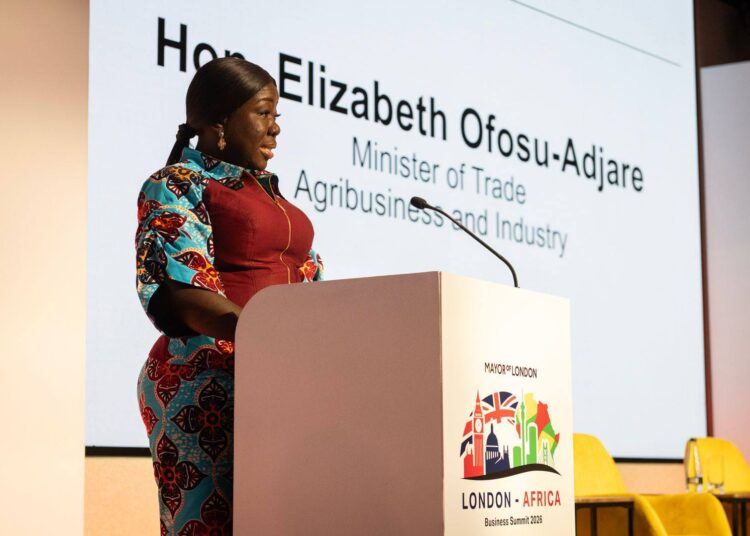
The Ministry of Trade, Agribusiness and Industry (MoTAI), in alignment with the Ghana Enterprises Agency (GEA), has escalated its national industrialization drive by outlining a blueprint to transition local micro, small, and medium enterprises (MSMEs) into high-yielding, digitally empowered corporate entities.
In a high-profile address delivered at the MSME Day 2026 Celebration and Exhibition, the sector Minister, Hon. Elizabeth Ofosu-Adjare, underscored the state’s unwavering commitment to placing small-scale operators at the absolute center of Ghana’s macroeconomic stabilization and job creation agenda.
The ministerial address, which was formally presented on behalf of the Minister by the Director for General Administration of MoTAI, Mr. Yaw Sakyi, brought together a distinguished assembly of state officials and industrial stakeholders.
These included Honorable Seth Terkper, the designated Representative of the Chief of Staff, alongside the Chairman and members of the parliamentary Select Committee on Trade, Industry, and Tourism, members of the diplomatic corps, and leading executives from various financial institutions and business associations.
“This year’s theme, elevating the future generation of Ghana’s MSMEs through digital empowerment and innovation, carries both a warning and a promise. As digital technology reshapes global business, we must ensure that no entrepreneur is left behind. The future of enterprise, however technology-driven, must remain rooted in people, opportunity, dignity, and inclusion”
Hon. Elizabeth Ofosu-Adjare, Minister for Trade, Agribusiness and Industry
The Ministry noted that government policy is geared toward creating an inclusive commercial environment where technological adoption does not isolate smallholders but rather enhances the human dignity, financial viability, and operational capacity of local entrepreneurs.

Institutional Support
To demonstrate the concrete impact of ongoing public interventions, MoTAI presented a highly detailed statistical breakdown of corporate development services deployed across the country over the past three quarters.
The performance audit revealed that from the third quarter of 2025 through the first quarter of 2026, the Ghana Enterprises Agency, working in direct coordination with MoTAI and its global development partners, successfully delivered vital business development services to a staggering 306,000 MSMEs.
This massive field operation spanned all sixteen administrative regions of Ghana, ensuring a balanced distribution of state resources. The support framework encompassed intensive “capacity building, specialized business counseling, professional corporate coaching, and direct startup interventions” to stabilize fragile, newly established commercial operations.
According to the Ministry, 70% of the entities that benefited from the interventions were women-led enterprises, marking a significant milestone in the economic empowerment of female industrialists across the agricultural, manufacturing, and trade sectors.
Concurrently, youth-led enterprises received unparalleled institutional backing during the same operational period, with 95,000 youth-owned businesses receiving targeted support under three coordinated mechanisms: the Business in the Box Project, the Ghana Jobs and Skills Project, and the Harnessing Agricultural Productivity and Prosperity for Youth Project.
Furthermore, the government successfully trained 3,000 businesses in advanced digital skills, e-commerce integration, and artificial intelligence readiness, while steering 12,000 informal operations through the formal registration process, linking 13,000 entities to formal banking institutions, and preparing 6,000 operators for the export market.

Credit Bankability and Proposals Gap
Despite these highly encouraging operational milestones, Hon. Ofosu-Adjare acknowledged that persistent headwinds continue to restrict the growth velocity of the domestic private sector, with affordable finance, low rates of localized technology adoption, packaging deficiencies, and long-term corporate sustainability being among the most pressing.
“While most of our MSME entrepreneurs have strong ideas and viable business prospects, it has become evident that most of them are unable to translate these ideas into bankable proposals that financial institutions can access and support”
Hon. Elizabeth Ofosu-Adjare, Minister for Trade, Agribusiness and Industry
To resolve these bottlenecks, the sector Minister announced that MoTAI, in partnership with the GEA and leading financial institutions, will launch a dedicated national program in the coming months designed to fundamentally retrain entrepreneurs in corporate financial literacy.
The primary objective of this upcoming initiative is to teach business owners how to translate raw commercial viability into sophisticated, highly structured credit applications that commercial banks can confidently approve.
Overcoming Standards Barriers
The final core pillar of the government’s renewed trade strategy focuses on aggressively unlocking lucrative international commercial pathways that are already legally available to Ghanaian corporations.
The Ministry pointed out that while the Republic of Ghana possesses highly favorable, pre-existing bilateral trade agreements with both the European Union and the United Kingdom, local businesses have always struggled to fully exploit these lucrative sovereign assets due to strict border rejections.
To rectify this market failure, MoTAI is building a tight regulatory alliance with the Ghana Standards Authority (GSA) and the Food and Drugs Authority (FDA) to ensure that local goods are manufactured in total compliance with global phytosanitary regulations and international food safety laws.
To ensure that no enterprise is excluded from these international markets due to compliance costs, the government will soon announce a dedicated support program to provide direct administrative and technical backing to help local manufacturers obtain premium-quality certifications.
As the 2026 MSME Day Celebration and Exhibition drew to a close, the Minister praised the deep resilience of the Ghanaian entrepreneurial class, reiterating that the government will continuously optimize the domestic regulatory framework to drive export expansion, agribusiness processing, digital trade facilitation, and sustainable job creation for the future generation.
READ ALSO: Standard Chartered Assures Deposits Safe Despite Retail Sale Plans