Voters across the island nation of São Tomé and Príncipe are heading to polls in a closely watched presidential election that is expected to test the resilience of one of Africa’s longest-standing democracies amid political divisions, economic hardship and growing public demands for accountable governance.
Approximately 142,000 registered voters are eligible to cast their ballots in the tiny Gulf of Guinea archipelago, according to the National Election Commission, with nearly 15% of the electorate residing abroad.
While the country has earned international recognition for conducting peaceful and competitive elections since embracing multiparty democracy more than three decades ago, this year’s presidential race unfolds against the backdrop of heightened political tensions and an unresolved constitutional dispute that has reshaped the country’s political landscape.
Incumbent President Carlos Vila Nova is seeking a second five-year term but, unlike his successful 2021 campaign, is contesting the election as an independent candidate rather than under the banner of the ruling Acção Democrática Independente (ADI).
The rift became public in January last year when Vila Nova dismissed then Prime Minister Patrice Trovoada, triggering one of the most significant political crises in recent years. Trovoada’s successor, former Justice Minister Ilza Amado Vaz, resigned after only three days in office before Américo Ramos was appointed to lead the government, highlighting divisions within the country’s governing structures.
Despite those tensions, Vila Nova has campaigned on a message of national unity, institutional stability and democratic continuity, arguing that São Tomé and Príncipe must remain focused on strengthening governance and preserving the peaceful political culture that has distinguished it from many countries in the region.
His bid for re-election faces competition from four other candidates, including ADI parliamentary leader Nito D’Abreu, who has emerged as one of the president’s strongest challengers after receiving support from a faction of the governing party aligned with Prime Minister Américo Ramos.
Former Prime Minister Jorge Bom Jesus, another prominent figure in São Toméan politics, also remains on the ballot despite attempting to withdraw his independent candidacy after missing the legal deadline to do so. The Constitutional Court ruled that his name must remain on the ballot, adding another layer of complexity to an already competitive election.
Also contesting the presidency are jurists Miques João Bonfim and Eugénio Tiny, broadening the field in an election that could require a second round if no candidate secures more than 50% of the vote.
Political alliances have shifted considerably ahead of polling day. The Movement for the Liberation of São Tomé and Príncipe (MLSTP), traditionally the country’s principal opposition party, has joined a broader coalition backing Vila Nova despite years of fierce rivalry with the ADI.
Meanwhile, internal divisions within the governing party have seen another influential faction rally behind D’Abreu, underlining the fragmented nature of the country’s political environment.
The campaign has unfolded against mounting economic pressures that many voters say should dominate the next administration’s agenda. Rising inflation, persistent fuel shortages, unreliable electricity supplies, youth unemployment and concerns about public sector corruption have emerged as defining issues throughout the campaign.
The election has also drawn attention because of the exclusion of businessman and football administrator Domingos “Nino” Monteiro, whose candidacy was rejected by the Constitutional Court.
Monteiro, who has served as President of the São Toméan Football Federation since 2015, was ruled ineligible after judges determined that he failed to satisfy constitutional citizenship requirements. Although born in São Tomé and Príncipe, his parents retained Cape Verdean nationality and were never naturalised as São Toméan citizens.
The ruling has sparked much discussion on citizenship regulations and political engagement.
After being disqualified, Monteiro declared, “the equal rights principle is being violated by the constitutional court.It is time for descendants born in São Tomé and Príncipe to say no to discrimination, to the culture of xenophobia and persecution.”
His political coalition described the ruling as discriminatory and politically motivated, arguing that it unfairly excludes citizens born in the archipelago because of their parents’ nationality.
Democracy and Economic Reform Shape Presidential Contest
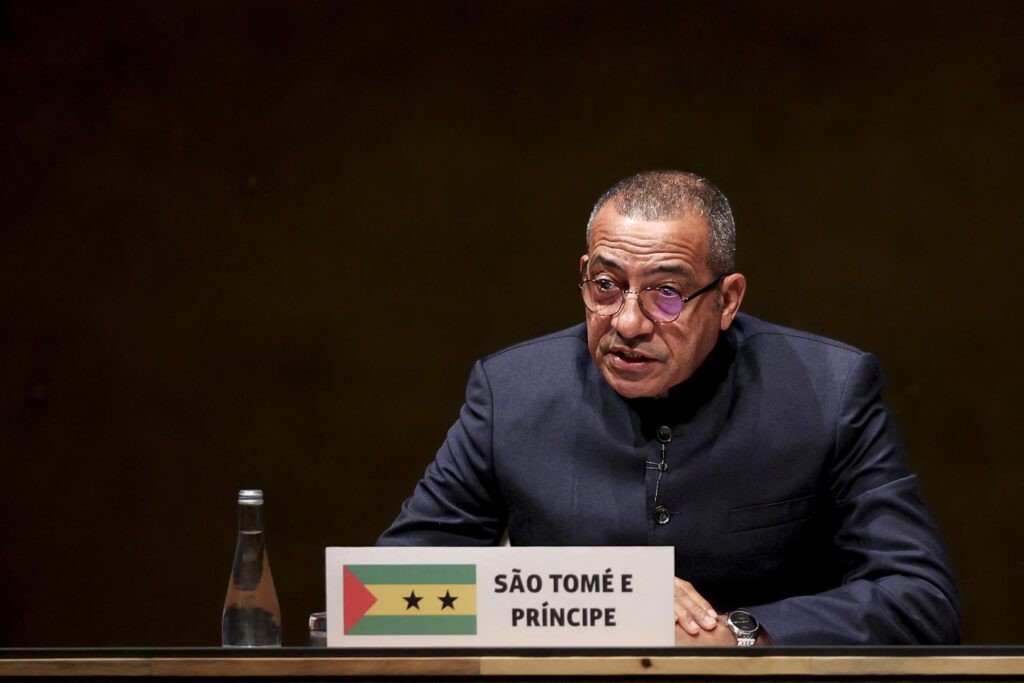
Although São Tomé and Príncipe is Africa’s second-smallest country by population, the election carries significance beyond its borders because of the country’s reputation as one of the continent’s most stable democracies.
After gaining independence from Portugal in 1975, the island nation spent its first 15 years under a Marxist one-party system dominated by the Movement for the Liberation of São Tomé and Príncipe.
That changed dramatically in 1990 when more than 95% of voters approved constitutional reforms introducing multiparty democracy and imposing presidential term limits. Since then, the country has conducted a series of competitive elections and successfully resisted attempted military coups in 2003 and 2009, reinforcing its image as a politically resilient democracy.
International observers are once again monitoring the electoral process, with missions from the European Union, the G7+, and the Community of Portuguese Language Countries deployed across the islands to assess the credibility and transparency of the vote.
Beyond domestic politics, São Tomé and Príncipe occupies an increasingly important strategic position in the Gulf of Guinea, a region vital to international maritime trade but also affected by piracy and transnational security threats. The country’s offshore oil reserves and close partnerships with Western governments have further elevated its geopolitical importance.
Throughout the campaign, candidates have sought to convince voters they possess the leadership needed to tackle corruption and revitalise the economy.
Nito D’Abreu made anti-corruption a central pillar of his campaign, arguing that stronger institutions are essential for the country’s future.
According to Nito D’Abreu, “corruption in São Tomé and Príncipe is the greatest catastrophe the country has experienced in this half-century of independence.”
For President Vila Nova, the election represents both a referendum on his first term and a test of whether voters will reward his calls for political stability despite divisions within the party that first brought him to office.
READ ALSO: Saka Nets Hattrick, Mbappé and Olise Make History as England Win Bronze