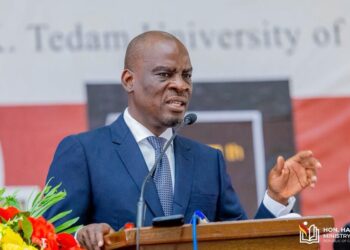
The Attorney-General and Minister of Justice, Honourable Dominic Akuritinga Ayine has explained that the removal of a Chief Justice requires strict adherence to constitutional procedures outlined under Article 146. He noted that the process does not allow a President to remove a Chief Justice through a simple administrative decision.
Honourable Ayine emphasised that Article 146 establishes a framework for determining whether allegations of misconduct against a Chief Justice meet the required threshold for removal. He explained that the constitutional provision protects the independence of the judiciary by ensuring that such decisions follow due process.
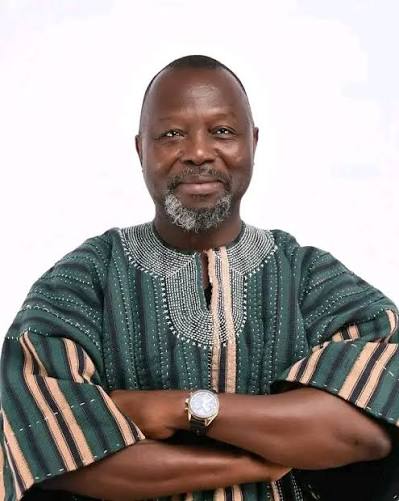
“The President cannot, by the stroke of a pen, remove the Chief Justice. The Constitution provides a procedure for determining whether stated misconduct has taken place.”
Honourable Dominic Akuritinga Ayine
The Attorney-General stated that the judiciary remains a key institution within Ghana’s governance structure and deserves protection from actions that could undermine its authority. He acknowledged that officers occupying high judicial positions carry significant responsibilities and require appropriate safeguards.
Furthermore, Honourable Ayine explained that recent developments involving the removal of a former Chief Justice, Gertrude Torkornoo, brought renewed discussions about the constitutional process. He indicated that the review of existing procedures would help provide greater clarity on how such matters should be handled in the future.
Addressing questions about whether previous removal proceedings followed the required standards, the Attorney-General argued that the process involving the former Chief Justice did not happen without legal steps. He explained that constitutional requirements guided the proceedings leading to the eventual outcome.
Additionally, the Minister of Justice disclosed that efforts are being made to refine procedural rules connected to the removal process. He noted that the aim would be to provide clearer guidelines and reduce uncertainty surrounding future applications of Article 146.
The Attorney-General stressed that Ghana’s constitutional democracy depends on maintaining a balance among the different branches of government. He explained that the judiciary, executive and legislature each perform distinct roles that contribute to effective governance.

According to Honourable Ayine, protecting judicial independence requires recognition that accountability and due process must work together. He indicated that while public officers remain subject to constitutional standards, the processes governing their removal must receive careful attention.
Dual Citizenship Does Not Determine National Loyalty
The Attorney-General and Minister of Justice, Honourable Dominic Akuritinga Ayine argued that holding dual citizenship does not reduce an individual’s loyalty or commitment to Ghana when serving the country. He explained that citizens with citizenship ties to other nations can contribute meaningfully to public service when they act with integrity and respect for Ghana’s laws.
Honourable Ayine made the clarification while responding to questions about whether persons with dual citizenship could be vulnerable to foreign influence when appointed to public positions. He indicated that loyalty depends on personal conduct and values, adding that citizenship status alone cannot determine a person’s commitment to national interests.
The Attorney General noted that individuals without dual citizenship could also be influenced by financial or material considerations. He explained that foreign interests may seek cooperation from people through different means, making the issue one that extends beyond citizenship arrangements.
“Having dual citizenship does not diminish a person’s loyalty to this country. Any citizen who wishes to offer public service must do so in good faith and with fidelity to the laws of Ghana.”
Honourable Dominic Akuritinga Ayine
Discussing historical examples, Honourable Ayine referenced the overthrow of Ghana’s first President, Osagyefo Dr Kwame Nkrumah, and argued that foreign influence cannot be linked solely to people who hold citizenship of another country. He noted that questions surrounding loyalty require a broader examination of individual actions and motivations.

Furthermore, the Attorney-General explained that the Central Intelligence Agency’s involvement in Ghana’s political history during the period surrounding Dr Nkrumah’s removal did not establish that dual citizenship played a role in those events. He stated that the issue of foreign influence requires careful analysis without making assumptions based on nationality.
Addressing questions involving former Finance Minister Ken Ofori Atta, Honourable Ayine explained that he did not have information suggesting that the former minister acted as an agent of any foreign organisation. He indicated that his focus remained on the general principles surrounding citizenship and public service.
Additionally, the Minister of Justice noted that Ghana’s laws should continue to encourage capable citizens to contribute to national development. He explained that excluding individuals solely because they possess another citizenship could prevent the country from benefiting from their skills and experience.
The Attorney-General stressed that public officers must demonstrate commitment to Ghana’s laws regardless of their personal background. He stated that accountability should be based on actions and responsibilities carried out by individuals holding public positions.
According to Honourable Ayine, the debate surrounding dual citizenship requires a balanced understanding of national interest and individual rights. He suggested that the country’s approach should promote responsible participation in public service while protecting Ghana’s sovereignty.
READ ALSO: English FA Introduces Minimum 10-Match Ban for Discriminatory Offences