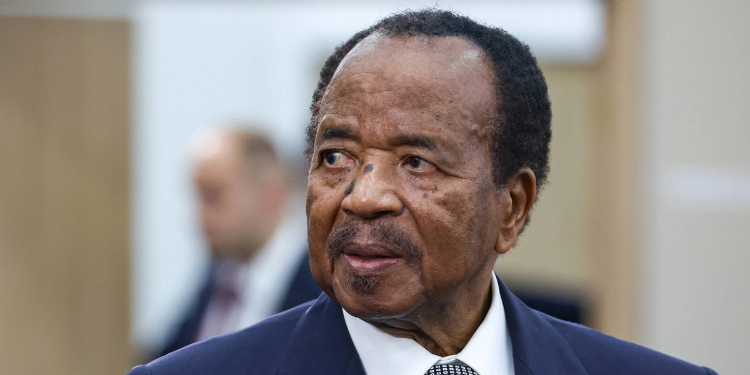
Cameroon has entered another period of heightened political scrutiny after President Paul Biya approved a sweeping reshuffle of the country’s senior military leadership while remaining outside the Central African nation for more than two months, raising renewed questions about governance, succession and the future of one of Africa’s longest-serving administrations.
The military appointments, announced through three presidential decrees involve promotions and command changes across some of the country’s most influential security institutions.
Among the most significant decisions was the promotion of the Commander of the Elite Presidential Guard, Raymond Jean Charles Beko’o Abondo, from Colonel to Brigadier General while retaining him at the helm of the unit responsible for protecting the resident and key state institutions.
The decrees also replaced commanders in four of Cameroon’s five Joint Military Regions, elevated Major General Ebaka Hippolyte to Major General of the Armed Forces General Staff, appointed a new commander of the Rapid Intervention Brigade and promoted several senior army officers to the rank of brigadier general.
Although military reshuffles are a regular feature of governance in Cameroon, the latest changes have attracted widespread attention because they come while President Biya remains abroad on one of the longest overseas stays of his presidency.
The 93-year-old leader, who has governed Cameroon since 1982, left the country on June 7 for what the Civil Cabinet described as “a brief private stay in Europe.”
More than two months later, he has yet to return, fuelling intense speculation over his health, whereabouts and ability to continue leading the oil- and cocoa-producing nation.
Government officials have sought to dismiss rumours surrounding the President’s condition. Government spokesperson René Emmanuel Sadi communicated earlier that “the President is alive” and would return to Cameroon soon, while maintaining that there is no constitutional vacuum and that Biya continues to exercise his presidential authority despite his absence.
Nevertheless, the prolonged stay abroad has intensified political debate both within Cameroon and internationally, particularly as the country prepares for another electoral cycle and continues to confront multiple security challenges.
The military remains one of the most influential institutions in Cameroon, where security forces continue to battle Boko Haram insurgents in the Far North Region while also confronting separatist violence in the country’s English-speaking Northwest and Southwest regions.
Border security, organised crime and regional instability have further increased the strategic importance of maintaining a cohesive and effective military command.
Security Appointments Underscore Succession Uncertainty
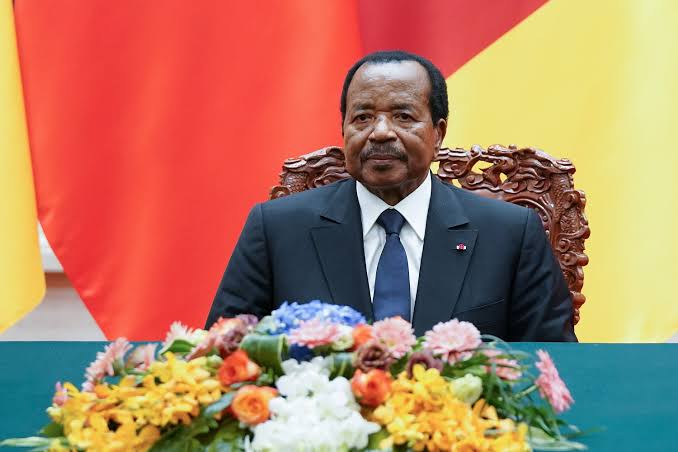
Among the appointments attracting the greatest attention is the promotion of Raymond Jean Charles Beko’o Abondo, who remains Commander of the Presidential Guard after serving in the role for 13 years.
The Presidential Guard occupies a uniquely influential position within Cameroon’s security architecture. Beyond protecting President Biya, the elite formation is responsible for safeguarding the presidency and other strategic state institutions, making its commander one of the country’s most trusted military figures.
Another notable appointment saw Major General Ebaka Hippolyte become Major General of the Armed Forces General Staff, placing him at the centre of coordinating military operations across the army, navy, air force and gendarmerie. The role carries significant operational responsibilities, particularly as Cameroon continues to respond to multiple security threats simultaneously.
The Presidential decrees also introduced new commanders for four of the country’s five Joint Military Regions, whose responsibilities include overseeing military operations across geographically diverse areas facing different security challenges.
These include counter-insurgency operations against Boko Haram in the Far North, efforts to contain separatist violence in the Anglophone regions and safeguarding Cameroon’s borders against transnational criminal activities.
While the government has not linked the reshuffle to the President’s absence, political analysts argue that senior military appointments inevitably attract greater significance during periods of uncertainty surrounding national leadership.
For years, succession has remained one of the most closely watched issues in Cameroonian politics. Despite President Biya’s more than four decades in office, no publicly defined roadmap has emerged regarding how political power would be transferred when his presidency eventually comes to an end.
Although government officials continue to insist that there is no constitutional crisis and reject suggestions of instability, Biya’s age and prolonged absence have intensified public discussion over the future direction of the country.
The latest appointments are therefore being interpreted by some observers as an effort to reinforce continuity within one of the state’s most critical institutions while ensuring experienced commanders remain in positions capable of responding to both security threats and any unforeseen political developments.
Whether the reshuffle represents routine military administration or forms part of broader preparations for a changing political landscape remains uncertain.
For now, the government continues to project confidence, insisting that constitutional governance remains intact and that President Biya remains firmly in control of state affairs despite being abroad.
READ ALSO: Nuclear Power Moves Closer to Ghana’s Energy Mainstream