Dennis Miracles Aboagye, Aide to Dr. Mahamudu Bawumia, has taken aim at government’s “No-Stress Fee” policy, alleging that not a single Ghanaian student has received the stress-free tuition support originally promised, with beneficiaries instead being asked to pay upfront and seek refunds later.
Speaking on the role of opposition politics in holding government accountable, Mr Aboagye argued that it falls squarely on the opposition to expose gaps between government’s promises and its actual delivery, insisting that ruling parties will rarely admit their own shortcomings without external pressure.
Mr Aboagye framed his criticism of the policy within a broader argument about the function of opposition politics in a democracy, maintaining that it is the responsibility of opposition figures to prompt citizens to look more critically at government claims rather than accept official narratives at face value.
“It is the opposition party that would trigger the conversation and trigger the thought that, you know, this guy is telling you are fine, but you know you are not fine.”
Mr Aboagy
He insisted that his criticism of the policy was rooted strictly in verifiable facts rather than political propaganda, challenging anyone disputing his account to point to specific inaccuracies in his claims rather than dismissing them outright.
Central Allegation, Promise Versus Delivery
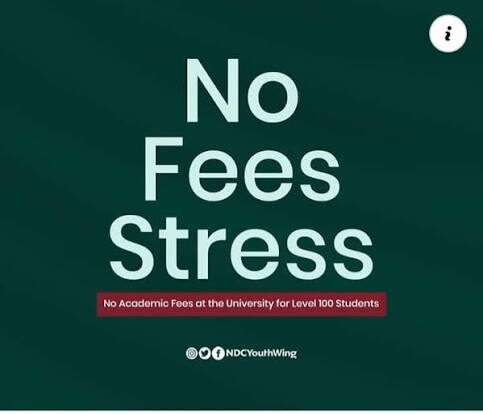
At the heart of Mr Aboagye’s argument was a direct comparison between what he said government originally promised under the No-Stress Fee policy and what has actually been delivered to students. He explained that the policy, as communicated to the public, was meant to ensure that once a student secured university admission, government would pay their fees directly to the institution, removing the need for families to scramble for funds.
He argued that this is fundamentally different from what has occurred in practice, where he claims students have been required to source funds independently, pay their fees upfront, and only then apply for a refund from government.
“Not a single Ghanaian child has received a stress-free fee. All of them, the two batches, what they have received rather is a post-stress refund.”
Mr Aboagy
Mr Aboagye drew on his own experience navigating university financing through the SSNIT student loan scheme, explaining that the process required him to first secure funds independently before receiving a refund later in the academic year, typically in the second semester.
He argued that this reimbursement-based model is precisely what the No-Stress Fee policy was meant to eliminate, not replicate under a different name.
He specifically referenced the case of a well-known “Free SHS boy,” identified as Amoani, who despite securing admission to the University of Ghana, remained at home farming in hopes of eventually raising enough money to attend school.
Mr Aboagye argued that students like Amoani represent the exact target group the policy was designed to serve, and that a refund-based system fails them entirely if they cannot raise the initial funds required.

Debate Over Whether Circumstances Justified the Shift
In response to suggestions that the change in approach might be attributable to fiscal realities uncovered only after government took office, Mr Aboagye rejected the explanation, arguing that any incoming administration should have properly assessed the scale of financial commitments before making public promises.
He maintained that once a party takes on the responsibility of governance, it must be prepared to deliver on commitments made during its campaign, rather than adjusting its promises after assuming office and citing unforeseen fiscal constraints as justification.
He further pushed back against the notion that a policy of retroactive refunds is functionally similar to the original stress-free promise, insisting that the burden of finding money upfront defeats the entire purpose of the policy for the very students it was designed to help.
Impact on Vulnerable Students Highlighted
Mr Aboagye pointed to real-world consequences of the policy’s implementation gap, noting that some students who could not raise upfront fees have had to rely on public appeals for financial assistance, including social media fundraising efforts by individuals attempting to help affected students access their admissions.
He argued that this pattern illustrates the core failure of the policy as currently implemented, students without existing financial safety nets, the very group the policy was intended to serve, remain the most affected by the gap between promise and delivery.
Mr Aboagye framed his overall critique as part of a broader communications effort aimed at helping the public distinguish between government’s stated intentions and the practical realities citizens are experiencing on the ground.
He argued that his role, as he sees it, is to help lift what he described as a “facade” surrounding government’s economic and social policy achievement, encouraging citizens to evaluate outcomes based on lived experience rather than official messaging alone.
The exchange reflects the sharpening political debate ahead of future elections, with opposition figures increasingly scrutinising the practical delivery of government’s flagship social intervention programmes, particularly those targeting access to tertiary education for financially vulnerable students.
READ MORE: Health Ministry Denies ARV Shortage, Assures Uninterrupted Access