The Ebola outbreak in the Democratic Republic of Congo has killed more than 2,500 people and is growing exponentially in an area larger than the size of France, according to a senior United Nations Ebola Coordinator Julien Harneis.
The rapidly worsening outbreak has become the largest in the country’s history by the number of cases, with the virus spreading faster and across a wider area than health authorities and humanitarian organisations can currently contain.
Julien Harneis warned that the response is facing an increasingly urgent shortage of funds, with existing resources expected to run out within weeks unless additional assistance is secured.
Speaking from Bunia in northeastern Congo, near the epicentre of the outbreak, Harneis stated that the scale and speed of transmission were placing extraordinary pressure on health workers and humanitarian agencies operating in communities already weakened by decades of conflict.
“The Ebola outbreak is growing exponentially. The epidemic is spreading to an area that is bigger than France, and the outbreak is growing faster and wider than the Ebola response. And all of this is happening in an area that has had three decades of conflict and is generating huge humanitarian needs.”
Julien Harneis
The warning comes as Congo battles its 17th Ebola outbreak, which has rapidly overtaken the country’s previous worst epidemic of 2018 to 2020 in terms of reported cases. The current outbreak, declared in May 2026, is being driven by the Bundibugyo species of Ebola, for which there is no approved vaccine or treatment specifically licensed for the strain.
The speed of the outbreak has alarmed international health authorities. The US Centers for Disease Control and Prevention reported 5,208 confirmed cases and 2,476 confirmed deaths as of August 18, while the UN’s latest assessment puts the overall death toll above 2,500.
Harneis noted that the worsening emergency was unfolding across an enormous geographical area, making it increasingly difficult for response teams to reach vulnerable communities, identify infections and break chains of transmission.
The humanitarian consequences are compounded by insecurity in eastern Congo, where armed conflict and population displacement have for years weakened access to healthcare and other essential services.
Communities affected by Ebola are therefore confronting the disease alongside displacement, poverty and limited access to basic infrastructure.
Health Workers Under Attack as Funding Shortages Threaten Ebola Response
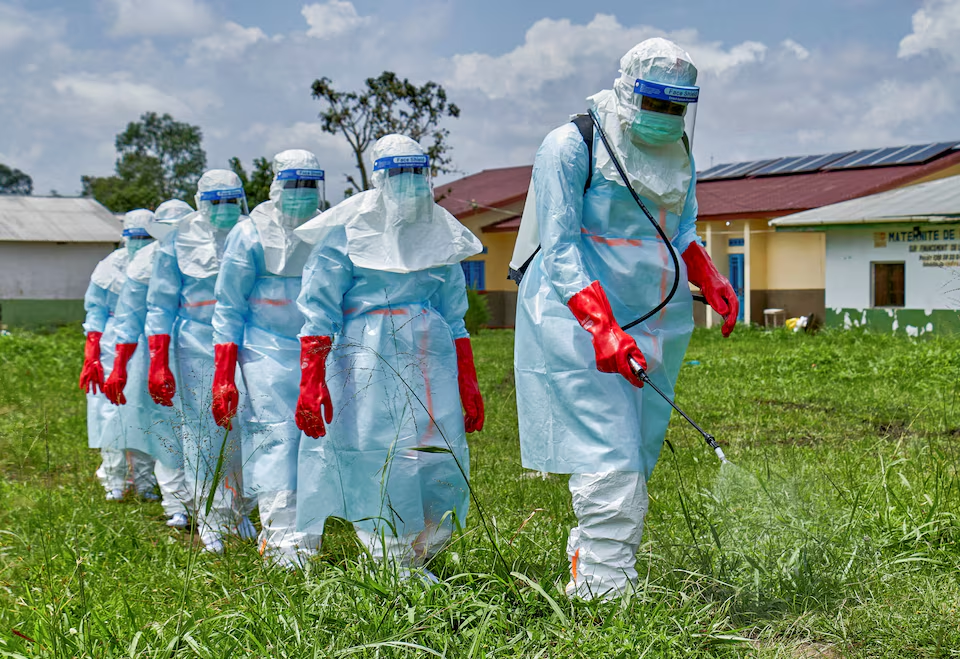
For health workers, the crisis has become particularly dangerous.
According to Harneis, about 160 healthcare workers had themselves fallen ill with Ebola, with 43 dying from the disease. At the same time, frontline workers are facing hostility from communities frightened by the virus and, in some cases, influenced by misinformation and conspiracy theories.
“And then, when we do respond, apart from the threat from the virus, healthcare workers and frontline workers have been attacked by youths, ambulances have been burned and stoned, and the healthcare facilities have been attacked.”
Julien Harneis
He added, “fear translates into angry young men who start throwing stones at their object of fear, the ambulance.“
More than 260 attacks on health workers have reportedly been recorded during the past six months, with eight health workers killed in attacks, according to Harneis.
The violence threatens to undermine an already fragile response. Ambulances are essential for transporting suspected patients, while health facilities provide critical isolation, treatment and monitoring services. Attacks on those systems can delay diagnosis and treatment and potentially allow the virus to spread further.
Aid workers have also reported that misinformation has contributed to distrust in the response. Some residents have questioned whether the outbreak is genuine, while others have resisted restrictions around the handling and burial of people who have died from Ebola.
Such resistance presents a serious challenge because controlling Ebola depends heavily on early detection, contact tracing, isolation, infection prevention and cooperation from affected communities.
The funding crisis adds another layer of uncertainty. Harneis indicated that cuts to humanitarian assistance in recent years had already reduced the capacity of aid organisations operating in Congo. Now, with the outbreak expanding rapidly, response agencies face the possibility of running short of the money needed to sustain operations.
Another immediate difficulty is paying the tens of thousands of people involved in the Ebola response. Banking services have been disrupted after the government halted commercial flights, affecting the movement of cash and making it harder for organisations to pay frontline workers.
The situation comes as international partners attempt to expand the medical response. The World Health Organization and its partners announced plans to send 70,000 doses of the Ervebo Ebola vaccine to Congo, although the vaccine is not licensed for the Bundibugyo strain responsible for the current outbreak. Some doses are intended for frontline workers, while others will support clinical trials examining whether the vaccine could offer protection against the virus.
Despite those efforts, the UN has warned that a much larger international mobilisation is required.
READ ALSO: Vacation Trials Can Proceed, Supreme Court Rules Against Oppong Nkrumah