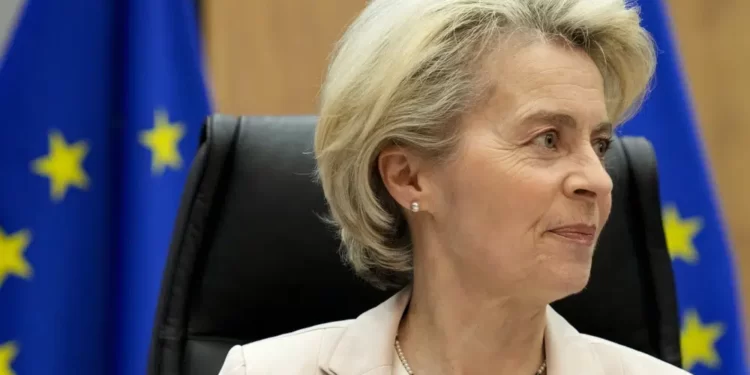
European Commission President Ursula von der Leyen has warned that the European Union is prepared to use its full range of trade defence mechanisms if ongoing negotiations with China fail to produce a breakthrough in addressing what Brussels describes as a record-high trade imbalance.
Speaking to Medef, the French business organisation, von der Leyen said that dialogue with Beijing remained necessary but stressed that negotiations must produce tangible results. “And when dialogue is not enough, we must be ready to make full use of our instruments,” she added.
Her remarks come as tensions remain high between Brussels and Beijing following the launch of talks last June aimed at rebalancing trade relations between the two economic powers. The European Commission has set October as a deadline for reaching an agreement with China, as concerns grow in Brussels over the scale of Chinese imports entering the European market and the widening trade deficit.
According to von der Leyen, the European Union’s trade deficit with China has reached approximately €1 billion per day. She said that the bloc was also experiencing a significant increase in imports from China, with the volume of cheaper Chinese goods entering the EU rising by 45% over the past five years.
The surge has prompted the European Commission to increase its use of trade defence investigations, which can examine whether imported products are being sold at unfairly low prices or are benefiting from subsidies that distort competition.
EU To Step Up Investigations
Von der Leyen said the Commission had opened 30 trade defence investigations during the past year, almost three times the historical average. “We are stepping up investigations significantly,” she said.
The investigations are part of a broader effort by Brussels to respond to concerns that European manufacturers are facing increasing competition from Chinese companies across a range of sectors. The EU and China have remained close to a broader trade confrontation in recent months. Beijing has repeatedly threatened retaliatory action against proposed European regulations that could limit market access for Chinese companies.
Over the summer, China moved to prohibit Chinese firms from participating in European Union antitrust investigations, adding another source of tension to the already difficult economic relationship. At the same time, the European Commission has continued to launch trade defence investigations into Chinese products that it suspects may be entering the European market at unfairly low prices.
Von der Leyen stressed that the EU did not intend to sever its economic relationship with China, describing Beijing as an important partner. However, she said cooperation could not mean accepting a permanent imbalance in trade.
“China is a key economic partner. And our approach is clear and consistent: derisking without breaking ties. But being a partner does not mean accepting permanent imbalances.”
Ursula von der Leyen
The European Union’s strategy of “derisking” seeks to reduce economic vulnerabilities and dependencies without pursuing a complete economic separation from China.
In June, EU leaders gave the Commission President a mandate to pursue a rebalancing of the relationship through dialogue while also reviewing and, where necessary, using the bloc’s available trade defence mechanisms.
Among the strongest tools available to the EU is its anti-coercion instrument, which can be activated when a foreign country is considered to be applying economic pressure to force the European Union or one of its member states to change its policies. The mechanism, sometimes described as the EU’s “trade bazooka,” could allow Brussels to impose significant countermeasures, including restrictions on access to public procurement markets and measures involving intellectual property rights.
However, activating such a tool would require the support of a qualified majority of EU member states. Whether sufficient support could be secured remains uncertain, particularly because individual European countries maintain significant trade and investment relationships with China.
Several EU governments continue to seek access to China’s vast consumer market and remain interested in attracting Chinese investment, potentially complicating efforts to build a united position on tougher economic measures. The European Commission therefore faces the challenge of balancing calls for stronger action against China with the differing economic interests of its 27 member states.
Von der Leyen’s remarks nevertheless signal that Brussels is preparing for the possibility that negotiations may fail to resolve the growing tensions. The October deadline will be closely watched by businesses and policymakers in both Europe and China.
A negotiated agreement could help stabilise the relationship and reduce the risk of further retaliatory measures. Failure to reach a breakthrough, however, could lead the European Union to consider stronger trade measures, potentially escalating tensions between two of the world’s largest economic powers.
READ ALSO: Countries Express Solidarity After Flash Floods In Nepal and China