The Minority Leader and Member of Parliament for Effutu, Honourable Alexander Kwamena Afenyo-Markin, has urged the majority on Parliament’s Appointments Committee to allow adequate scrutiny of three Supreme Court nominees before proceeding with their vetting.
He argued that the committee’s timetable could undermine the constitutional and procedural requirements governing the appointment of judges to the apex court.
According to the Minority Leader, Parliament’s consideration of the nominations should begin with confirmation that the constitutional conditions for the appointments have been properly fulfilled. He therefore called for evidence that the advice of the Judicial Council was obtained and genuine consultations with the Council of State took place for each nominee.
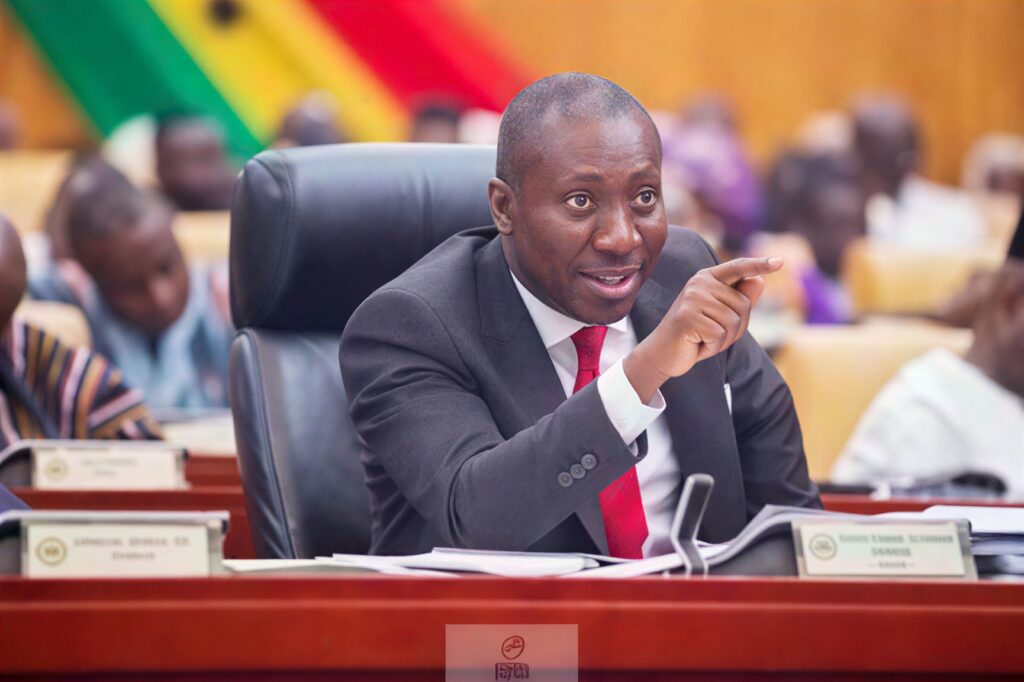
The Effutu MP further challenged the compressed timetable under Article 296 of the Constitution, which requires discretionary powers to be exercised fairly, candidly and in accordance with due process.
He explained that the authority to schedule the committee’s business constitutes a discretionary power and must therefore meet the constitutional standard of fairness. In his view, convenience linked to the impending end of the parliamentary recall cannot by itself justify an accelerated process.
“This committee ought not to vet nominees whose own constitutional foundation has not first been confirmed.”
Honourable Alexander Kwamena Afenyo-Markin
Furthermore, the Minority Leader relied on the Speaker’s earlier explanation of the recall to strengthen his objection. He noted that the Speaker had made clear that recalling Parliament did not amount to a determination of the merits of matters placed before the House.
The distinction, he argued, should guide the Appointments Committee as it exercises the House’s delegated responsibility. The fact that the nominations are being considered during the recall, he added, should therefore carry no implication that the nominees must be assessed within an unnecessarily shortened period.
Honourable Afenyo-Markin stressed that the committee must preserve room for meaningful examination of the nominees. He cautioned that treating the recall itself as a reason for speed would undermine the careful scrutiny required for appointments to the Supreme Court.
The Minority Leader also urged the committee to consider the constitutional weight attached to judicial appointments. He pointed to Article 146, which provides an elaborate process for removing serving judges and argued that the difficulty of removing a Supreme Court Justice makes Parliament’s initial scrutiny particularly significant.
Consequently, he added that the committee should not approach the exercise with the same flexibility that may apply to appointments that can easily be reversed. The decision before Parliament, he noted, could have lasting implications for the administration of justice.
Minority Insists Supreme Court Vetting Demands Full Scrutiny
The Minority’s position centres on ensuring that Parliament completes its constitutional responsibility without allowing numerical strength to determine the pace or substance of the vetting process.
Honourable Afenyo-Markin emphasised that the minority was not rejecting the President’s constitutional authority to nominate persons for appointment to the Supreme Court. His objection, instead, focused on the procedure and the time being allowed for Parliament to discharge its oversight responsibility.
The Effutu legislator therefore called for the relevant parliamentary orders to remain in force during the exercise. He specifically referred to Orders 217, 265, 266 and 267, arguing that their application should not be bypassed without the appropriate parliamentary procedure.
In addition, the Minority requested that consideration of the three nominations extend beyond the current recall period. Such an approach, he argued, would give members sufficient opportunity to comply with the requirements governing the committee’s work.

The committee was also asked to obtain confirmation from the Clerk to Parliament or the Attorney-General that the constitutional preconditions under Article 144(2) had been satisfied for each nomination. That verification, according to the Minority Leader, would establish the proper foundation for the vetting.
On the calibre of the nominees and their records of public service, Honourable Afenyo-Markin acknowledged that the nominees were individuals who had devoted substantial periods of their careers to serving Ghana and the wider sub-region.
He consequently stressed that the Minority’s position should not be interpreted as opposition to their nomination. The central demand, he explained, was for Parliament to undertake the exercise with the level of care required by the importance of the office.
“The majority must not use its supermajority in terms of numbers to stampede this process.”
Honourable Alexander Kwamena Afenyo-Markin
Against this backdrop, the Minority Leader proposed that the committee suspend the current hearing process and undertake the necessary parliamentary procedures before returning to the vetting.
He urged members to use dialogue and deliberation to resolve the procedural questions instead of allowing numerical strength to determine the outcome. For the Minority, such an approach would preserve the integrity of Parliament’s constitutional role while giving every member adequate space to assess the nominees.
The proposed course of action, he added, would involve suspending the hearing, undertaking the required advertisement and returning to conduct the vetting after the procedural requirements had been addressed.
“We are not opposed to the nomination, save that, respectfully, this committee be resolved that all these concerns be taken into consideration.”
Honourable Alexander Kwamena Afenyo-Markin
The Minority Leader appealed to the committee to give serious consideration to the objections before proceeding with the nominations. He also urged the majority to engage with the Minority’s submissions through deliberation, stressing that Parliament’s responsibility extends beyond the immediate demands of the recall sitting.
READ ALSO: UNEP Urges Responsible Mining as Demand for Critical Minerals Rises