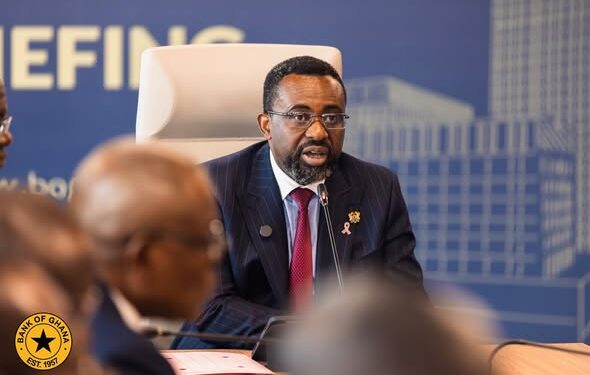
Ghana is increasingly positioning itself for another boost in its international credit standing, with Bank of Ghana Governor Dr. Johnson Asiama expressing confidence that the country could secure a ratings upgrade in the second half of 2026.
The optimism comes as Ghana continues to implement fiscal reforms, rebuild investor confidence and strengthen its external reserves following years of severe economic and debt pressures.
Speaking at the Fidelity Bank Debt Capital Market Conference in Accra, Dr. Asiama disclosed that discussions with international ratings agencies were already underway, raising expectations that Ghana could receive favourable assessments in the coming months.
Moody’s Review Raises Fresh Expectations
Dr. Asiama revealed that he had recently met with representatives of Moody’s, one of the world’s leading credit ratings agencies.
“Only yesterday, I had a meeting with another ratings agency, Moody’s and we look forward to some good reviews in the coming months,” the Governor stated.
The comments have heightened expectations that Ghana could be moving closer to another sovereign ratings improvement.
Moody’s maintained Ghana’s credit rating at Caa1 in April 2026 but changed the outlook from stable to positive. The agency cited improvements in Ghana’s public finances while maintaining concerns about credit constraints and the country’s exposure to exchange rate and commodity price volatility.
The positive outlook was significant because it suggested that Ghana’s creditworthiness could improve if the economic and fiscal gains were sustained.
S&P and Fitch Have Already Upgraded Ghana
Ghana’s latest ratings ambitions are backed by improvements already recorded from other major international agencies.
S&P Global Ratings upgraded Ghana’s sovereign rating to B-/B in November 2025 from CCC+/C. Fitch Ratings subsequently upgraded Ghana from B- to B in May 2026.
These upgrades represent a substantial improvement from the distressed ratings Ghana carried during the height of its economic crisis.
According to Dr. Asiama, the progress has been driven largely by fiscal consolidation and efforts to restore debt sustainability.
He said the recovery programme has been underpinned by stronger domestic revenue mobilisation, prudent expenditure management and measures aimed at restoring debt sustainability.
The Governor’s comments suggest that authorities now believe the foundations have been established for Ghana to secure further improvements in its credit profile.
Fiscal Discipline Remains Key
Ghana’s ability to sustain fiscal discipline will likely remain central to any future ratings decision.
For years, high budget deficits, rising public debt, debt-service pressures and weak revenue mobilisation undermined investor confidence and placed significant pressure on the economy.
The government has since pursued fiscal consolidation while working through the consequences of the Domestic Debt Exchange Programme and broader debt restructuring.
The improvements in Ghana’s fiscal position have increasingly attracted attention from international institutions and ratings agencies.
However, a ratings upgrade is not guaranteed. Agencies will likely assess whether the recent improvements are sustainable and whether Ghana can maintain fiscal discipline without undermining economic growth or social spending.
6% Growth Expected in Second Half
Beyond the ratings outlook, Dr. Asiama also delivered an upbeat assessment of Ghana’s economic growth prospects.
The Governor expects economic growth to reach 6% during the second half of 2026, signalling continued confidence in the recovery.
Strong economic growth could provide additional support for Ghana’s credit profile by improving government revenues, strengthening corporate activity and reducing the relative burden of public debt.
However, sustaining growth will depend on continued macroeconomic stability and investment across productive sectors.
The Governor also expects inflation to remain within the Bank of Ghana’s medium-term target range of 8% plus or minus 2%.
Inflation Risks Still Threaten the Recovery
Despite the positive outlook, the Bank of Ghana is not ignoring potential threats to price stability.
Dr. Asiama identified quarterly utility tariff adjustments and renewed geopolitical tensions in the Middle East as potential downside risks to Ghana’s inflation outlook.
Higher utility tariffs could directly affect household and business costs, while renewed geopolitical tensions could push up international commodity and energy prices.
Ghana remains particularly exposed to external shocks because movements in global commodity prices and exchange rates can quickly affect domestic inflation.
Nevertheless, the Governor maintained that inflation should remain within the target band throughout 2026, provided the economy does not experience major unexpected shocks.
Cedi Stability and Reserves Take Centre Stage
The Bank of Ghana is also taking steps to strengthen the foreign exchange market and rebuild Ghana’s external buffers.
Dr. Asiama said the new Foreign Exchange Operations Framework has improved transparency and predictability in the central bank’s foreign exchange operations.
He further highlighted the Ghana Accelerated National Reserve Accumulation Policy, known as GANRAP, through which the country is rebuilding its external reserves through gold accumulation in coordination with the Ministry of Finance.
Stronger reserves could provide Ghana with greater protection against external shocks and help strengthen confidence in the cedi.
BoG Pushes Financial Market Reforms
The Governor also pointed to broader reforms aimed at deepening Ghana’s financial markets.
According to Dr. Asiama, the Bank of Ghana will continue implementing institutional reforms, including efforts to safeguard the independence of the central bank and deepen financial markets.
A framework is also being developed for Virtual Asset Service Providers following the passage of the relevant legislation.
The reforms are expected to provide greater structure and oversight within Ghana’s evolving financial ecosystem.
Dr. Asiama also said the authorities want to incentivise banks to list on the equity market, potentially giving financial institutions greater access to long-term capital for productive investments.
Cocoa Board Eyes US$1 Billion Commercial Paper
One of the most significant developments highlighted by the Governor was the potential participation of Ghana Cocoa Board in the domestic debt capital market.
He disclosed that COCOBOD intends to finance operations for the 2026/2027 cocoa crop season through commercial paper issuances.
The programme is reportedly targeting US$1 billion in three phases.
Such an issuance could significantly deepen Ghana’s debt capital market while giving institutional investors additional investment opportunities.
Dr. Asiama expressed hope for greater participation from corporate and quasi-governmental issuers as Ghana works to build a stronger domestic capital market.
Ratings Upgrade Could Transform Investor Confidence
For Ghana, another ratings upgrade would carry significance beyond the headline announcement.
A stronger sovereign rating could improve investor sentiment, potentially reduce borrowing costs over time and strengthen Ghana’s ability to access international capital markets.
It could also serve as evidence that the country’s post-crisis economic reforms are gaining credibility.
However, maintaining the momentum will require continued fiscal discipline, stable inflation, stronger external buffers and sustained economic growth.
With S&P and Fitch already having upgraded Ghana, and Moody’s maintaining a positive outlook, the country enters the second half of 2026 with renewed hopes of another major ratings breakthrough.
READ ALSO: CSIR Commissions New Screen House to Boost Quality Okra Seed Production