
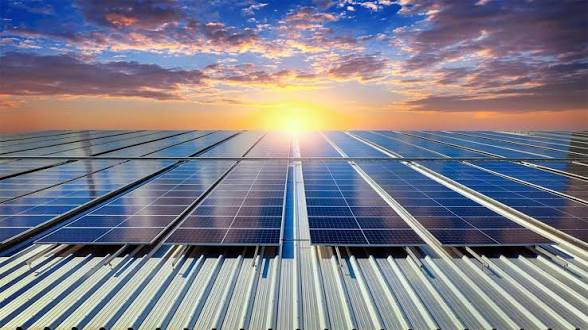
Africa’s solar market is entering a new phase, with installations expected to reach a record 17 GW in 2026, representing a 45% increase from 2025 and marking the third consecutive year of record growth.
The scale of the expansion is significant not simply because of the volume of new generation, but because much of the growth is occurring outside the traditional utility-scale projects that governments and international agencies have historically relied on to measure renewable-energy deployment.
The latest analysis by Ember, produced in partnership with African Tech Futures Lab, estimates that around three-quarters of Africa’s solar capacity additions between 2023 and 2025 came from distributed solar.
This includes smaller systems installed on rooftops and on the customer side of the electricity network.
Such installations are becoming an increasingly important part of Africa’s power system, even though they remain poorly captured in official statistics.
A Solar Market Moving Beyond Big Projects
The central message from the analysis is that Africa’s solar transition is broader than the utility-scale projects that typically dominate energy-policy discussions.
Ember’s methodology uses Chinese customs data to estimate solar panels shipped to African countries and applies a calibrated installation rate.
The analysis estimates that approximately 73% of exported panels globally are installed within six months, allowing the researchers to make an estimate of Africa’s full-year 2026 installations before complete national statistics become available.
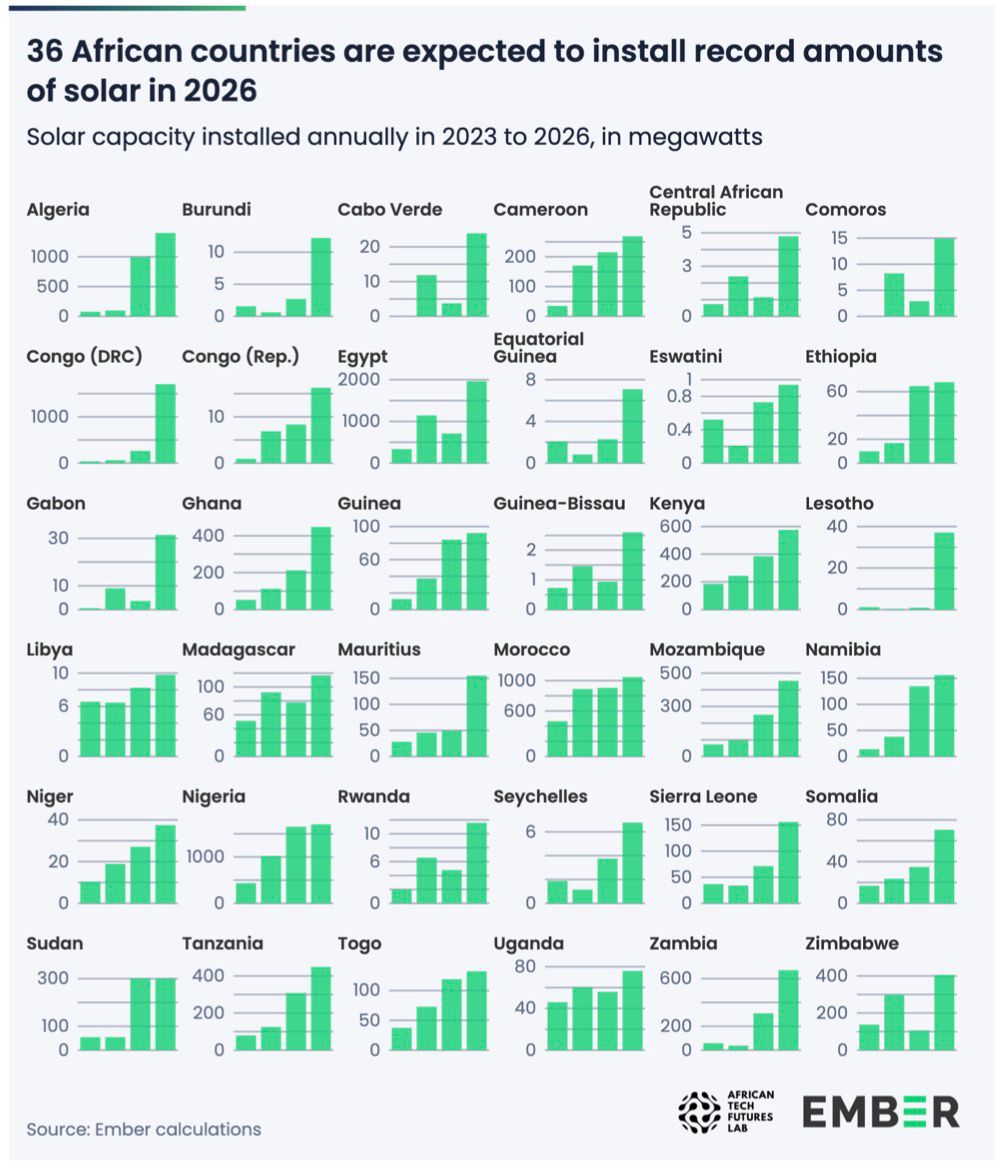
“17 GW of solar was installed in 2026, equal to around 100,000 solar panels every day.”
Ember and African Tech Futures Lab analysis
The implications extend beyond generation capacity.
The estimated 17 GW of new solar is expected to produce approximately 23 TWh of electricity annually, equivalent to about 2.3% of Africa’s electricity generation.
According to the analysis, this is greater than the continent’s average annual electricity-demand growth of 2.2% recorded between 2014 and 2024.
That comparison is important. It suggests that, if the pace of deployment is sustained, solar could meet a substantial portion of incremental electricity demand rather than merely supplementing existing generation.
The geographical distribution of growth is also changing.
South Africa, which historically accounted for a dominant share of Africa’s solar expansion, is expected to account for less than 20% of installations in 2026 for the first time since 2019.
Meanwhile, 36 of Africa’s 54 countries are expected to install record amounts of solar this year.
Ghana Faces A Different Solar Challenge
For Ghana, the African-wide acceleration presents both an opportunity and a policy test.
Ghana already has a relatively mature electricity-access system, with access exceeding 89%, according to the Ministry of Energy and Green Transition.
The country’s renewable-energy challenge is therefore increasingly about diversifying the electricity mix, reducing exposure to expensive thermal generation, improving energy resilience and allowing consumers and businesses to generate part of their own electricity.
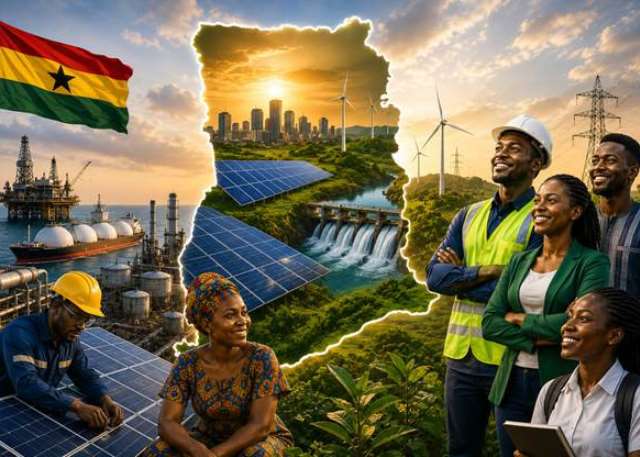
Official Ghanaian statistics show that solar PV generation increased rapidly over the past decade, although its contribution to total electricity generation remains small.
Solar PV generation reached 181 GWh in 2024, while renewable sources other than large hydro accounted for only a small share of total electricity generation.
The Energy Commission’s statistics also separately track distributed solar PV, demonstrating that Ghana already recognises the category within its national energy data architecture.
The problem is that Ghana’s opportunity is not necessarily captured by simply pursuing another large solar farm.
Distributed solar could become particularly valuable for commercial and industrial consumers facing high electricity costs, as well as public facilities and households seeking greater reliability.
Ghana is already preparing to scale up rooftop solar, mini-grids and other distributed renewable-energy systems, while the country has also pursued programmes involving thousands of net-metered solar PV systems.
This creates a strategic opening: solar can increasingly operate not only as a generation technology but also as an energy-security tool.
The Grid Must Adapt To Distributed Generation
The rapid growth of distributed solar, however, creates a second question that is just as important as installation itself: can the electricity system effectively integrate millions of smaller generators?
Utility-scale solar is relatively visible. A large solar farm has a known location, installed capacity, connection point and ownership structure.
Rooftop and customer-side systems are much harder to monitor.
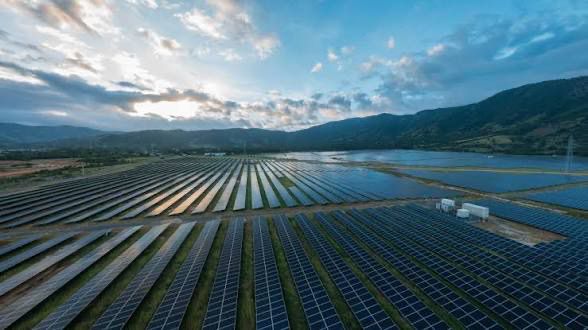
They can be installed progressively across homes, commercial buildings, factories and institutions, making their aggregate impact difficult to assess without effective registration and data systems.
This is a major planning issue for Ghana.
As distributed solar expands, the electricity system must increasingly account for electricity flowing not only from large power plants through transmission networks to consumers, but also from consumers back into distribution networks.
That makes net metering, technical standards, smart metering, protection systems and distribution-network planning increasingly important.
The African analysis identifies this data problem as continental rather than uniquely Ghanaian.
Official national solar-capacity reporting could be found for only 36 of Africa’s 54 countries, while only 14 of those had data for 2025.
Only South Africa, Tunisia and Tanzania were identified as publishing some solar data monthly or quarterly.
“The rise in solar capacity is likely to meet much of Africa’s electricity demand growth, and the sheer scale of cheap new supply could spur more demand growth too.”
Ember and African Tech Futures Lab
For Ghana, the lesson is clear: the country cannot effectively plan the future electricity system if a growing portion of generation remains outside comprehensive and timely data systems.
Solar Growth Must Translate Into Industrial Value
There is also a broader economic question.
Africa is installing solar panels at a rapidly increasing rate, but 94% of panels installed across the continent are still imported from China.
At the same time, African solar-panel manufacturing is expected to quadruple to about 3.5 GW in 2026, driven largely by new plants in Egypt and Tanzania.
Much of that production, however, is reportedly intended for export rather than domestic African consumption.
That exposes a familiar weakness in Africa’s energy transition: growing deployment does not automatically create a comparable domestic industrial base.
For Ghana, the opportunity therefore extends beyond installing panels.
A sustained solar market could support local assembly, electrical installation, maintenance, battery storage, engineering services, energy-management systems and eventually other parts of the clean-energy value chain.
The economic case becomes stronger when solar deployment is connected to productive activity.
Commercial and industrial users can use distributed solar to reduce exposure to electricity-price volatility, while battery storage can allow businesses to manage peak demand and improve resilience.
Government’s wider renewable-energy plans are already moving in this direction, with proposals covering solar systems, mini-grids, rooftop installations and other off-grid solutions.
The emerging African market suggests that the next stage should be more systematic.
The Policy Question Is No Longer Whether Solar Will Grow
Africa’s solar trajectory is increasingly making one question less relevant: whether solar will become a significant part of the continent’s energy system.
The more important question is whether governments, regulators and utilities will build the institutions capable of managing its growth.
For Ghana, that means improving the visibility of distributed solar, strengthening technical standards, accelerating appropriate grid upgrades and ensuring that renewable-energy deployment is linked to industrial competitiveness.
It also means treating batteries and flexible demand as part of the electricity transition rather than as separate technologies.
The country’s electricity system has historically been structured around large generators and centralised networks.
The emerging solar market points towards a more distributed model in which households, businesses and institutions increasingly become both consumers and producers of electricity.
That transition could reduce pressure on the conventional grid and lower energy costs for productive users.
But without stronger planning and data, it could also create new challenges for distribution utilities, revenue collection and system management.
The African solar boom therefore presents Ghana with an opportunity larger than adding megawatts.
It provides a chance to rethink how electricity is generated, financed, consumed and integrated into economic activity.
The countries that benefit most from the solar surge will not necessarily be those that install the largest number of panels.
They will be those that turn rapidly falling solar costs and distributed generation into reliable power, lower industrial costs, stronger energy security and domestic economic value.
For Ghana, the policy imperative is to ensure that the solar revolution becomes part of the country’s industrial and energy-security strategy, not simply another category in the generation mix.
READ ALSO: Deputy AG: No Tension With OSP, Allegation of Rebuffed Collaboration False