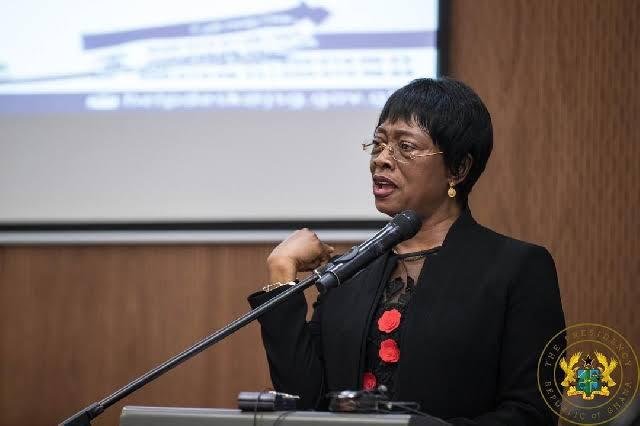
Sophia Akuffo, Distinguished Fellow of the Institute of Economic Affairs (IEA) and former Chief Justice, has lent her weight to structural policy interventions in Ghana’s extractive sector, arguing that a dedicated institutional mechanism similar to the Petroleum Revenue Management Act is urgently required to manage mineral revenues.
Addressing the persistent fiscal instability that has haunted the nation’s balance sheet, she underscored that replicating petroleum-style oversight within the mining domain is essential to halt the cyclical economic disruptions that have plagued the country for decades.
In an interview with The Vaultz News, the former Chief Justice stressed that navigating this proposed policy shift requires deep economic prudence and careful financial strategy to justify every structural adjustment made.
She cautioned against top-down mandates, noting that while the overarching goal must be to insulate the domestic economy from global commodity price swings, operational evolution within state financial institutions such as the Bank of Ghana’s gold operations must be guided by sound technical logic.
“Any mechanism for improving the overall management of the economy in such a way that these ups and downs we’ve been having over all these boring years will stop? It’s nauseating. We cannot continue like that.”
Sophia Akuffo

The Imperative for a Mineral Revenue Legislation
For decades, Ghana’s resource governance has suffered from an asymmetric framework that treats petroleum and solid minerals differently.
While the Petroleum Revenue Management Act (PRMA) established statutory rules for revenue allocation, sovereign wealth saving through the Heritage and Stabilization Funds, and public disclosure, the mining sector has largely operated under fragmented fiscal arrangements.
“No, it’s not for us to tell them what to do, but what is important is that having of the gold bar from the Bank of Ghana, with wisdom, with economic and financial wisdom, and I’m only going to go through, but I know that if you want to change the way things operate, you must use wisdom and every move you make has to justify it.”
Sophia Akuffo

Establishing a dedicated Mineral Revenue Management Act would codify clear, legally binding rules for capturing, managing, and investing gold, bauxite, and lithium revenues. Without a statutory cushion, windfalls from record-high mineral prices are frequently absorbed into recurrent expenditure rather than capital accumulation or counter-cyclical buffers.
Furthermore, institutionalizing mineral revenue management provides a structural defense against boom-and-bust cycles.
The lack of a centralized revenue management mechanism leaves the broader economy vulnerable to exogenous shocks, forcing periodic balance-of-payments crises.
Former Chief Justice Akuffo observed that “we cannot continue like that,” pointing out that erratic fiscal trajectories undermine long-term national planning.
Enacting a comprehensive legal framework ensures that mineral wealth directly funds long-term economic diversification rather than short-term consumption gaps.
Strategic Wisdom in Financial Operations
Reforming the extractive sector requires more than statutory declarations; it demands absolute operational discipline across the central bank and fiscal authorities.
The Bank of Ghana’s domestic gold purchase program designed to build reserve assets and support currency stabilization represents a major shift in how physical mineral wealth interacts with monetary policy.
However, as the IEA Fellow cautioned, changes to gold handling must be executed with “economic and financial wisdom” to avoid market distortions or fiscal slippages.
Every policy move must carry clear economic justification to protect public confidence in the state’s financial stewardship.
This call for strategic wisdom extends to how the state structures its engagements with commercial entities and international markets.
Rather than relying on outdated concessionary arrangements that deliver marginal returns, aligning monetary strategy with resource governance allows the state to retain maximum value.
Integrating central bank operations into a broader mineral management framework transforms gold reserves into a direct anchor for economic stability.
Breaking the Cycle of Volatility
The ultimate mandate of a Mineral Revenue Management Act is to permanently break the pattern of fiscal volatility that Akuffo described as “nauseating.”

By establishing transparent saving rules, intergenerational equity funds, and ring-fenced development spending, Ghana can convert finite underground wealth into permanent physical and human capital.
Modernizing the governance of solid minerals ensures that future price downswings no longer trigger economic hardship or force reliance on emergency external financing. Reforming these systems with rigor and foresight remains the primary pathway to achieving enduring national prosperity.
READ ALSO: Carlos Queiroz Stays on as Black Stars Head Coach