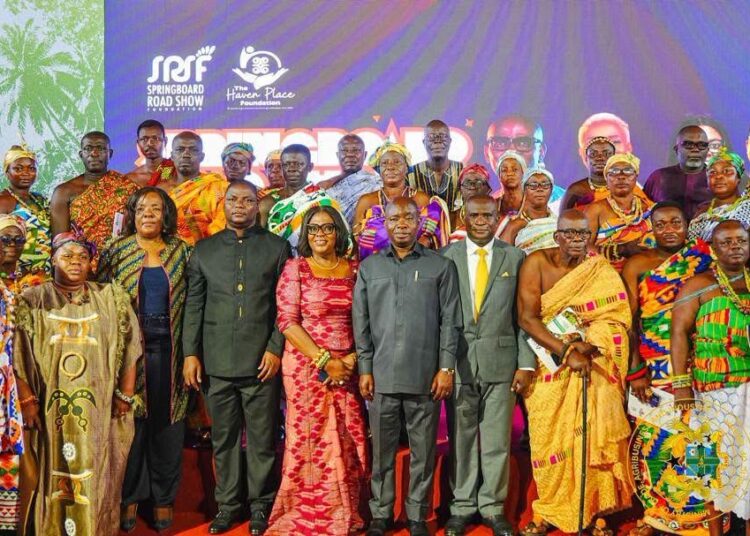
The Deputy Trade Minister Sampson Ahi announces integrated industrialisation drive at Axim Business Summit 2026 to connect 13 landing beaches, fertile farmlands and historic assets to global markets under AfCFTA in Axim in the Western Region.
The Government of Ghana has outlined a comprehensive strategic framework aimed at unlocking the full economic potential of Axim and the wider Nzema area, positioning the historic coastal town as a model for agro-industrialisation and sustainable blue growth in the country.
The bold vision was unveiled at the Axim Business Summit 2026, where the Deputy Minister for Trade, Agribusiness and Industry, Hon. Sampson Ahi (MP), declared that government has fundamentally shifted its approach to local economic transformation.
Delivering the keynote address on behalf of the Sector Minister, Hon. Elizabeth Ofosu-Adjare, Hon. Ahi stated that under the Mahama administration, the realigned Ministry of Trade, Agribusiness and Industry now treats production, processing, and trade as one continuous and inseparable value chain, a critical departure from past fragmented policies.
“The era where we produce what we do not process and process what we do not market is over. The realigned Ministry now treats production, processing, and trade as one continuous value chain to drive sustainable development and job creation. Axim’s time has come.”
Hon. Ahi
Hon. Ahi told a packed audience of traditional leaders, investors, fisher folk, farmers, and youth entrepreneurs. He described Axim as a town of “extraordinary abundance” that has for decades remained under leveraged.
The town, he noted, hosts 13 major landing beaches, vast fertile lands suitable for high value cash crops including coconut, oil palm, rubber and cocoa, and iconic heritage assets such as Fort Saint Anthony and pristine beaches that hold immense tourism potential.
According to the Deputy Minister, the central challenge has not been the lack of resources, but the lack of connecting this abundance to capital, to modern processing infrastructure, to standards and certification, and to global markets under the African Continental Free Trade Area (AfCFTA).
“Axim does not need pity; Axim needs connection. Connection to finance, connection to cold chain and processing plants, connection to packaging and quality assurance, and connection to buyers in Accra, Lagos, and across the continent. That is what this strategic framework will deliver.”
Hon. Ahi
The Four Pillars to Drive “Made in Axim”
Hon. Ahi outlined four key policy instruments that will serve as the engine for Axim’s transformation: First is the National Agribusiness Policy, which will provide structured support for smallholder farmers and cooperatives in the area to scale up production of cash crops with guaranteed off-take agreements with processing companies.
Second, the Feed the Industry Programme, a flagship initiative designed to ensure that Ghanaian industries are fed by Ghanaian raw materials. Under this, Axim’s coconut, oil palm and rubber will be directly linked to factories under the government’s industrialisation drive, ensuring farmers retain more value.
Third, the Accelerated Export Development Programme (AEDP), which will help local SMEs meet international standards, obtain Ghana Standards Authority and FDA certification, and leverage the AfCFTA National Coordination Office to export value-added products like coconut oil, smoked fish, and gari.
Fourth, the 24-Hour Economy Policy, which will ensure that critical economic infrastructure from landing sites and agro-processing centres to markets and ports operates efficiently round-the-clock to reduce post-harvest losses, particularly in fisheries, and create shift-based jobs for youth and women.
He emphasised that the 24-Hour Economy is particularly crucial for the blue economy. With 13 landing beaches, fishermen in Axim often lose up to 40% of their catch due to lack of cold storage.
The policy, he said, will facilitate investments in solar powered cold stores, ice-making plants, and modern fish processing facilities that operate day and night.
The ultimate goal, he noted, is to make “Made in Axim” a recognized mark of quality and origin, both domestically and internationally.

Traditional Authority at the Centre of Development
The Summit was uniquely co-chaired by the two custodians of the land, His Royal Majesty Awulae Attibrukusu III, President of the Lower Axim Traditional Council, and His Royal Majesty Awulae Kwaw Armah II, President of the Upper Axim Traditional Council, signalling a unified traditional front for development.
This dual chairmanship was hailed by participants as a powerful symbol of unity and a prerequisite for sustainable local development. Hon. Ahi commended the traditional leaders, stating that government recognizes that no sustainable development can happen without the active leadership of Nananom.
“The Ministry sees our traditional authorities not as stakeholders, but as co-drivers of this industrialisation agenda. Their role in land administration, community mobilisation, and preserving social cohesion is irreplaceable.”
Hon. Ayi
In their remarks, the traditional leaders pledged their full support for the government’s framework and called on sons and daughters of Nzema, both home and abroad, to come and invest in the area. They also appealed for deliberate investments that protect the environment and empower women and youth, who form the backbone of the local agro-economy.
A New Model for Local Industrialisation
The Axim Business Summit 2026, organised in collaboration with the Nzema East Municipal Assembly and private sector partners, brought together over 300 participants, including development partners, financial institutions, and agribusiness firms.
The Agro- Industrial and Blue Economy Hub, if fully implemented, the framework is expected to significantly reduce youth unemployment, curb rural-urban migration, empower women processors and traders, and position Axim as a leading beneficiary of the AfCFTA.
The Deputy Minister concluded by reaffirming the government’s commitment, assuring the people of Axim that this will not be another policy that ends on paper.
READ ALSO:SIGA Flags Deep Compliance Failures Among Ghana’s Specified State Entities