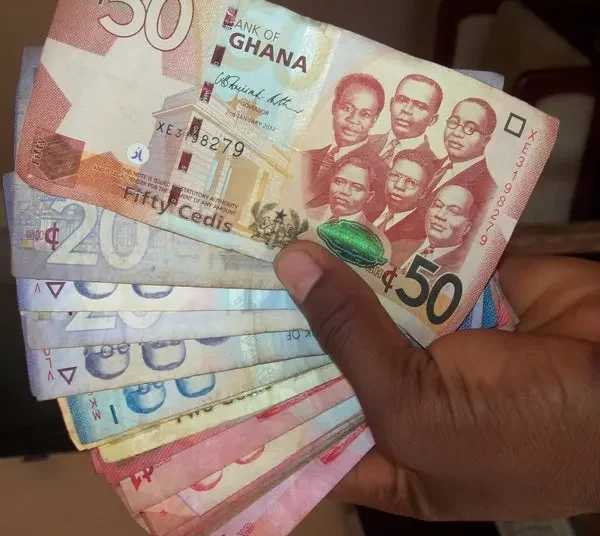
Ghana’s cedi is facing renewed pressure as businesses increase foreign-exchange demand ahead of the Christmas import season, testing whether the country’s unusually strong external balances can translate into sufficient dollar liquidity when commercial demand rises. Market reporting on Tuesday linked the pressure mainly to corporate import payments and higher energy-related foreign-exchange needs.
The movement is visible in Bank of Ghana’s official interbank rates. The cedi ended August at GH¢11.25 per US dollar and the Bank’s September 14 weighted median stood at GH¢11.463, a depreciation of about 1.9% from the end-August level.
That is renewed weakening, but not a currency dislocation. It follows a 3.5% month-on-month appreciation in August, when the cedi still ended the month 7.11% weaker against the dollar than at the start of 2026.
Ghana recorded a US$8.8 billion merchandise trade surplus and US$5.1 billion current-account surplus in the first half, while BMI, a Fitch Solutions company, has just raised its 2026 current-account surplus forecast to 7.8% of GDP.
The latest cedi movement therefore does not contradict the stronger external position. It demonstrates the difference between earning foreign exchange over a period and having enough dollars available at the precise moment importers, energy firms and other market participants need them.
A Surplus Not the Same as Spot Dollar Liquidity
The current account records Ghana’s transactions with the rest of the world over time. A surplus means foreign-currency receipts from exports, services, income and transfers exceed corresponding outflows. But those flows do not arrive evenly, and they are not all held by the central bank or immediately available to commercial banks.

Merchandise exports reached US$18.29 billion, but imports still totalled US$9.48 billion. Services and income payments absorbed additional foreign exchange, while commercial banks and private firms also accumulated foreign financial assets.
A strong annual external balance can therefore coexist with short periods when demand for immediately available dollars exceeds supply in the domestic market.
That is also why the recent 7.8% current-account forecast should be treated as an external cushion rather than a promise of uninterrupted cedi appreciation. The forecast improves Ghana’s ability to absorb shocks, but exchange-rate movements still depend on the timing and location of foreign-exchange flows.
Seasonal Imports Meeting Costlier Energy Bill
The present pressure comes at a seasonally important point. Businesses typically build inventories before the December shopping period, raising demand for dollars to pay overseas suppliers. That seasonal requirement is now overlapping with elevated international oil prices, which increase the foreign currency needed to settle Ghana’s energy import bill.
Energy was already a major source of external demand in the first half. Bank of Ghana data show oil and gas imports rose 39.0% year-on-year to US$3.35 billion, with the central bank linking higher payments to the Middle East conflict. If oil prices remain elevated, even unchanged fuel volumes can require more dollars.
For firms, a tighter foreign-exchange market can increase the cedi cost of imported machinery, raw materials, medicines, fuel and consumer goods. For households, the main transmission comes later if those higher import costs are passed into retail prices. That makes cedi stability relevant not only to importers but also to the inflation outlook.
GoldBod Increasing Formal Dollar Supply
Ghana has also built a new source of market support through GoldBod’s foreign-exchange financing model. In August, the institution generated US$1.315 billion in foreign exchange, selling US$668.21 million directly to commercial banks while making US$646.59 million available to the Bank of Ghana for reserve accumulation.

GoldBod is targeting US$1.4 billion in September, with US$700 million expected to go to commercial banks and up to US$700 million to the central bank. If realised, that split would simultaneously support current market liquidity and strengthen reserves. But the important test is whether those inflows arrive consistently enough to offset periods of concentrated import demand.
The Bank of Ghana remains relatively confident. In its July Monetary Policy Report, it said: “Over the medium term, the Ghana cedi is expected to remain relatively stable.” It added that “FX intermediation is expected to moderate the pressures on the cedi, along with remittance flows.”
The Next Test Whether Pressure Remains Orderly
The central question is therefore not whether Ghana has enough external strength on paper. The country clearly has stronger export earnings, a sizeable current-account surplus and meaningful reserve buffers. The test is whether the foreign-exchange system can move those resources efficiently to the parts of the economy where legitimate demand is concentrated.
Some cedi depreciation during a period of heavy seasonal imports would not by itself signal a reversal of the external recovery. A flexible exchange rate should move when demand and supply change.

The warning sign would be a persistent acceleration in depreciation accompanied by widening market spreads, falling reserves or repeated shortages that interfere with normal commercial payments.
Businesses should therefore watch the pace of Christmas-related imports, energy prices and GoldBod’s September dollar deliveries, while policymakers will be watching whether the exchange-rate movement begins feeding into inflation expectations.
Ghana’s external buffer remains substantial. The current episode is testing something more practical: how well that buffer works when the demand for dollars arrives all at once.
READ ALSO: GoldBod Deploys Independent Business Model Following Agency Agreement Conclusion