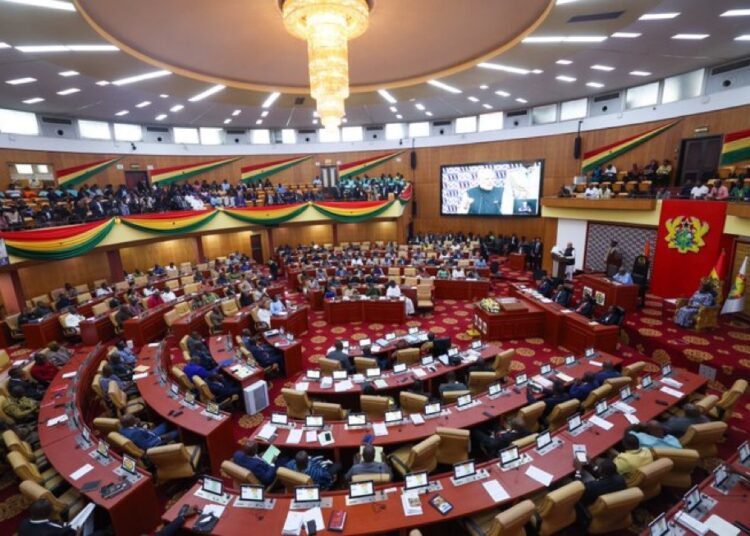
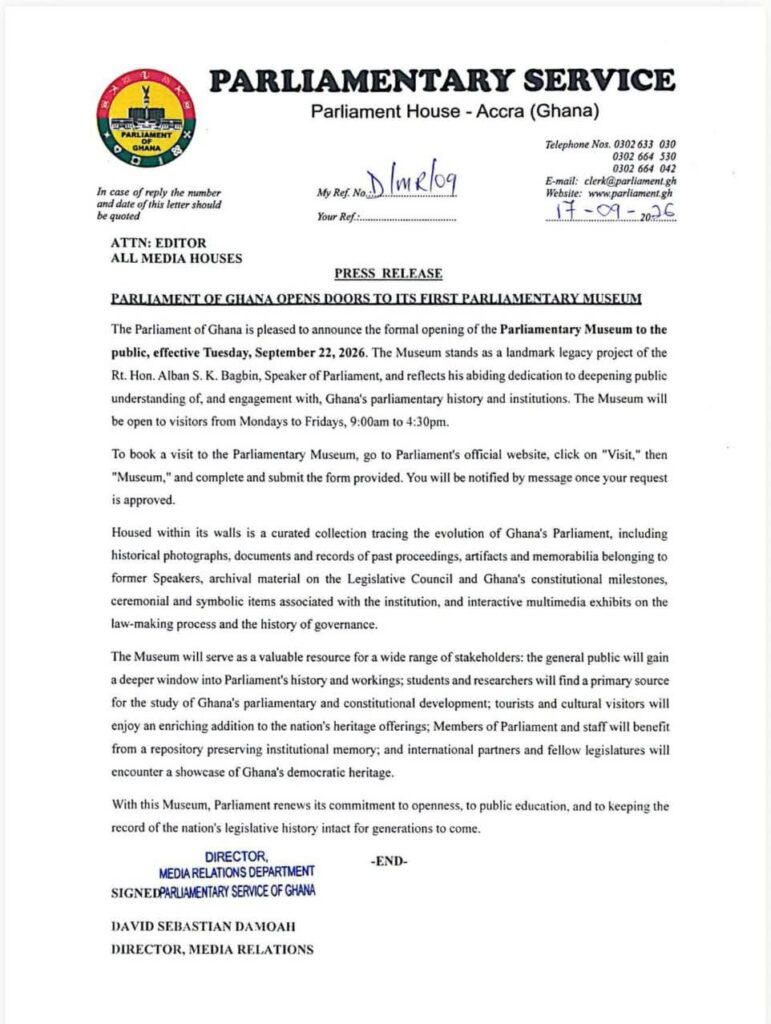
Ghana’s Parliament is set to open its first Parliamentary Museum to the public on Tuesday, September 22, 2026, marking a significant step in preserving and sharing the country’s legislative heritage.
The facility, located within Parliament House in Accra, will allow visitors to explore the evolution of Ghana’s Parliament, its constitutional journey, and key milestones in the nation’s democratic development.
According to a statement from the Parliamentary Service, the museum will operate from Monday to Friday between 9:00 a.m. and 4:30 p.m. Members of the public interested in visiting must book in advance through Parliament’s official website by selecting the “Visit” option, then “Museum,” and completing the online form. Approved applicants will receive confirmation notifications.
The museum is described as a landmark legacy project of Speaker of Parliament Rt. Hon. Alban Sumana Kingsford Bagbin. It aims to deepen public understanding of parliamentary institutions, preserve institutional memory, and provide educational resources for students, researchers, and the general public.
Officials say it will also serve Members of Parliament and staff as a repository of institutional knowledge while offering international partners and other legislatures an opportunity to engage with Ghana’s democratic heritage.
Exhibits will include historical photographs, documents, and records of past parliamentary proceedings. Visitors will see artefacts and memorabilia associated with former Speakers of Parliament, archival materials on the Legislative Council that preceded the modern parliamentary system, and items highlighting Ghana’s constitutional milestones.
Ceremonial and symbolic objects connected to Parliament will be on display, alongside interactive multimedia exhibits that explain the law-making process and the broader history of governance in Ghana.
Abeiku Santana, Acting Deputy Chief Executive Officer of the Ghana Tourism Authority, highlighted the museum’s potential as a cultural and educational attraction. In a social media post, he described the opening as history unlocking its doors, offering a new place for Ghanaians and visitors to learn, reflect, and experience the country’s democratic story.

The announcement aligns with ongoing efforts to promote Ghana’s heritage under the Visit Ghana campaign, positioning the museum as an addition to the capital’s cultural offerings.
The project builds on earlier work. The museum was commissioned in January 2025 as part of initiatives tied to the 30th anniversary of uninterrupted parliamentary democracy in Ghana. At that time, Speaker Bagbin emphasized its role in educating citizens about the evolution of the legislature, from pre-colonial systems of community decision-making through colonial structures to the post-independence National Assembly and the current Parliament.
He noted that the facility would house documents, photographs, documentaries, and artifacts that narrate the story of parliamentary democracy, helping future generations appreciate the sacrifices and struggles that shaped the nation.
Ghana’s parliamentary history stretches back to the colonial Legislative Council and evolved significantly after independence in 1957. The country has experienced periods of military rule interspersed with civilian governments but has maintained continuous multi-party democracy since the return to constitutional rule in 1992 under the Fourth Republic.
The museum seeks to document this trajectory, including key constitutional developments, the roles of successive Speakers, and the daily workings of the legislature.
By making these materials accessible, Parliament hopes to strengthen civic education. Interactive displays are expected to demystify the legislative process, showing how bills become law and illustrating the importance of representation and oversight.
Officials believe greater public familiarity with these processes can foster stronger engagement with democratic institutions and encourage informed participation.
Relevance of The Museum for Tourists and Cultural Visitors
For tourists and cultural visitors, the museum adds a focused institutional perspective to Accra’s attractions. Located inside the secure Parliament House complex, it will require advance booking, ensuring orderly access while allowing visitors to combine a museum tour with an appreciation of the seat of Ghana’s legislature.
Parliamentary staff note that the institution already receives tens of thousands of visitors annually, and the museum is expected to become a standard stop for many of them, as well as for school groups and researchers.
The collection continues to grow. During the earlier commissioning, appeals were made for members of the public holding relevant historical items to donate or loan them to the museum. Collaboration with the Ghana Museums and Monuments Board has supported the professional curation and presentation of materials.
As the September 22 opening approaches, the Parliamentary Service has framed the museum as more than a static display of the past. It is intended as a living resource that connects Ghana’s constitutional journey to the present-day work of Parliament and inspires ownership of the democratic process among citizens.
Students will find primary materials for study, researchers will gain access to archival records, and ordinary visitors will encounter the symbols, stories, and debates that have shaped modern Ghana.
The opening comes at a time when many African legislatures are exploring ways to make their histories more accessible to the public. Ghana’s initiative places it among countries seeking to use institutional museums to reinforce democratic culture and national identity.
With its combination of historical artifacts, multimedia storytelling, and a clear educational mandate, the Parliamentary Museum is positioned to become a valuable addition to both civic life and the tourism landscape.
Booking is already available online for those wishing to be among the first visitors when the doors open on September 22. Parliament has invited Ghanaians and international guests alike to explore this new window onto the country’s legislative heritage and democratic story.
READ ALSO:NaCCA Denies Institutional Role in Confucius Institute Teacher Training