Ecobank Transnational Incorporated has announced a combined US$2.6 billion lending commitment by 2030 to support women-owned businesses and agriculture-focused small and medium-sized enterprises across its 34 African markets.
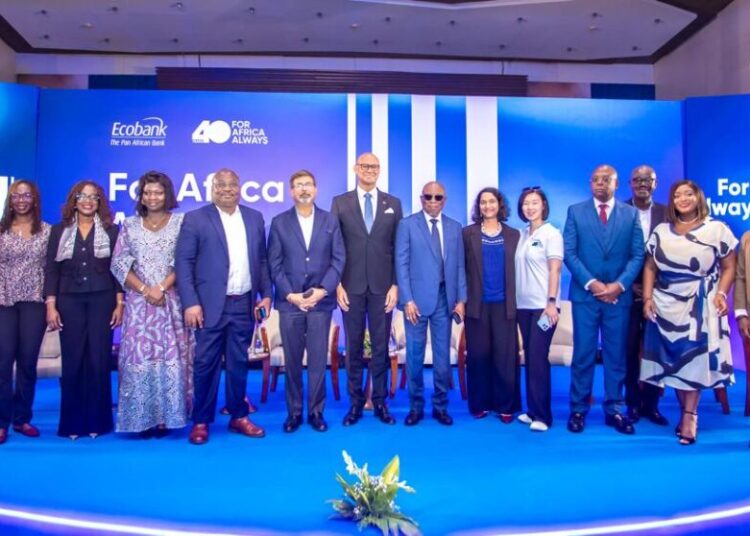
The announcement, made during the Ecobank@40 Media Conference in Lomé, marks a significant expansion of the bank’s financing ambitions as it looks beyond its four-decade history and towards Africa’s next phase of economic development.
The commitment consists of US$2.0 billion earmarked for women entrepreneurs through the Ellevate by Ecobank programme, alongside US$600 million dedicated to agriculture-focused SMEs.
Ecobank says the initiatives will support economic transformation, financial inclusion and sustainable development while helping businesses gain better access to capital and regional markets.
The scale of the commitment comes at a time when access to affordable and suitable financing remains a major challenge for businesses across Africa, particularly smaller enterprises and women-led firms.
$2bn financing push for women entrepreneurs
At the heart of the strategy is Ecobank’s Ellevate programme, which aims to build an outstanding loan portfolio of US$2.0 billion dedicated to women entrepreneurs by 2030.
The programme builds on financing and other support already extended to more than 110,000 women-led enterprises.
Ecobank plans to increase its registered client base to 400,000 formal businesses, while expanding digital onboarding and financial inclusion initiatives that could create funding pathways for up to one million female micro-entrepreneurs across the continent.
The bank also intends to provide unsecured and partially secured credit facilities, with strategic guarantee partnerships involving development finance institutions expected to help reduce lending risks.
Agribusiness, education and healthcare will receive particular attention under the expanded framework.
Such financing could prove significant for women entrepreneurs operating businesses that often struggle to meet traditional collateral requirements.
Rather than limiting support to conventional lending, Ecobank’s approach combines credit access with digital channels and guarantee mechanisms designed to bring more businesses into the formal financial system.
Agriculture gets $600m boost
Agriculture is the second major pillar of the financing announcement.
Ecobank has committed US$600 million in outstanding loans for agriculture-focused SMEs by 2030, with the initiative designed to cover the wider agricultural value chain rather than concentrate exclusively on seasonal crop financing.
Through its “Farm-to-Fork” approach, the bank intends to finance farmers, aggregators, processors, logistics providers, traders and exporters.
That broader approach recognises that agricultural production does not end when crops are harvested. Financing is also needed to move produce from farms to markets, process raw materials, manage logistics and support exports.
Climate-smart agriculture, digital payment channels across rural supply chains and structured trade finance will also form part of the strategy.
Ecobank says the approach is intended to strengthen regional food markets while reducing Africa’s dependence on food imports.
The bank’s focus on the agricultural value chain could therefore extend financing beyond farmers themselves, bringing businesses involved in storage, transportation, processing and distribution into the funding ecosystem.

Trade Hub opens wider African markets
A major component of the two commitments is the Ecobank Single Market Trade Hub, a digital marketplace connecting more than 60,000 businesses across Africa.
Through the platform and Ecobank’s pan-African payment infrastructure, women entrepreneurs in agriculture and commercial SMEs are expected to gain access to cross-border buyers and suppliers.
The infrastructure will also support multi-currency payments under the African Continental Free Trade Area, creating opportunities for businesses seeking to expand beyond their domestic markets.
Ecobank says the broader strategy will centre on expanded credit and de-risking, cross-border trade and AfCFTA acceleration, digitalisation of value chains, and capacity building alongside ESG integration.
Financing will cover working capital, trade loans and investment financing, supported by guarantees from development finance institutions and risk-sharing facilities.
Beyond money, the bank plans to provide training in business management, export readiness, leadership and sustainable agriculture.
Awori positions anniversary as launchpad
Ecobank Group CEO Jeremy Awori said the bank’s 40th anniversary should serve as a starting point for its next chapter rather than simply a celebration of its past.
“We are using the conclusion of our 40th anniversary as a strategic launchpad for Africa’s next economic chapter,” said Jeremy Awori, CEO of Ecobank Group.
“Africa cannot industrialise by financing harvests alone, nor can it achieve its full potential while women face structural capital gaps. By committing USD 2.0 billion to women entrepreneurs and USD 600 million to agricultural value chains, we are turning gender-smart financing and food sovereignty into the primary engines of African growth.”
Jeremy Awori
The announcement also connects directly to Ecobank’s founding vision established 40 years ago in Lomé, where the institution was created with an ambition to build an African bank by Africans and support the continent’s economic development and financial integration.
As the anniversary year closes, the US$2.6 billion commitment places women-led enterprises, agricultural value chains and cross-border commerce at the centre of Ecobank’s next growth chapter.
READ ALSO: MoH Defends New 160 Regional Hospitals Amid Agenda 111 Criticism