The Ministry of Health has defended government’s decision to construct three new 160-bed regional referral hospitals in the Oti, Savannah and Western North regions, insisting the projects are necessary to improve access to higher-level healthcare, even as the move draws criticism from opposition figures.
Tony Goodman, Head of Public Relations at the Ministry of Health, said the construction of the new regional facilities does not signal that government is abandoning unfinished district hospitals under the previous administration’s Agenda 111 programme, addressing concerns that resources were being diverted away from existing commitments.
Goodman’s comments come in direct response to criticism from former Health Minister and Greater Accra Regional Chairman of the New Patriotic Party (NPP), Dr Bernard Okoe Boye, who had questioned the rationale behind constructing new regional hospitals while numerous Agenda 111 projects remain stalled across the country.
Speaking in an interview, Goodman explained that the affected regions require regional hospitals to provide secondary and tertiary healthcare services closer to residents, arguing that this need exists independently of the status of ongoing district-level hospital projects.
In addressing the opposition’s concerns, Goodman pointed to what he described as an unfulfilled promise from the previous NPP administration regarding regional healthcare infrastructure in the Oti Region.
“In NPP’s own manifesto and promise, they also promised to build regional hospitals for the people of Oti. They failed to do that, and then we have decided to do this for the people, knowing very well that this is what they need at this time.”
Tony Goodman, Head of Public Relations at the Ministry of Health

By framing the new hospital construction as the fulfilment of a longstanding gap rather than a policy shift, Goodman sought to position the decision as addressing an established need rather than introducing a new or competing priority within the health sector.
Reducing Travel Burden for Residents
Goodman further explained that the proposed Oti Regional Referral Hospital would significantly reduce the distance residents currently have to travel in order to access specialised medical care.
According to him, government’s own assessment of healthcare needs in the region informed the decision to prioritise a regional facility over relying solely on smaller district-level hospitals.
“After the assessment, we realised that what would work properly, what would help them get that quality of care, is to add on a regional hospital so that you don’t travel from Oti to Accra.”
Tony Goodman, Head of Public Relations at the Ministry of Health
This explanation suggests that the decision to construct the new regional hospitals was based on a deliberate evaluation of gaps in the existing referral system, rather than being pursued independently of broader healthcare planning considerations.
Rejecting Claims Of Misplaced Priorities
Goodman also directly rejected suggestions that the construction of new regional hospitals was being prioritised at the expense of basic healthcare infrastructure needs across the country.
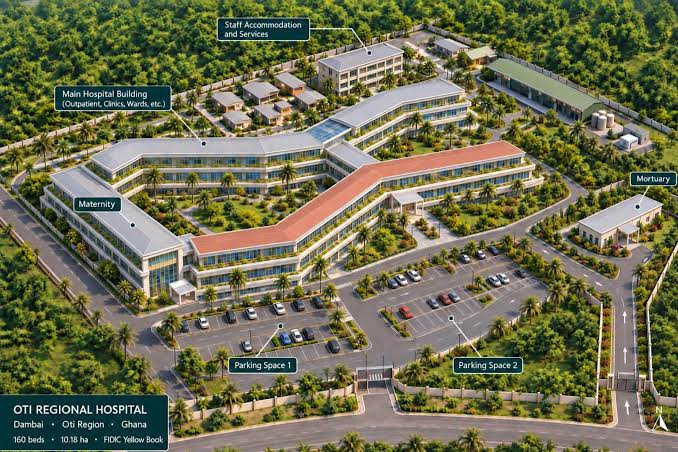
He maintained that government was simultaneously advancing work on peripheral health facilities, including health posts and accommodation for District Health Management teams, indicating that investment was continuing across multiple levels of the healthcare system rather than being concentrated solely on large regional facilities.
By highlighting this parallel investment in smaller-scale infrastructure, Goodman sought to counter the narrative that government’s healthcare spending decisions reflect a trade-off between regional and district-level facilities, presenting instead a picture of simultaneous, multi-tiered investment across the health sector.
Context: Agenda 111 And Ongoing Debate
The exchange reflects continuing political debate over the pace and prioritisation of healthcare infrastructure projects inherited from the previous administration’s Agenda 111 programme, which was launched to construct hospitals across multiple districts nationwide.
Critics, including Dr Okoe Boye, have pointed to stalled projects under the initiative as evidence that new infrastructure commitments should not take precedence over completing existing ones.
Government’s position, as articulated by Goodman, appears to rest on the argument that regional and district-level healthcare needs can be addressed concurrently, rather than requiring one category of infrastructure to be completed before the other is pursued.

As construction of the three new regional referral hospitals proceeds, attention is likely to remain on the pace of progress on outstanding Agenda 111 district hospital projects, which continue to serve as a point of political contention.
The extent to which government can demonstrate simultaneous progress on both fronts may shape ongoing public and opposition scrutiny of its healthcare infrastructure strategy going forward.
READ MORE: Ghana Hosts High-Level Talks on Protecting Education During Crises