
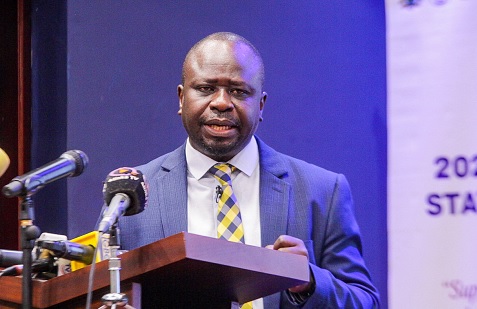
Prof. Samuel Kobina Annim, Director of the African Centre for Statistics at the UN Economic Commission for Africa (UNECA), has proposed five fixes to close the gap between data and policy in Africa. He presented them during the inaugural lecture of the Academic Policy Dialogue Series at the University of Cape Coast (UCC).
His proposals call for academic influence to move up to regional statistical bodies, research methods to be taught against policy needs, and data collection to start from policy rather than questionnaires. He also urged UCC to build an AI-powered data and policy observatory and asked the three communities in the room to recalibrate how they work together.
The prescriptions follow a run of warnings from the same lecture. Prof. Annim said a two-year health data lag fails Africa’s policymakers and that executive hijack of Ghana’s policymaking leaves research on shelves.
He also cautioned that a trust deficit is undermining Ghana’s data and policy systems, and the former census chief had earlier warned that Ghana’s population figures differ by 1.6 million.
Aim Higher Than National Statistics Offices
Prof. Annim described how far academic support for statistics has gone so far. “In my mind, the farthest that we’ve gone is to support the 54 national statistical systems. But let’s keep in mind that the 54 national statistical systems draw their mandates from these three regional bodies.”

He said the relationship needs a new target. “So if we really want to strengthen the relationship, then we need to move a notch higher than the national statistical system and begin to influence what happens at the regional level.”
The three regional bodies are the African Union Commission (STATAFRIC), the African Development Bank’s statistics department and UNECA’s African Centre for Statistics. For universities, that means engaging the institutions that set the mandates, not only the national offices that carry them out.
Teach Research Methods Against Policy Needs
Prof. Annim turned next to the classroom and the way economists are trained. “We teach our research methods by mapping descriptive research to different policy dimensions, diagnostic research to different policy dimensions, and causal research to different policy dimensions.“
Under this approach, every research design answers to a decision that a minister or agency director must make. Graduates would leave university able to ask the policy question before they choose a method.
Start With Policy, Not Questionnaires
The most technical of his five fixes concerns how data gets collected. Annim said he is pushing for a change of starting point. “One of the things that I am pushing for is a drift away from integrated modular questionnaire for data collection to theory of change based data collection”
He described the sequence he wants statistical work to follow: “So instead of starting with data analysis policy, now the conversation that I’m really pushing for is policy data analysis recommendations and then back to policy.”

He used the Sustainable Development Goals to show how this works in practice. “So you don’t start from SDG 1 and count them up to SDG 17. You start with SDG 3, SDG 2, and then think about how the nutrition wage hypothesis will take you to SDG 8 and then back to SDG 1.”
The shift puts the policy question at the front of the data cycle and lets a government collect what it needs to test a specific idea.
An AI-Powered Observatory for UCC
Prof. Annim also set a task for the School of Economics.
“One of the things that the School of Economics, I’m hoping, can do is not just to create a data repository, which was the thinking about 15 years ago, but to align with what we are doing at the Africa Center for Statistics.
“Create an observatory that gives us data from all different sources. Create an observatory that has policy documents, deploy AI tools that would help us understand the link between different data sets and different policy instruments”
Prof. Samuel Kobina Annim, Director of the African Centre for Statistics at the United Nations Economic Commission for Africa (UNECA)
The proposal moves the school from storing data to connecting it. Policymakers and researchers would gain one place to see how datasets relate to the policy instruments meant to act on them.
Recalibration and a Call From the Floor
Prof. Annim closed his presentation with a demand for change across the board. “The first thing we need to do is to adjust, don’t continue to do the things that we are doing. This requires recalibration.”

The question and answer session produced a practical request. A participant suggested that UNECA host African national statistics offices’ data on its website for easier access.
The Department of Data Science and Economic Policy says it will turn the discussion into a policy brief and communique for policymakers in Ghana and across Africa. Those documents will show which of Annim’s five fixes the academic and policy community chooses to pursue first.
READ ALSO: Bailey Warns AI Investment Could Trigger Financial Market Shocks