

Former Government Statistician Prof. Samuel Kobina Annim, now Director of the African Centre for Statistics at the United Nations Economic Commission for Africa (UNECA), has warned that the two-year lag in health data across Africa leaves governments on four-year mandates making decisions without current evidence.
He raised the concern at the inaugural edition of the Academic Policy Dialogue Series organised by the Department of Data Science and Economic Policy at the University of Cape Coast (UCC).
Delivering the lecture on the theme “Building Pan-African Statistical System: The Stakes for the Academic and Policy Community,” the UNECA statistics chief challenged academics to help close the gap through emerging data sources and new methods.
He argued that when lives are at stake, the pursuit of complete and perfectly representative data should not delay action.

Health Data Lag Frustrates Policymakers
Prof. Annim said the delay between data collection and publication weakens the value of official statistics for those who must act on them. He described the lag as a problem the academic community is well placed to solve.
“Now we live in a community where health data always has a two-year gap. To what extent would this be important for the policy world if we always have to work with a two-year gap? These are the gaps that we expect the academic community to fill”.
Prof. Samuel Kobina Annim, Director of the African Centre for Statistics at the United Nations Economic Commission for Africa (UNECA)
He also questioned how researchers handle time in their own work, noting that econometric studies routinely ignore what happened before their data begins. “Nobody is concerned about if your data started in 1980, how did interventions and outcomes between 1975 and 1979 influence your starting point in 1980,” he said.
Digitisation and Automation to Close the Data Gap
During the open forum, Dr. Avoko asked how resources, digitisation and automation could shorten the time it takes for data to reach policymakers.
Prof. Annim said resources, digitalisation and automation would remain central to the work of national statistics offices, and pointed to steps he took while heading the Ghana Statistical Service (GSS).
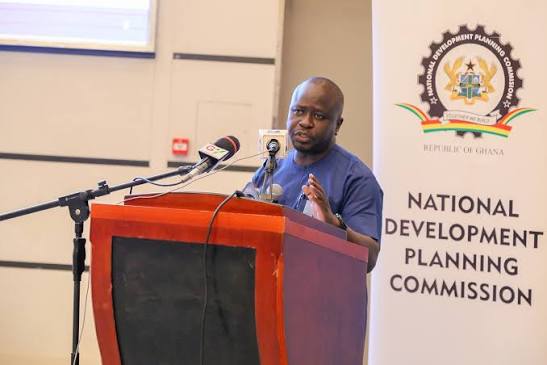
“When I was at GSS again, I introduced this concept of CAN, Change Automation and Novelty, and did a roadmap on data science to see how we can bridge some of the gaps. But always keep in mind that our goal is official statistics”.
Prof. Samuel Kobina Annim, Director of the African Centre for Statistics at the United Nations Economic Commission for Africa (UNECA)
His answer framed technology as a means of speeding up delivery without lowering the standards that give official figures their credibility.
Representativeness Versus Urgency in Policy Decisions
Mr. Oglo, another participant, pressed the point further. He asked whether governments with only four years in office should wait for large, representative datasets released years later or rely on smaller, faster ones.
The question echoed a point Prof. Annim made earlier in his lecture: that governments build their entire policy agenda around a four-year term in office. Prof. Annim drew a sharp line between what academic research demands and what governments need in a crisis.
“If you are interested in academic curiosity, then you want to find data that is complete, it has a long span, it has been quality assured from all levels so that you’ll be pushing the frontiers of knowledge.
“But again, if you want to know what policymakers are interested in, assuming there’s a displacement somewhere now and governments want an intervention, who cares about data representativeness? Who cares about data accuracy? The government needs an intervention to save lives”.
Prof. Samuel Kobina Annim, Director of the African Centre for Statistics at the United Nations Economic Commission for Africa (UNECA)
He added that numbers which fail to reflect everyday reality should not be used simply because they come from a complete dataset. Relatability, in his view, matters as much as statistical completeness when data is meant to guide real decisions.
Access and Public Trust in Ghana’s Data
Participants also raised barriers beyond timeliness. Diana Roberts, who joined online, said regional-level data remains difficult to obtain for academic research, and she urged that data be made accessible without delay.
Isaac Eshun, who did his national service at the GSS national accounts office, raised a problem at the point of collection. “There should be a public education regarding national data and statistics because when you go to the field, the data that the interviewers and the respondents gives are different,” he said.

Prof. Annim agreed that public education on statistics deserves more attention, noting that data can only be as good as what respondents are willing and able to give. Across his answers, one message held firm: speed and rigour need not compete.
For a government with four years to deliver, he suggested, universities and statistics offices must work together so that evidence arrives while decisions are still being made, not two years after the fact.
READ ALSO: Minerals Commission Unveils Real Time Equipment Tracking