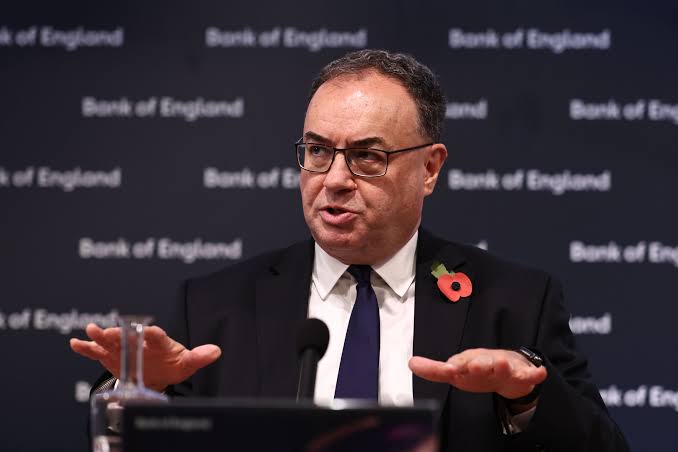
The Governor of the Bank of England, Andrew Bailey, has warned that the rapid flow of investment into artificial intelligence could trigger financial market shocks if the technology fails to deliver the returns investors currently expect.
Speaking in an interview, Bailey stated that the central bank is monitoring the huge sums being invested in AI “very carefully,” cautioning that the surge in valuations surrounding the sector could eventually lead to a correction in asset prices.
The AI investment boom has already pushed some technology companies to unprecedented market values. Nvidia, whose chips are central to the development and operation of many advanced AI systems, has become the world’s most valuable listed company, with a market valuation of about $5.5tn (£4.14tn).
The company’s rise has been closely linked to expectations that demand for AI computing infrastructure will continue to expand as businesses and governments increase their use of the technology.
At the same time, major technology companies including Alphabet, Meta, Microsoft and Amazon are committing hundreds of billions of dollars to AI development, infrastructure and related technologies.
The scale of that spending has raised questions about whether the industry can ultimately generate sufficient returns to justify the enormous capital being committed to it.
Two of the world’s largest AI companies, Anthropic and OpenAI, are also preparing potential stock-market listings, moves that could bring hundreds of billions of dollars in additional investment into the sector.
Bailey acknowledged that the scale of investment was understandable given AI’s potential to become a major source of economic growth but warned that financial markets can become vulnerable when expectations become concentrated around a small number of perceived winners.
“There is a large, very large, amount of investment going into this sector now, and of course that’s natural because it’s a major area of growth.
“And of course, you see that the asset prices of the companies that are developing it have gone up a lot and that reflects the fact that there are high expectations of what it can deliver.”
Andrew Bailey
The governor’s concern is not that investment in AI is necessarily misplaced. Instead, it centres on the possibility that markets may be pricing companies on the assumption that the technology’s economic benefits will be realised quickly and broadly.
“Everybody is currently priced to be a winner. Google was not the first market leader in internet search. It was Netscape. Nobody can remember Netscape today. It doesn’t exist. So not everybody always wins.”
Andrew Bailey
Moreover, Bailey noted the Bank of England is preparing for such possibilities and stressed the importance of ensuring that the wider financial system could withstand sudden shocks.
AI Expansion Brings New Economic and Security Risks
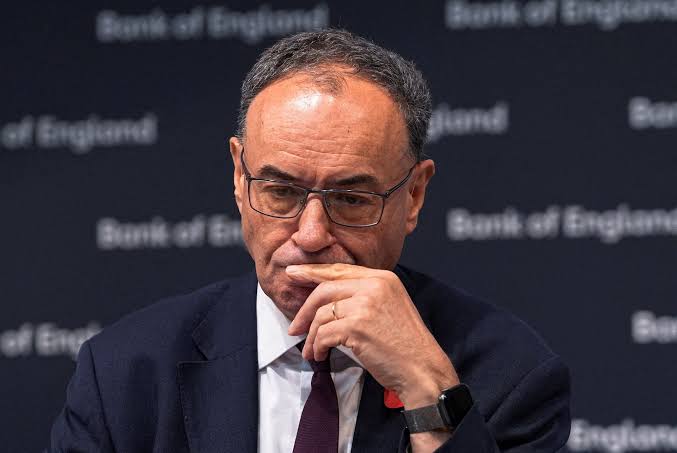
Alongside his warning, Bailey offered a more cautious view of AI’s potential economic contribution across the UK.
The Bank of England Governor stated that technology could significantly strengthen economic growth, an outcome he described as particularly important at a time when economies are seeking new sources of productivity.
Bailey indicated that he believes AI has “great potential to strengthen growth in our economies,” while emphasising that the benefits have to be considered alongside the risks.
However, he added that “it also brings with it substantial risks, and so we have to be on top of both of those.”
Within central banking itself, Bailey explained that AI could help policymakers process and analyse information used to support decisions on interest rates.
He pointed specifically to the Monetary Policy Committee (MPC), the Bank’s body responsible for setting UK interest rates.
A key potential benefit, he noted, is AI’s capacity for “speeding up the work that supports the Monetary Policy Committee [MPC]” which sets interest rates.
Bailey stressed, however, that AI would support rather than replace human decision-making.
“It’s not taking a decision, but it’s a tool in the hands of the policy maker, and that’s good,” he added.
Yet financial instability is only one of the risks Bailey identified.
The governor also warned that AI could strengthen cyber attacks by making it easier for malicious actors to identify weaknesses in computer systems and software.
He described AI as creating a “much more powerful way of uncovering vulnerabilities.”
“It’s revealing things that have been in bits of operating software that we’ve had, and all of us have had. In the wrong hands, it’s a very powerful, potentially very powerful, weapon.”
Andrew Bailey
Meanwhile, the same technologies that can help companies identify weaknesses and improve cybersecurity can potentially be used by attackers to discover and exploit those weaknesses.
READ ALSO: John Boadu Leads NPP Chairmanship Race Ahead of October 3 Elections