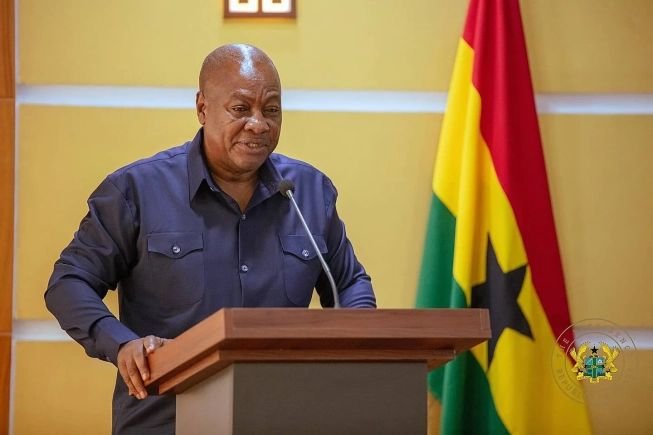
President John Dramani Mahama has referencd major strides in Ghana’s small-scale mining sector during the 2026 Mining in Motion Summit, crediting structural regulatory interventions like the Ghana Gold Board (GoldBod) for a surge in national gold export revenues.
Addressing industry leaders, international investors, and president Mahama emphasized that rigorous export oversight and policy realignments within artisanal and small-scale operations have successfully restored transparency, drastically curbed informal leakage, and delivered substantial economic capital back into the state coffers.
“In 2024, from the artisanal and small-scale mining sector, Ghana exported 64 tons of gold. In 2025, from the artisanal and small-scale sector, Ghana exported 104 tons of gold. This is from April to December, after the gold war was won in April.”
President John Dramani Mahama

Elaborating on these milestone developments, President Mahama highlighted the notable jump in physical gold volume exports and direct state earnings recorded between 2024 and 2025.
During the nine-month period from April to December 2025 following decisive administrative interventions the small-scale sector exported 104 tons of gold, up from the 64 tons exported during the entirety of 2024.
Concurrently, national revenues derived directly from small-scale gold export regulations experienced a remarkable leap to $10.8 million in 2025, reflecting an almost 100% surge compared to the $4.66 million brought into the country in 2024.
Furthermore, the President underscored a strategic operational pivot toward local empowerment, detailing the implementation of a comprehensive local content policy that actively transitions corporate mining entities from traditional owner-mining setups to sustainable contract-mining models.
Restructuring Small-Scale Mining and Formalizing Supply Chains
The imperative for these regulatory interventions stems from decades of unregulated artisanal operations, revenue capital flight, and systemic environmental degradation that previously undermined Ghana’s extractive potential.
Historically, the informal nature of artisanal and small-scale gold mining often termed galamsey led to massive unrecorded exports, severe loss of foreign exchange reserves, and unchecked ecological destruction
Unregistered middlemen exploited regulatory loopholes to syphon precious minerals across borders, depriving the central bank and municipal assemblies of crucial tax dividends and foreign exchange liquidity.

By establishing direct regulatory oversight and standardized export protocols under GoldBod, the government moved to address these systemic vulnerabilities.
Establishing an organized export mechanism ensures that legal, fully traceable channels exist for small-scale miners to sell their yields at fair market prices tied to official reference rates.
This formalization directly incentivizes miners to bypass illegal smuggling networks, channeling national mineral wealth through domestic financial frameworks to bolster foreign reserves and stabilize the macroeconomy.
Driving Localization and Contracting Equity in the Extractive Economy
Beyond export regulation, the policy shift from owner mining to contract mining addresses a long-standing structural deficit in national resource governance.
Historically, foreign-owned mining firms operated foreign-capitalized equipment and foreign technical teams, leaving local communities and indigenous firms with minimal participation in high-value mining supply chains.
The new framework mandates that corporate mining concessions outsource core operational activities directly to Ghanaian-owned contracting firms, ensuring retained domestic value.

This local content mandate acts as a catalyst for industrial capacity building and technology transfer across the country. Ghanaian heavy-equipment operators, engineering firms, and mineral logistics providers are now directly integrated into primary extraction processes.
By converting large multinational concessions into contract opportunities for indigenous contractors, the state fosters local capital accumulation, creates high-skilled jobs, and ensures that the wealth generated from subsoil minerals yields lasting domestic industrial infrastructure.
Future Horizons for Ghana’s Gold Governance
Looking ahead, the success touted at the 2026 Mining in Motion Summit marks a broader institutional turn toward sustainable, value-driven resource management.
Industry analysts note that maintaining this trajectory will require continuous enforcement of export compliance alongside expanded access to formal credit for small-scale miners.
As the formal sector expands its export footings and indigenous contractors assume larger roles in field production, the institutional framework laid out under GoldBod positions Ghana to maximize the long-term socio-economic returns of its mineral wealth.
READ ALSO: Downing Street Defends UK’s Role in Afghanistan War