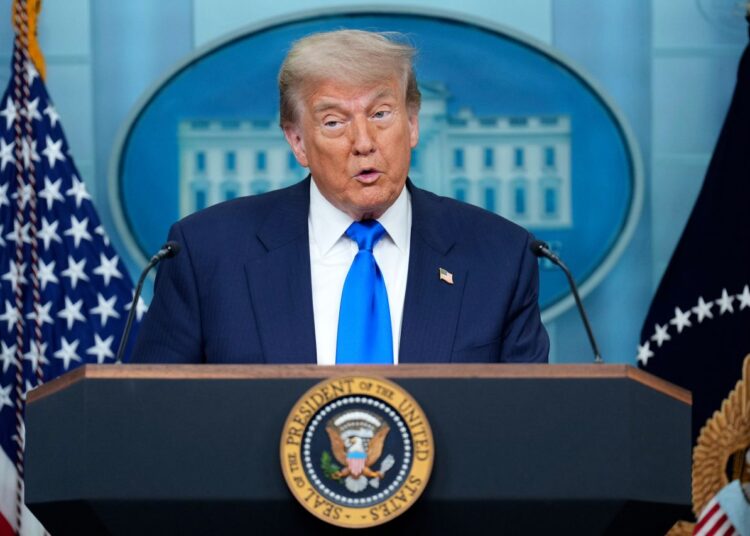
The White House has asserted that US President Donald Trump is promoting a nationwide investment drive spanning manufacturing, energy, agriculture, semiconductor production, shipbuilding and national security.
It said that the initiatives are bringing production back to the United States and creating jobs for American workers.
In a statement, the White House disclosed projects and funding commitments across 11 states, describing them as evidence of the administration’s America First economic agenda.

“President Donald J. Trump is delivering an America First surge of manufacturing, energy, agriculture, semiconductor, shipbuilding, and national security investments that are bringing production home, expanding domestic capacity, and locking in American jobs. These commitments build on the trillions in private investment the Trump Administration has secured since taking office — proving that when America puts itself first, results follow.”
White House
The White House described the initiatives as evidence of the “Trump Effect,” arguing that the administration’s policies are encouraging companies to invest domestically while strengthening economic and national security.
Manufacturing, Semiconductor Investments Target Domestic Production
Among the major projects highlighted is Audi’s planned $4.2 billion investment in its first US production site near Macon, Georgia. According to the White House, the facility is expected to create 4,500 jobs and have an annual production capacity of 200,000 vehicles.
The administration attributed the investment to Trump’s trade agenda, presenting the project as part of its effort to strengthen American automotive manufacturing.
In North Carolina, the White House highlighted plans to invest up to $1.5 billion in semiconductor production. It also pointed to Sibelco’s expansion of high-purity quartz and related materials production in Mitchell County, which the statement said would support the semiconductor supply chain.
Nebraska is another focus of the administration’s manufacturing push, with a reported $1.3 billion investment in domestic fertilizer production. The White House said TalusAg would open two facilities in the state to supply farmers with lower-cost, American-made fertilizer.
Meanwhile, Cleveland, Ohio, is set to host a new US Submarine Component Repair Center, a project the administration says will strengthen the country’s undersea naval industrial base.
In Maryland, the Navy and Anduril are reportedly investing $6.6 billion in Arsenal-2, described by the White House as a new software-defined shipyard in Baltimore and the largest new American shipbuilding initiative in generations.
Together, the projects reflect the administration’s emphasis on expanding domestic industrial capacity across automotive manufacturing, critical technology, agriculture and naval infrastructure.
Energy Security And Agricultural Support
The White House also highlighted measures aimed at increasing domestic energy production and supporting farmers facing higher fuel costs.
In Iowa, the Trump administration plans to release $150 million under the Defense Production Act to expand US refining capacity. The statement said the funding would boost domestic diesel and gasoline production, with the broader goals of strengthening energy security and lowering costs.
In Kansas, the administration is launching the Harvest Fuel Relief Program, which will provide farmers with up to $8 billion in support to offset elevated diesel costs during the current harvest season.
The initiative is intended to help protect agricultural producers from higher operating expenses while supporting the country’s food production sector.
Alaska also features in the investment programme. The White House said Taiwan is investing $4.4 billion in the state’s mega-gas project, while the Federal Communications Commission is providing an additional $162 million to expand high-speed internet access across Alaska.
The administration presented these initiatives as part of a wider effort to strengthen domestic energy capacity, improve infrastructure and support economic activity in communities across the country.
Healthcare And Defence Projects Expand Workforce, Military Capacity
Beyond industrial production, the White House cited investments in healthcare staffing and pharmaceutical manufacturing.
In a nationwide initiative announced under the Florida section of its statement, the administration said it was investing $275 million to recruit, hire and retain at least 5,000 nurses in elder care facilities. The programme is intended to expand the workforce serving older Americans.
In Kentucky, the Department of War is advancing an $80 million investment with pharmaceutical company Antheia at a facility in Winchester. According to the White House, the project is intended to revitalise pharmaceutical manufacturing and restore critical drug production to the United States.
Montana is also included in the administration’s national security plans. The Department of War is establishing a new super range to test advanced weapons and technologies, including autonomous weapons, space and electronic warfare capabilities, supersonic systems and hypersonic technologies.
The White House said that the facility would help maintain American military superiority by supporting the testing of advanced defence capabilities.
These initiatives demonstrate the range of sectors covered by the administration’s investment agenda, from healthcare and medicines to military research and advanced weapons testing.
The White House stated that the projects would continue to bring jobs and production home, support American workers and farmers, strengthen energy and national security, and expand the skilled workforce.
However, the statement presents the projects and their anticipated benefits from the administration’s perspective. It does not provide a consolidated timeline for their completion or independent assessments of their projected economic impact.
The administration pledged to continue pursuing investments aimed at rebuilding American industry and advancing its America First agenda.
READ ALSO: Lula Vows To Defend Democracy After Historic Election Comeback