B5 Plus Limited is expanding its manufacturing operations in Ghana, with plans to establish a tanker and trailer production facility expected to manufacture 300 units and be inaugurated in the first quarter of 2027 under the 24-Hour Economy and Accelerated Export Development Programme.
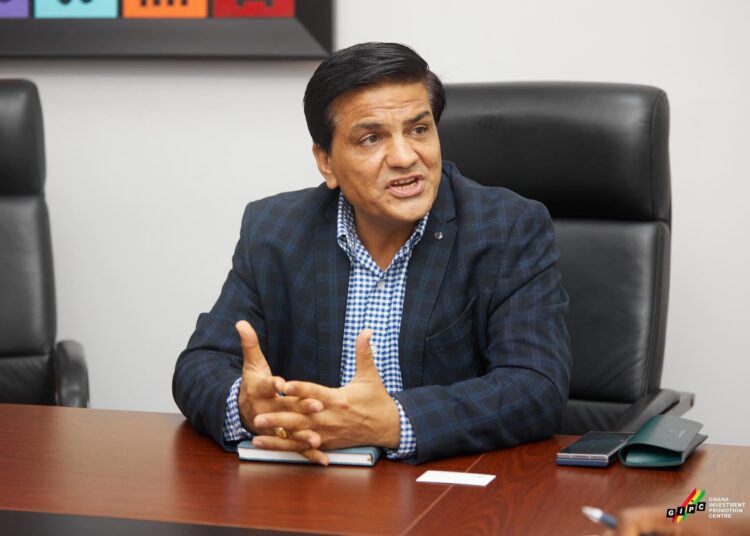
The company’s Chief Executive Officer, Mr. Mukesh V. Thakwani, announced the planned expansion while speaking at the International Federation of Procurement and Supply Management (IFPSM) World Summit 2026 in Akosombo.
The announcement comes as Ghana seeks to strengthen local production, improve industrial competitiveness and reduce dependence on imported manufactured goods.
The government’s 24-Hour Economy programme is designed to increase productivity through multiple-shift operations, strengthen domestic value chains and promote export-oriented industries.
“Under his vision of 24-Hour Economy, we are building up our tankers and trailer facility, which will be producing 300 tankers and trailers, which will be inaugurated in the first quarter of 2027.”
Chief Executive Officer, Mr. Mukesh V. Thakwani
Its implementation framework also emphasises coordination between public institutions and private businesses.
Tanker Facility Targets Local Manufacturing
The proposed tanker and trailer facility represents a planned addition to Ghana’s industrial manufacturing capacity, particularly in equipment used for transportation and logistics.
If delivered as announced, the project could strengthen local access to specialised transport equipment while creating opportunities for employment, technical skills development and business partnerships across the manufacturing value chain.
Tankers and trailers support the movement of industrial materials, agricultural commodities, fuel and other goods across domestic and regional markets.
Local production can potentially reduce reliance on imported finished equipment, although the extent of import substitution will depend on production costs, component sourcing, quality standards and the competitiveness of locally manufactured units.
The planned capacity of 300 tankers and trailers is a key target announced by the company.
However, further details on the facility’s investment value, production schedule, employment projections and anticipated local content have not been established in the information available for this report.
For Ghana’s industrial sector, the project also highlights the relationship between manufacturing and logistics.
Expanding production requires access to raw materials, machinery, reliable transport networks and customers capable of purchasing locally manufactured equipment.
The government’s 2026 Budget identifies the 24-Hour Economy as a production-led programme intended to accelerate industrialisation, expand exports and strengthen integrated value chains.
The budget sets an ambition of creating more than 1.7 million decent jobs by 2028 across agriculture, manufacturing, logistics and services. This is a programme target, not a measure of jobs already created.
Solar Investment Supports Industrial Operations
Beyond the proposed tanker and trailer facility, Thakwani highlighted B5 Plus Limited’s investment in renewable energy, describing a 25-megawatt solar installation at the company as operational.
“Our solar plant, 25 megawatt, as it is already installed and operating right here in Ghana.”
Chief Executive Officer, Mr. Mukesh V. Thakwani
The company’s reported solar capacity points to the role industrial businesses can play in expanding renewable energy use, particularly where electricity availability and operating costs influence production decisions.
However, the claim that the installation is the largest in Ghana, West Africa and Africa requires independent verification and should not be treated as an established continental ranking without comparative capacity data.
Ghana’s energy statistics underline the importance of diversifying electricity generation.
The Energy Commission’s 2024 Energy Outlook projected that thermal power would account for 64.4 per cent of electricity generation that year, hydropower 34.9 per cent and other renewables, including solar photovoltaic and biogas, 0.7 per cent.
These figures are projections published in the outlook rather than a final audited breakdown of actual generation.
Mr. Thakwani also connected industrial investment to the principle of sustainability, arguing that businesses must consider their long-term economic and environmental responsibilities alongside immediate commercial returns.
“A business becomes truly sustainable when it creates value not only for today’s shareholders and customers but also for tomorrow’s generation.”
Chief Executive Officer, Mr. Mukesh V. Thakwani
The statement places energy investment within a broader discussion of industrial resilience.
For manufacturing companies, sustainability increasingly involves balancing production growth with resource efficiency, responsible investment and long term operational planning.
Public Private Partnerships Key to Growth
Mr. Thakwani emphasised that manufacturing expansion requires more than investment by individual companies.
He identified reliable energy, efficient ports, good roads, access to finance, skilled labour and consistent industrial policies as important conditions for sustainable industrial development.
The government’s 24-Hour Economy and Accelerated Export Development Programme seeks to address these interconnected issues by encouraging production, improving supply-chain efficiency and supporting businesses that contribute to local value addition.
President John Dramani Mahama assented to the 24-Hour Economy Authority Bill on February 19, 2026, establishing a statutory body to coordinate implementation of the initiative.
Mr. Thakwani ended his remarks with a call for stronger cooperation between government and industry, stressing the importance of policies that encourage responsible investment and improve the movement of goods across African borders.
READ ALSO:Kobbie Mainoo Returns to Training Ahead of Chelsea Clash