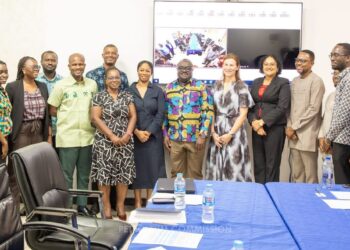

Tema Oil Refinery (TOR) is exploring a renewed collaboration with the Kwame Nkrumah University of Science and Technology (KNUST), in a move that could connect academic research more directly to the technical challenges facing Ghana’s state-owned refinery.
The proposed partnership, discussed during a KNUST delegation’s visit to TOR , centres on using the university’s research expertise, engineering talent and student projects to develop practical responses to problems identified by the refinery.
At its core, the engagement raises an important question for Ghana’s industrial development: can the country turn its universities into more active problem-solvers for the industries expected to drive economic transformation?
For TOR, the potential value lies in directing research towards operational and technical needs rather than allowing academic work and industrial practice to develop in isolation.
For KNUST, the opportunity is to give students and researchers access to real-world engineering challenges, where theoretical knowledge can be tested against the demands of industrial operations.
The proposal, however, remains at an exploratory stage. TOR has welcomed the presentation and asked KNUST to submit a formal proposal for consideration before the parties discuss the next steps. No final agreement, funding commitment or implementation timetable was announced.
From Academic Research To Industrial Solutions
The proposed collaboration is built around a straightforward idea: some of the technical problems confronting industry could become research questions for universities.
According to the announcement on the meeting, the parties discussed how selected technical challenges at TOR could be developed into research topics for undergraduate and postgraduate students.

The intention is to encourage students to investigate practical problems and develop solutions that could be relevant to the refinery’s operations.
The announcement describes the objective as developing “practical ideas or technologies” to address the refinery’s technical challenges.
That phrase captures the central promise of the proposed arrangement. Research would not be treated solely as an academic exercise; it could also become a means of identifying solutions to problems that matter to an industrial facility.
The distinction is important for an economy seeking to strengthen domestic manufacturing and industrial capacity. Universities produce graduates and research, while companies possess operational experience and confront practical constraints.
When these two sets of capabilities are connected effectively, research can help businesses investigate problems, test possible solutions and improve technical processes.
But the benefits are not automatic. Research projects must be based on clearly defined problems, access to relevant information, realistic objectives and an assessment of whether proposed solutions can be applied commercially or operationally.
For TOR and KNUST, the next step will therefore be to translate the broad proposal into a workable framework identifying the refinery’s priorities, the research questions students could address and the expertise required to supervise the work.
Giving Student Projects An Industrial Purpose
One of the proposal’s notable features is its emphasis on student research.
The meeting announcement states that “selected needs at TOR could also be explored as research topics for undergraduate and postgraduate students.”
This approach could provide students with opportunities to work on problems beyond hypothetical classroom examples.

Rather than studying engineering concepts without direct exposure to their industrial application, participating students could investigate challenges identified by refinery personnel and explore possible responses under academic and industry supervision.
For KNUST, such projects could strengthen the connection between engineering education and the requirements of Ghana’s industrial sector.
Students would have an opportunity to understand how technical decisions are shaped by operational conditions, equipment requirements, safety considerations and the practical limitations of industrial facilities.
For TOR, student research could provide additional avenues for investigating selected problems, particularly where a clearly defined research question can be matched with appropriate academic expertise.
The proposal does not establish that student projects will necessarily produce technologies ready for commercial deployment. Their value would depend on the quality of the research, the relevance of the problems selected and the refinery’s ability to evaluate the findings.
Nevertheless, a structured arrangement could create a pathway through which promising academic work is assessed for possible practical application.
The critical issue is whether the proposed collaboration will move beyond identifying research topics to establishing a process for selecting projects, supervising students, evaluating results and determining whether successful findings can be implemented.
Refinery Experience Meets Engineering Education
The proposed relationship also includes opportunities for TOR engineers to participate in seminars and workshops at KNUST, where they would share their practical experience with engineering students.
This would create a two-way exchange. Students could learn from professionals working in an industrial environment, while refinery engineers could contribute practical perspectives to academic discussions and help connect engineering concepts to workplace realities.

The announcement identifies “seminars and workshops at KNUST” as part of the proposed engagement, with TOR engineers sharing their experience with students.
Such interaction could help students understand the gap that sometimes exists between knowing how an engineering process should work in theory and managing the conditions under which it operates in practice.
Industrial experience can expose students to the complexity of maintenance, equipment performance, operational planning and technical decision-making. It can also help them appreciate how safety, reliability, cost and efficiency influence engineering choices.
For TOR, participation in university programmes could provide a channel for engaging with emerging engineering talent and contributing to the development of skills relevant to the petroleum-refining industry.
However, the extent of that benefit would depend on the frequency and substance of the engagements. Occasional presentations may raise awareness, but sustained interaction involving technical case studies, research supervision and feedback on student work would provide a stronger foundation for long-term collaboration.
Internships Could Bridge The Skills Gap
The proposal also envisages opportunities for KNUST students to visit the refinery and potentially secure internships, giving them direct exposure to industrial operations.
The announcement identifies “firsthand exposure” as one of the intended benefits of student visits and internship opportunities.
For students, this could help bridge the gap between academic preparation and professional experience.
Exposure to a refinery environment can help them understand how technical knowledge is used within a complex industrial operation and what employers expect from engineering graduates.
For the refinery, internships could offer an opportunity to engage with students before they enter the labour market, while giving participants a clearer understanding of the technical and professional demands of the sector.
But internships would need to be structured around defined learning objectives, appropriate supervision and the refinery’s operational and safety requirements.
A visit can introduce students to an industrial facility; a properly designed placement can provide a more sustained learning experience.

The distinction matters if the collaboration is intended to build skills rather than simply create opportunities for occasional exposure.
A formal arrangement could clarify how students would be selected, the departments or technical areas in which they might be placed, the responsibilities of supervisors and the criteria used to assess the experience.
These details have not yet been announced and would need to be addressed as the proposal develops.
The Formal Proposal Is The Real Test
TOR has welcomed KNUST’s presentation and indicated that the university should submit a formal proposal for consideration. Discussions on the next steps are expected to follow that submission.
That process will determine whether the initial discussions become an operational partnership with measurable objectives.
A credible framework would need to identify the refinery’s priority technical challenges, match them with relevant university departments and establish how research findings would be assessed.

It would also need to clarify the responsibilities of both institutions, the resources required and the arrangements for student access and supervision.
The absence of announced funding or implementation details does not mean the proposed collaboration lacks potential. It does mean that the practical value of the initiative cannot yet be measured.
The immediate task is to move from a general expression of interest to a defined programme of work.
If the parties can establish clear research priorities and maintain regular engagement, the collaboration could create a channel through which university expertise contributes to industrial problem-solving while students gain relevant experience.
If it remains limited to meetings, presentations and occasional visits, its effect on refinery operations and skills development may be more modest.
Turning Collaboration Into Capability
The proposed TOR–KNUST engagement reflects a wider opportunity for Ghana: using existing academic and industrial capabilities more deliberately to support national development.
For a refinery, research collaboration can provide another route to examining technical challenges. For a university, it can make research and training more responsive to the needs of industry. For students, it can provide a bridge between academic knowledge and the workplace.

The broader lesson is that partnerships should be judged not only by the institutions involved or the intentions expressed at their launch, but by what they deliver.
For TOR and KNUST, that means identifying practical research questions, developing meaningful student projects, creating useful exchanges between engineers and academics, and establishing internship arrangements that provide genuine learning opportunities.
The formal proposal will be an important first step. The more demanding test will come afterwards: whether the two institutions can turn their discussions into a sustained relationship that produces useful research, strengthens engineering skills and helps address real industrial challenges.
Ultimately, the promise of the collaboration lies in connecting knowledge to application. If the proposal is developed into a clear and workable programme, the relationship could help bring the university closer to the refinery floor—and give academic research a more direct role in solving Ghana’s industrial problems.
READ ALSO: B5 Plus Expands Manufacturing Under 24-Hour Economy