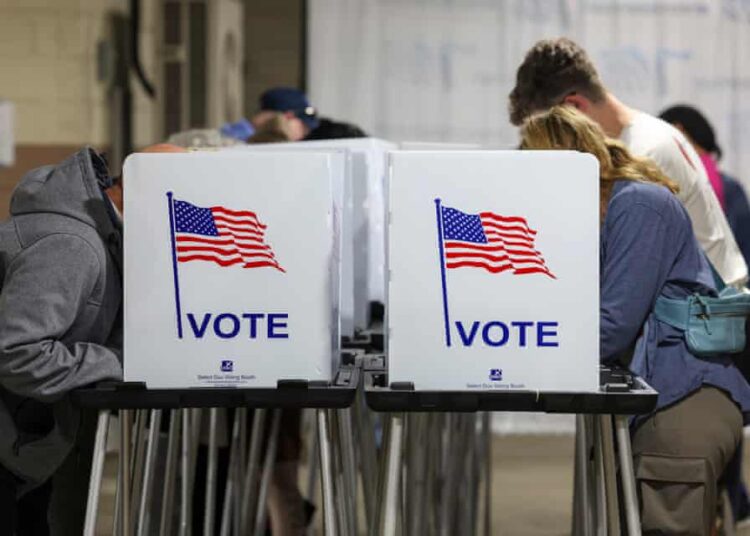
Americans are heading to the polls on today, November 3, 2026, for midterm elections that could reshape the balance of power in Congress and determine how much political room President Donald Trump has to pursue his agenda during the remainder of his second term.
More than 54 million Americans have already cast their ballots through early voting, surpassing the 45.9 million recorded in the 2022 midterm elections.
Control of both chambers of Congress is at stake, with Republicans currently holding majorities in the Senate and House of Representatives. Democrats are seeking to regain control of both chambers, hoping to use growing dissatisfaction with the administration to strengthen their position in Washington.

The campaign has been dominated by Trump, who has staged dozens of rallies across the country in support of Republican candidates. He has repeatedly urged his Make America Great Again (MAGA) supporters to turn out for the party, encouraging them to vote as though his name were on the ballot.
Midterm elections have historically presented challenges for the party occupying the White House, which typically loses congressional seats. Democrats are hoping that trend, combined with declining approval ratings for Trump, will translate into a significant electoral gain.
A Democratic victory in either chamber would give the party greater influence over legislation, congressional investigations and oversight of the administration. Securing both chambers would further strengthen its ability to challenge Trump’s policy priorities.
Trump’s Policies Dominate Campaign Debate
Democrats have made the US President a central focus of their campaign, arguing that the election offers voters an opportunity to place limits on his administration.
They have criticised his immigration crackdown, which has involved mass arrests and deportations, his decision to launch military action against Iran, tariffs on foreign imports and major construction projects, including a proposed White House ballroom.

The party has also sought to highlight what it describes as corruption involving Trump and members of his family, while placing affordability and the rising cost of living at the centre of its appeal to voters.
Trump, meanwhile, has remained actively involved in the campaign, travelling across the country to rally support for Republican candidates despite opinion polls cited in the campaign placing his approval ratings between 33 and 37 per cent.
The US President had made reducing living costs a major promise during his 2024 presidential campaign. However, rising prices have remained a concern for voters and have become a significant point of contention between the two parties.
The conflict with Iran has added another dimension to the economic debate. The war, launched by the United States and Israel last February, has contributed to higher global oil prices, increasing costs for American motorists at petrol stations.
Higher diesel prices have also placed additional pressure on supply chains and farmers, further intensifying concerns about the cost of goods and household expenses.
Democrats Target Republican Senate Seats
Opinion surveys ahead of the election have suggested that Democrats are well-positioned to make gains in the House of Representatives. Regaining control of the Senate, however, presents a more difficult challenge.
The party has targeted several Republican-held Senate seats, including those in Ohio, Texas and Maine, as it seeks to overcome the Republican majority.
The final days of the campaign have also exposed divisions within Democratic ranks, particularly in Michigan, where Democratic Congresswoman Haley Stevens endorsed Republican Senate candidate Mike Rogers on Sunday.
Stevens had lost the Democratic Senate primary to Abdul El-Sayed, who is now competing against Rogers for the seat.
Her endorsement attracted criticism from fellow Democrats and followed a dispute with the El-Sayed campaign over an advertisement by an outside group. The advertisement had linked the rising cost of living to US support for Israel, contributing to tensions between the campaigns.
The development added an unexpected complication to Democratic efforts to consolidate support in a state regarded as important to the party’s broader Senate ambitions.
Election Integrity Concerns Cast Shadow
Beyond the contest for congressional control, the elections are taking place amid uncertainty over whether Trump would accept the results if Republicans lose their majorities.
The US Justice Department plans to deploy a record 1,000 election monitors to polling stations across the country, a move that has attracted criticism from opponents who describe it as a potential form of voter intimidation.
The controversy has added to wider concerns about the administration’s involvement in the electoral process and the possibility of disputes over the outcome.
For Democrats, the elections represent an opportunity to regain congressional influence and strengthen oversight of the Trump administration. For Republicans, retaining control of both chambers would allow Trump to continue pursuing his legislative and policy priorities with congressional backing.
The results will therefore have implications beyond the immediate allocation of Senate and House seats, shaping the political environment in which Trump governs during the remainder of his presidency.
READ ALSO: US, Iran Trade Attacks Over Strait Of Hormuz