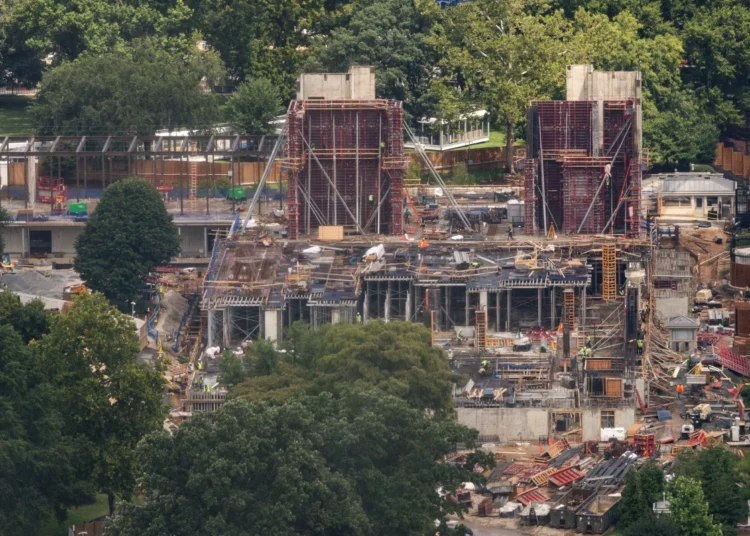
The Trump administration has asked the U.S. Supreme Court to allow construction of a planned $400 million ballroom at the White House to continue while it appeals a lower court ruling that halted above-ground work on the project.
Solicitor General D. John Sauer filed the request, seeking to suspend the decision by a three-judge panel of the U.S. Court of Appeals for the District of Columbia Circuit. The appeals court ruled last week that President Donald Trump could not proceed with construction without authorization from Congress.
The administration has asked the Supreme Court to act before the appeals court’s decision takes effect on August 21. The dispute centers on Trump’s plans to build a 90,000-square-foot ballroom on the site of the White House’s former East Wing, which was demolished last year to make way for the project.
In its filing, the administration argued that stopping construction would interfere with a broader security project at the White House. Sauer described the court’s order as an “extraordinary and unlawful injunction” that would halt construction of what he called an integrated military complex that includes “a totally secure ballroom space.”
The administration maintains that the proposed facility is necessary to improve the security and operational capacity of the White House. It has argued that the project incorporates measures designed to protect the President, his family and staff from potential threats.
The legal challenge, however, has focused primarily on whether Trump has the authority to undertake such a major alteration to the White House without congressional approval. The D.C. Circuit ruled by a 2-1 majority that the President does not have unilateral authority to proceed with the ballroom during the ongoing legal proceedings. The two judges in the majority wrote, “Whether or not a massive ballroom should be constructed is for Congress to decide and is not a matter for Executive self-help.”
The ruling upheld an earlier decision by U.S. District Judge Richard Leon, who ordered a halt to above-ground construction in April. Leon, a Republican appointee, nevertheless allowed work below ground to continue, including construction connected to bunkers, military installations and other national security facilities.
The appeals court’s decision followed a lawsuit brought by the National Trust for Historic Preservation, which argues that the project requires congressional authorization and raises concerns about changes to the historic White House complex. The administration has challenged the group’s legal standing, arguing that the preservation organization does not have the right to bring the case.
Trump officials have also maintained that the President has broad authority to renovate and modify the White House without approval from Congress. Judge Neomi Rao, the Trump-appointed member of the appeals court panel who dissented from last week’s decision, agreed with the administration’s position on standing.
She argued that the preservation group had not demonstrated a sufficient legal basis to challenge the project and said the lower court had placed too much weight on aesthetic concerns compared with the government’s security interests. “The district court elevated the aesthetic displeasure of a single passerby over the government’s security interests in the ballroom,” Rao wrote.
Administration Argues Ballroom Construction Already Advanced
The Justice Department has also sought to portray the construction halt as potentially disruptive because work on the project is already well advanced. The administration says construction has been under way for about 10 months and is approximately 65% complete.
Sauer argued that the project is already an active construction site and that forcing work to stop could create additional security and logistical complications. “Given those developments, the injunction promises chaos in service of nothing,” Sauer wrote in the Supreme Court filing.
During an appeals court hearing in June, Justice Department lawyer Yaakov Roth defended the administration’s broad interpretation of presidential authority over major public facilities. In response to a hypothetical question, Roth argued that even significant changes to landmarks such as the Statue of Liberty or the White House would not necessarily give certain individuals legal standing to challenge the government’s actions.
The preservationists, meanwhile, contend that the issue is not simply whether the ballroom is desirable but whether the executive branch can undertake such a major project without authorization from Congress.The administration’s Supreme Court request comes as the legal dispute continues while construction remains subject to the lower courts’ orders. The appeals court has temporarily delayed the effect of its ruling to give the administration time to seek relief from the Supreme Court.
The high court must now decide whether to allow construction to proceed while the broader legal challenge continues. Its decision could determine whether the Trump administration can continue work on the ballroom in the short term, even as the underlying dispute over presidential authority and congressional approval remains unresolved.
READ ALSO: North Korea Warns Of New Deterrent Over US-South Korea Drills