The Bank of Ghana (BoG) and the Chartered Institute of Bankers (CIB) Ghana have intensified efforts to strengthen the country’s banking sector through greater collaboration, stronger ethical standards and enhanced professional development.
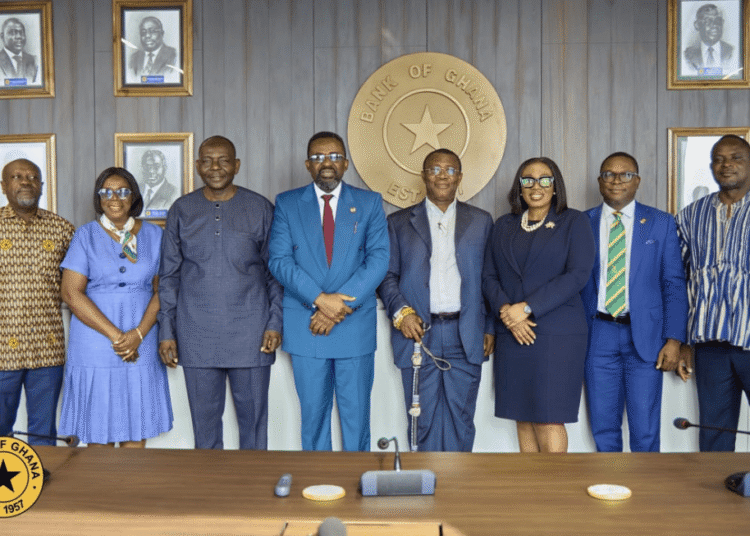
The renewed commitment emerged when the Governing Council of CIB Ghana paid a courtesy call on the Governor of the Bank of Ghana, Dr Johnson Pandit Asiama, at the Bank Square in Accra.
The engagement comes at a time when Ghana’s financial sector continues to face evolving risks linked to fraud, cybersecurity, technological disruption and changing customer expectations. The two institutions therefore believe stronger cooperation is critical to maintaining confidence and ensuring that banking professionals are adequately prepared for emerging challenges.
Fresh Push for Ethics and Professionalism
Discussions between the BoG and CIB Ghana placed strong emphasis on ethics and professionalism, which the institutions identified as critical pillars for a resilient financial sector.
Both sides underscored the importance of maintaining high professional standards among banking practitioners while strengthening the systems designed to protect customers and financial institutions.
The discussions also covered customer protection, cybersecurity and fraud prevention, areas that have become increasingly important as financial services become more digital.
The institutions agreed that closer collaboration would help address emerging risks while strengthening the human capital needed to sustain public confidence in Ghana’s banking industry.
The renewed focus on ethics also reflects growing recognition that regulatory reforms alone cannot guarantee stability if professionals within the sector fail to uphold integrity and accountability.
Fraud Fight Takes Centre Stage
Fraud prevention emerged as another major area of cooperation between the two institutions.
The Governor commended CIB Ghana for supporting efforts by the BoG, the Ghana Association of Banks (GAB) and other stakeholders to combat fraud and emerging threats to the financial sector.
As banking services increasingly move online, financial institutions face growing risks involving cybercrime, identity theft, digital fraud and other sophisticated forms of financial misconduct.
CIB Ghana has already introduced industry-wide ethics certification and fraud awareness campaigns as part of its efforts to strengthen professional conduct.
The Institute also briefed Dr Asiama on initiatives aimed at equipping banking professionals with the skills required to respond effectively to emerging challenges.
These include the Branch CEO Programme, the Chartered Banker for Executive Leadership (CBEL) Programme, research activities and other capacity-building initiatives.
Technology Set to Reshape Banking
Technology was also a major feature of the discussions, with both institutions examining how emerging innovations could transform Ghana’s financial services industry.
Particular attention was given to artificial intelligence (AI) and quantum computing and their potential impact on the future of banking.
AI is already transforming financial services globally through applications in customer service, fraud detection, credit assessment and data analysis. Quantum computing, although still developing, could eventually introduce new possibilities and risks for financial institutions.
The BoG and CIB Ghana therefore recognise the need for banking professionals to acquire the knowledge required to understand and manage these emerging technologies.
The discussions also touched on digital assets and ongoing banking sector reforms, highlighting the changing nature of financial services and the need for Ghana’s banking industry to remain responsive.
CIB Ghana Unveils Leadership Priorities
The courtesy call also provided CIB Ghana with an opportunity to formally introduce its new leadership to the Governor.
Dr Ellen Ohene-Afoakwa, the incoming President of CIB Ghana, said the new leadership would place renewed emphasis on ethics and professionalism as part of efforts to strengthen the banking profession.
She also outlined plans to rebuild the Bankers’ House and host the World Conference of Banking Institutes (WCBI) in Accra in 2028.
According to her, the international conference will provide Ghana with an opportunity to showcase its banking sector and professional education ecosystem to the world.
She said the event would further demonstrate Africa’s contribution to global banking development while highlighting how technology and innovation are redefining the future of financial services.
BoG Challenges CIB Ghana
Dr Asiama, for his part, stressed that banking professionals, like practitioners in other critical sectors, are expected to demonstrate competence, professionalism and ethical conduct in the discharge of their responsibilities.
The Governor also challenged CIB Ghana to expand its ethics and capacity-building programmes beyond conventional banking institutions.
He specifically called for greater attention to community banking and the wider financial ecosystem as Ghana implements reforms aimed at improving access to financial services.
Dr Asiama also outlined the Bank’s efforts to strengthen verification processes within the banking sector and ensure the successful implementation of community banking reforms.
The call signals a broader expectation that professional standards should extend across the financial system rather than remain concentrated among major commercial banks.
A New Chapter for Ghana’s Banking Industry
The renewed partnership between the BoG and CIB Ghana could have significant implications for the future of Ghana’s financial sector.
With fraud becoming more sophisticated, technology reshaping banking and customer expectations changing rapidly, financial institutions require professionals who can combine technical competence with strong ethical standards.
The collaboration also reinforces the importance of continuous training and professional development as Ghana seeks to build a banking industry capable of responding to emerging threats.
As the BoG continues its regulatory reforms and CIB Ghana expands its professional programmes, the two institutions are positioning ethics, innovation and human capital at the centre of efforts to create a more resilient and trusted banking sector.
The planned 2028 World Conference of Banking Institutes could further elevate Ghana’s profile as a hub for banking education, professional development and financial sector innovation in Africa.
READ ALSO: Mahama Unveils $10bn New Economic Era After Stabilisation Gains