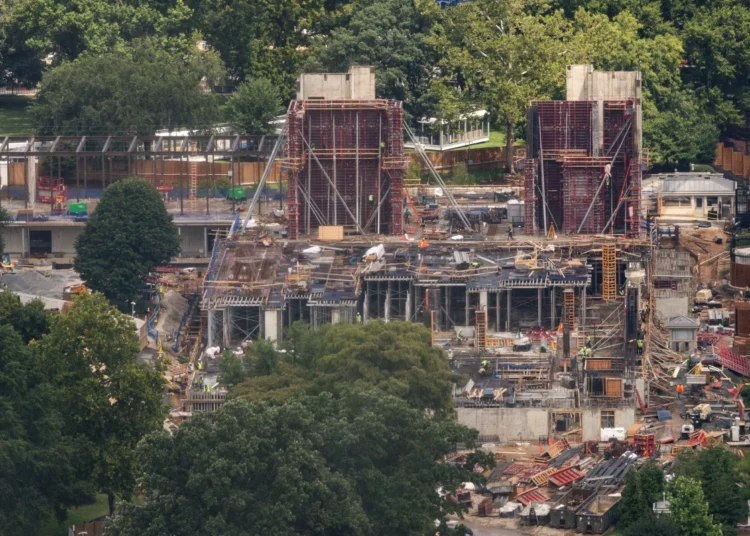
A U.S. federal appeals court has ordered the Trump administration to halt above-ground construction of its proposed $400 million White House ballroom, ruling that the project cannot proceed without congressional authorization despite the President’s insistence that it is being financed with private donations.
In a 2-1 decision, a three-judge panel of the U.S. Court of Appeals for the District of Columbia Circuit sided with historic preservation advocates who challenged the project, concluding that President Donald Trump lacks unilateral authority to build the massive ballroom on the White House grounds without approval from Congress.
The appeals court panel consisted of Judges Patricia Millett, Neomi Rao and Bradley Garcia. Millett and Garcia formed the majority, while Rao dissented.
The ruling temporarily blocks construction of the planned 90,000-square-foot (8,400-square-meter) ballroom, which is being built on the site of the former East Wing after its demolition last year. However, the appeals court stayed its decision for 14 days to allow the administration time to seek emergency relief from the U.S. Supreme Court.
In its opinion, the court emphasized that the dispute was not about the merits of the proposed ballroom but about constitutional authority over federal construction projects. “Whether or not a massive ballroom should be constructed is for Congress to decide and is not a matter for Executive self-help,” the judges wrote.
“This holding has nothing at all to do with whether the proposed ballroom is desirable, or not, as a matter of policy. This ruling does not even necessarily mean that the Defendants may not ultimately construct the ballroom.
“What it does mean is that the Defendants may not do so during the district court’s expeditious litigation without securing Congress’s authorization, as the Constitution and laws require.”
Judges
The lawsuit was brought by the National Trust for Historic Preservation, which filed the case in December 2025, shortly after the East Wing was demolished to make way for the ballroom. The nonprofit organization argued that only Congress has the legal authority to approve such a significant alteration to the White House, regardless of how the project is funded.
Following today’s ruling, the organization’s President and Chief Executive Officer, Brent Leggs, welcomed the decision. “From the beginning, our position has been clear and consistent: the law states that only Congress can authorize the construction of a ballroom at the White House,” Leggs said.
“We are pleased with the DC Circuit Court’s decision to uphold the District Court’s preliminary injunction, which although stayed for 14 days will block any above-ground ballroom construction unless and until Congress takes action.”
Brent Leggs
The group also said the ruling reaffirmed “the American people’s right to voice their opinions about the historic places they cherish,” including the White House.
Trump Administration Cites Security Needs
The administration has defended the project by arguing that it includes critical national security improvements alongside the ballroom itself. Government lawyers told the court that the wider construction plan incorporates upgraded security infrastructure designed to protect the White House against modern threats, including drones, ballistic missiles and biological hazards. “These upgrades, alterations, and improvements are essential to protecting the President, his family, and his staff, as well as the White House itself, and the entire project flows from them,” Government Attorneys wrote in court filings.
Attorneys representing the preservation group disputed that argument, maintaining that while underground security facilities may be necessary, the absence of a White House ballroom does not constitute a national security emergency. The appeals court largely agreed with that distinction, allowing lower court orders that permit underground construction—including bunkers, medical facilities and other security infrastructure—to continue while blocking work on the ballroom itself.
Trump has repeatedly argued that congressional approval is unnecessary because taxpayer money is not being used for the project. The U.S President has said he secured hundreds of millions of dollars in private donations from corporations, wealthy supporters and his own personal contributions to finance the estimated $400 million development. “He’s saying I need congressional approval and he’s so wrong,” Trump said in March following an earlier ruling by U.S. District Judge Richard Leon, adding, “This is being financed privately.”
Judge Leon had previously ruled that above-ground construction could not continue without congressional approval but permitted work on underground security facilities to proceed. Friday’s appellate decision upheld that approach.
The latest ruling comes during a week in which the administration’s construction ambitions have faced renewed scrutiny. Earlier, a National Park Service assessment found that Trump’s proposal to build a 250-foot triumphal arch near the Lincoln Memorial and Arlington National Cemetery could negatively affect the historic character of dozens of nearby sites.
Unless the Supreme Court intervenes during the two-week stay, construction above ground on what would become the largest structural addition to the White House in more than seven decades will remain on hold pending further court proceedings or congressional authorization.
READ ALSO: Spain Reports 70,000 Ceuta Migrants Back in Morocco