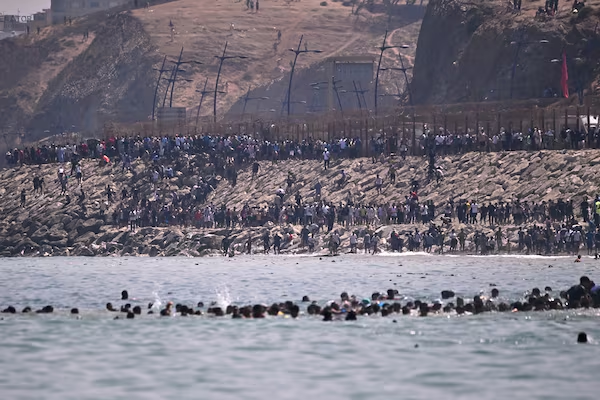
Spain’s Interior Minister, Fernando Grande-Marlaska has disclosed that 70,000 of the estimated 72,000 that crossed in Cueta have now returned to Morocco.
He added that Spain is “in the process of resolving” the status of the remaining individuals, and those who do not have the right to remain in the country will be returned to Morocco.
He made the comments as he briefed the press after an EU Interior Ministers’ meeting on Ceuta.
The Spanish Interior Minister said that all countries were “constructive” and acknowledged Spain’s immediate response. Nonetheless, he emphasized that the EU’s Schengen area “was in no way compromised” by the crisis, with “no secondary movement, nor even the possibility of any.”
Ceuta has a special status under the Schengen rules, meaning that all entries and exits to mainland Spain or the EU still require full border and document checks. He said that today’s meeting was “satisfactory” in recognising Spain’s work on irregular migration.
Grande-Marlaska also rejected suggestions that Spain was specifically warned about a potential surge at the Ceuta border, saying that if there had been any warning or signal of a similar surge, there would have been a much closer communication at the highest levels of the Spanish government.
He stated that the plans to extend the maritime border infrastructure were already in place before last week’s crisis.

Grande-Marlaska insisted that Spain will respect all fundamental rights of minors in Ceuta, but insisted that there were no reason to suggest otherwise.
He told Ministers that 75 dead bodies have been recovered so far, stressing that this figure was “preliminary” and could rise further. The Ministers also discussed the measures taken by Spain to strengthen its border, including a new floating barrier.
EU Ministers Express Solidarity With Spain
Meanwhile, French Interior Minister Laurent Nuñez said that during the three-hour meeting, the Ministers expressed their “solidarity” with Spain and praised how Madrid handled the crisis last week.
Nuñez also said that the Ministers were concerned by attempts to sow disinformation about the crisis and “interference” by foreign states in a bid to criticise the bloc and “sow division” among the member states.
He said that France remains available to help Spain in whatever way possible. In this context, he mentioned France’s decision to strengthen its checks on borders with Spain to prevent “secondary movements,” including towards France and the UK. The Minister also stressed the need to fight against human smuggling gangs, including the work “upstream” in the countries of origin. He said that all countries strongly backed the EU’s Asylum and Migration Pact, which he called “indispensable” in fight against irregular migration.
Ireland’s Home Affairs Minister Jim O’Callaghan also offered his take on today’s meeting. Ireland hosts the EU’s rotating presidency of the Council of the European Union, meaning it chairs the key meetings during this period.
In a diplomatically worded statement, O’Callaghan said, “The EU is united and stands ready to support Spain and protect our external borders from illegal migration.”
“We commend Spain for their swift response to the situation in Ceuta and extend our deepest condolences for the tragic loss of life. The EU’s external borders are our shared responsibility, and migration requires a united European response.
“Today’s meeting which I convened provided an important opportunity for member states to assess the tools already at our disposal, identify where further cooperation is needed, and advance our collective preparations ahead of the next ministerial meeting and the European Council in October.”
Jim O’Callaghan
The EU’s readout also added that there was “a common understanding on the need to continue relentlessly fighting migrant smuggling networks” and to “improve situational awareness” to prevent similar crises.
According to the readout, the council highlighted the importance of cooperation with third countries and to further develop partnerships that create the right opportunities for people in their home countries and strengthen migration management.
The Ministers pointed out that communication during moments of crisis could further be reinforced through timely coordination and should be more coherent, especially to counter malicious external actors engaged in foreign information manipulation and interference.
READ ALSO: Big Push Agenda Must Benefit Every Sector of Economy – Hon Iddrisu