
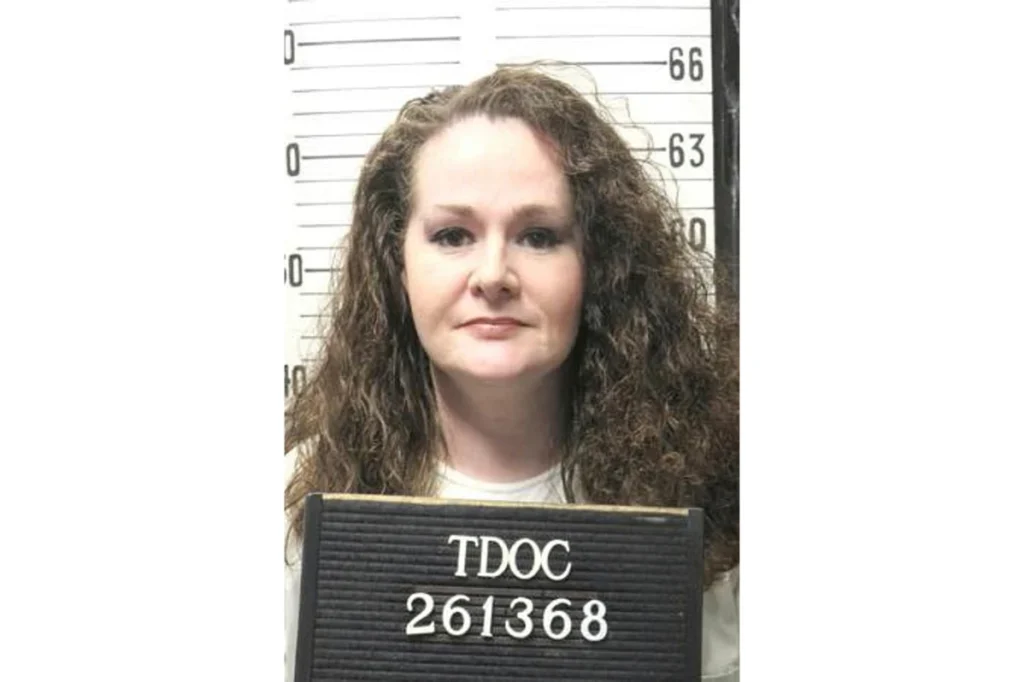
Tennessee Governor, Bill Lee has suspended executions in the state until at least the end of the year following a failed attempt to execute death row inmate Christa Pike, who reportedly remained alive and was heard snoring after receiving two doses of the lethal drug intended to end her life.
Lee, a Republican, announced the suspension on Thursday, describing the incident as deeply disturbing and ordering an independent investigation into the circumstances surrounding the botched execution at a prison in Nashville on Wednesday night.
Pike, 50, was scheduled to be executed for the 1995 murder of 19-year-old Colleen Slemmer, but the procedure failed after prison officials administered two doses of pentobarbital without achieving the intended outcome.
Pike was sentenced to death for the January 1995 murder of Slemmer, a fellow student at Knoxville Job Corps, in a case that attracted national attention because of the victim’s brutal killing and the young ages of those involved. Pike was 18 at the time of the murder, while her boyfriend, Tadaryl Shipp, was 17. Another female acquaintance was also involved in the incident.
The three tortured and killed Slemmer, who was 19, using box cutters and a rock. During the attack, Shipp reportedly carved a pentagram into the victim’s chest, while Pike later showed a friend a fragment of Slemmer’s skull.
Pike never denied her involvement in the killing and was subsequently convicted and sentenced to death. She was also later diagnosed with mental health disorders.
Speaking to reporters on Thursday morning, Lee said that he had spoken with Frank Strada, the secretary of the Tennessee Department of Correction, but had not received an update on Pike’s medical condition.
She was transported by ambulance to an off-site medical facility following the failed execution. “This is a tragedy,” Lee said, adding that he had yet to speak with the families of Pike and Slemmer.
“There is no one that wanted what happened last night to happen. It shouldn’t have happened.
Bill Lee
The Governor described the incident as an exceptionally difficult situation for the state, particularly given the circumstances surrounding the execution and the failure to complete the procedure.
“It’s the most difficult of circumstances as it relates to the sentence that should have been carried out by the state. It’s a tragedy, and it’s deeply disturbing that that has happened in this state. The people deserve better than that.”
Bill Lee
He also expressed disappointment over the incident, saying that Tennesseans deserved a comprehensive explanation of what had gone wrong.
The Governor announced that an independent, third-party investigation would be conducted to establish the circumstances of the failed execution.
The suspension affects all executions in Tennessee until at least the end of December, including the scheduled execution of Gary Wayne Sutton, who has been on death row since 1996 for the murder of a friend. Sutton was due to be executed on December 3.
Pike’s failed execution marks the second time this year that Tennessee has been unable to complete an execution. In the previous case, prison officials could not find a suitable vein for an intravenous line, resulting in the lethal drugs never being administered.
The latest incident has raised questions about the state’s execution procedures and the administration of lethal injections, prompting calls for greater scrutiny of the process.
Pike’s execution was initially scheduled for Wednesday morning, but an appeals court issued a stay approximately an hour before the procedure was due to begin. The US Supreme Court subsequently overturned the decision, allowing the state to proceed with the execution later that day.
Officials administered two doses of pentobarbital, a drug used in lethal injections, according to court filings submitted by Pike’s attorneys.
However, the execution did not proceed as intended. Witnesses reportedly heard Pike snoring loudly in the execution chamber more than an hour after the procedure began and nearly 30 minutes after the second, backup dose had been administered.
Her attorneys subsequently filed an emergency motion with the Tennessee Supreme Court, seeking to halt the execution. They argued that Pike was experiencing unnecessary suffering and that continuing the procedure violated her constitutional protection against cruel and unusual punishment.
The precise medical circumstances surrounding the failed execution remained unclear on Thursday, as Pike was receiving treatment at an off-site medical facility. Her attorneys had confirmed that she had been transported to a hospital by ambulance, but her condition had not been publicly established.
Tennessee Department Of Correction Defends Handling Of Execution
The Tennessee Department of Correction defended its handling of the procedure, maintaining that officials had followed the state’s established execution protocol.
In a statement, Department Spokesperson Dorinda Carter said that the execution team had complied with the procedures approved by the state Attorney General’s office. “The Tennessee Department of Correction followed every step of the State’s lawful, established execution protocol approved by the Attorney General’s Office,” Carter said.
She added that the lethal injection drug used in the procedure had consistently been effective and that the protocol did not permit additional procedures beyond those carried out during Pike’s execution attempt.
Carter also confirmed that Pike had been transferred to an off-site medical facility for further treatment.
Had Wednesday’s procedure been completed, Pike would have become the first woman executed in Tennessee in more than 200 years.
Her case has now become the focus of renewed scrutiny of the state’s capital punishment system, particularly following the failure of the lethal injection procedure and the governor’s decision to suspend further executions pending an independent investigation.
READ ALSO: France Deploys Emergency Measures As Student Protests Escalate