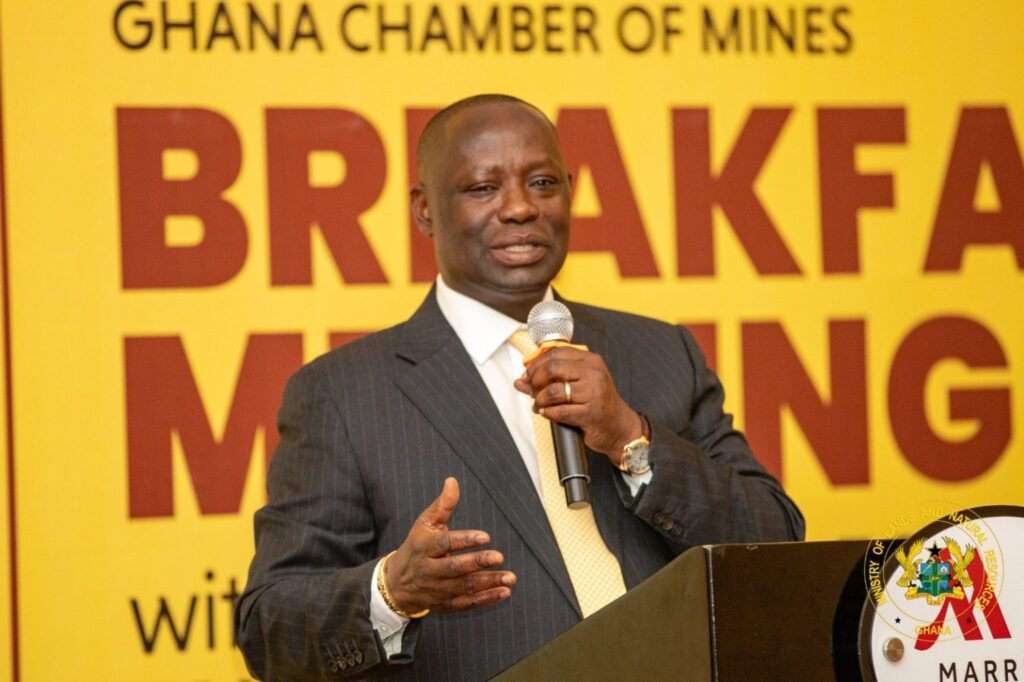
The Chief Operating Officer of the Ghana Chamber of Mines, Ahmed Dasana Nantogmah, has called on the government to establish a balanced mining fiscal framework that guarantees fair public revenues and tangible benefits for local communities while sustaining the long-term investment required to secure the industry’s future.
Speaking at a civil society dialogue in Accra organized in partnership with the Natural Resource Governance Institute (NRGI) under the theme “Ghana’s Mining Fiscal and Revenue Governance Architecture: Is Ghana Maximising Value from Its Mineral Wealth?”, Mr. Nantogmah argued that the true measure of Ghana’s success in managing its mineral resources lies not merely in short-term tax collection, but in building lasting economic opportunities across the nation.
“Investors, communities and government form the mining tripod. Each must derive value through fair returns, improved livelihoods and sustainable public revenues. Our goal should be to maximise and fairly share that value; squeezing one leg weakens the whole.”
Ghana Chamber of Mines

Expanding on this position, Mr. Nantogmah underscored that any policy measures designed to raise public revenue must carefully preserve the economic conditions necessary for continuous mineral exploration, mine development, steady production, and employment generation.
He cautioned that over-taxing the extractive sector threatens to undermine the primary engines of sector growth, emphasizing that a stable, transparent, and predictable regulatory structure is vital to encourage corporate reinvestment and safeguard future tax receipts.
According to the Chamber, effective environmental governance, transparent regulatory oversight, responsible gold trading practices, and regional investment competitiveness must advance concurrently to reinforce systemic sector reforms.
Structural Pressures and the Call for Fiscal Balance
The demand for a recalibrated fiscal regime arises at a critical juncture for Ghana’s extractive industry.
As Africa’s leading gold producer, Ghana has increasingly sought to optimize state receipts from its gold, manganese, and emerging green minerals through proposed statutory adjustments, including potential revisions to stability pacts and royalty structures.
However, market analysts and industry operators point out that high operational costs, volatile global commodity pricing, and stringent domestic tax levies risk capital flight to competing mining jurisdictions across the sub-region.
The dialogue organized with the NRGI highlighted the delicate equilibrium between sovereign extraction rights and investor security.
Industry experts at the event noted that while maximizing immediate non-tax and tax revenue appears politically advantageous, aggressive fiscal tightening without corresponding exploration incentives halts discovery pipelines.
Mining operations require substantial capital expenditure spanning decades before yielding returns; thus, policy volatility directly discourages the capital infusions needed to deep-mine existing reserves or discover new deposits.
Holistic Value Chain Management and Civil Society Collaboration
Addressing participants on systemic governance, Mr. Nantogmah urged stakeholders to evaluate the comprehensive chain of mineral value creation rather than focusing solely on point-of-sale revenue extraction.
He noted that governance efforts must track the full lifecycle of resources from initial geophysical discovery and commercial development to revenue collection, equitable distribution, and project implementation.

The ultimate test of national extractive governance, he noted, rests on whether mineral wealth translates into elevated living standards, resilient public institutions, and sustainable economic development within host communities.
Highlighting the role of non-state actors, the Chamber emphasized that civil society organizations bring crucial research capability, public scrutiny, and grassroots perspectives that directly complement the industry’s practical field experience.
Mr. Nantogmah explained that regular, constructive engagement between industry leadership, civic groups, and state policymakers allows stakeholders to rigorously test policy assumptions, identify regulatory blind spots, and draft pragmatic policy solutions capable of standing the test of time.
Safeguard Future Prosperity Through Policy Stability
Looking ahead, the Chamber of Mines reaffirmed its dedication to evidence-based policy advocacy, encouraging state regulators and civic actors to challenge legacy assumptions, engage differing perspectives, and establish clear operational consensus.
By aligning environmental compliance, transparent gold trading frameworks, and fiscal predictability, Ghana can maintain its status as an attractive destination for global mining capital while ensuring its citizens derive equitable, long-term dividends from their natural endowment.
READ ALSO: UEFA Announces Minute of Silence for Departed Tenerife Striker