By Kay Codjoe: Associate at the IMANI Centre for Policy and Education
Government performance should be examined through evidence rather than political sentiment. Progress deserves recognition where it exists, just as public institutions must remain accountable for the results they report.
Ghana’s tourism sector offers an instructive case. The Ghana Tourism Authority’s 2025 performance figures reveal measurable expansion across several indicators, including international arrivals, domestic tourism and licensed business activity.
These developments warrant attention, particularly as the country seeks to position tourism as a productive contributor to national economic development. International arrivals reached approximately 1.31 million, while visits to tourist attractions increased by seven per cent to about 1.79 million. Licensed tourism enterprises rose by 6.1 per cent to 7,109.
The commercial indicators are equally significant. Travel trade enterprises expanded by 18.6 per cent, while food, beverage and entertainment businesses recorded 8.2 per cent growth.
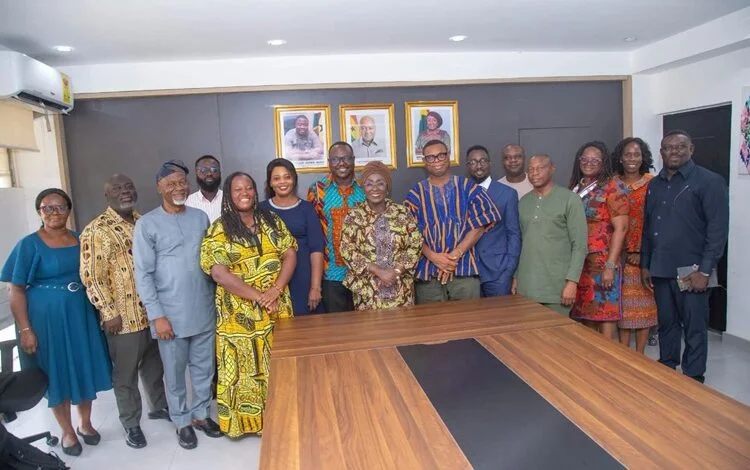
These figures indicate expanding formal participation in tourism-related economic activity. They also establish a credible basis for assessing the sector’s development priorities. It was against this background that IMANI Africa’s Centre for Policy and Education undertook a working visit to the Ministry of Tourism, Culture and Creative Arts.
Our delegation, comprising IMANI President Franklin Cudjoe, Vice President Selorm Branttie, and associates Princess Umul Hatiyya Ibrahim Mahama and myself, engaged Minister Abla Dzifa Gomashie in discussions covering tourism development, investment, cultural preservation and institutional coordination.
The Minister presented an integrated policy approach connecting tourism, hospitality, creative industries, cultural heritage and private enterprise. The economic reasoning is persuasive. Tourism operates through interconnected markets. Accommodation providers depend on transport operators, food producers, entertainment businesses and reliable public infrastructure.
Cultural attractions generate additional economic opportunities when supported by professional management and commercially viable visitor services. The Ministry’s approach recognises these relationships and the need for coordinated development. Another encouraging dimension emerges from visitor experience data.
The 2025 Tourism Report recorded satisfaction ratings of 99 per cent for Ghanaian friendliness and 98 per cent for airport facilities and formalities. More than 60 per cent of international visitors were repeat travellers.
Business travel accounted for approximately 31 per cent of international arrivals, while the entertainment and conference segment expanded by 14.3 per cent. These indicators point towards opportunities in business tourism, international conferences, hospitality services and organised cultural experiences.
They also suggest that Ghana’s tourism development strategy should address visitor retention, service quality and commercial diversification alongside destination promotion. The Minister’s attention to cultural merchandise, textiles, trademarks and intellectual property is particularly relevant.
Ghana’s cultural economy contains substantial opportunities for local production, enterprise development and commercial ownership. However, the economic benefits of cultural promotion depend on whether producers and traditional custodians can participate meaningfully in the markets created around their heritage.
Appropriate intellectual property protections, quality standards and access to commercial distribution channels would help strengthen that participation. During our engagement, IMANI also explored the potential application of augmented reality, digital heritage interpretation and historically authenticated storytelling.
These technologies could improve educational experiences at heritage attractions while creating opportunities for Ghanaian historians, filmmakers, animators and software developers.
Such possibilities demonstrate why tourism development increasingly requires cooperation across institutions and industries. The Ministry’s policy direction provides an opportunity to strengthen these connections.
There is, however, an important distinction between recording sectoral growth and establishing the specific contribution of government policy. Annual performance figures demonstrate changes in economic activity. They do not independently identify every intervention responsible for those changes.
That is precisely why institutional reporting matters. IMANI sees considerable value in a comprehensive Ministry performance report covering January 2025 onwards. Such an assessment could document expenditure, implementation milestones, investment partnerships, institutional reforms and measurable economic outcomes.
It would provide policymakers, investors and the public with a clearer understanding of the Ministry’s achievements and outstanding priorities. We also envisage a Reset Tourism Conference bringing together government institutions, traditional authorities, private investors and creative enterprises to translate development priorities into practical investment programmes.
The value of such an engagement would depend on clear responsibilities, financing arrangements and measurable commitments. These proposals complement the Minister’s articulated policy direction and reflect the importance of constructive engagement between government and independent policy institutions.
The Ministry’s integrated approach recognises that tourism development requires more than attracting visitors. It requires the systematic development of businesses, infrastructure, cultural assets and commercial opportunities. The sector’s recorded gains provide an encouraging foundation for that work.
The responsibility now is to consolidate progress through stronger institutional coordination, sustained private investment, competitive services and greater participation by Ghanaian enterprises. Success should ultimately be reflected in employment, business profitability, visitor satisfaction, heritage conservation and the economic benefits retained within local communities.
Ghana’s tourism sector has recorded progress worth acknowledging. The next responsibility is to convert that progress into lasting economic value, supported by transparent institutions and measurable results. That is the standard by which the Ministry’s development agenda should be assessed.
READ ALSO: Foreign Ministry Interdicts Two Officers Over Service Passport Scheme