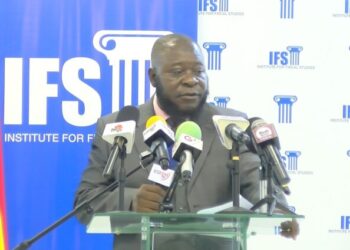
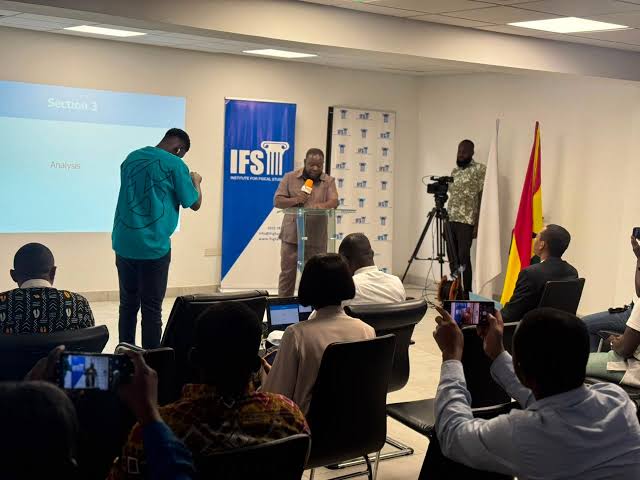
Ghana’s persistent struggle to mobilise sufficient domestic revenue has come under renewed scrutiny after fresh findings by the Institute for Fiscal Studies (IFS) revealed that the country continues to lag behind several Sub-Saharan African economies in converting economic activity into government revenue.
The findings place Ghana 18th among 25 selected Sub-Saharan African countries in terms of total revenue and grants as a percentage of Gross Domestic Product (GDP), exposing a significant weakness in the country’s fiscal capacity.
According to IFS, Ghana recorded a revenue-to-GDP ratio of just 15.7% in 2022, considerably below the regional average of 20.1%. The difference of 4.4 percentage points highlights the extent to which the country is falling behind its African peers in domestic revenue mobilisation.
The ranking raises important questions about Ghana’s ability to finance public expenditure, reduce its dependence on borrowing and create sufficient fiscal space to support economic development.
Ghana Falls Behind Regional Revenue Leaders
The IFS assessment paints an uncomfortable picture of Ghana’s revenue mobilisation performance when compared with other economies across the continent.
Namibia emerged as the strongest performer, recording a revenue-to-GDP ratio of 31.3%, followed by Seychelles at 30.0% and Botswana at 29.5%.
Mozambique secured the fifth position with 28.5%, while South Africa and Zambia both recorded 26.0%. Mauritius and Rwanda followed with 22.8% each, while Congo Brazzaville recorded 22.7%.
Ghana’s 15.7% performance places it considerably below these leading economies and reinforces concerns about the country’s ability to generate sufficient domestic resources.
The IFS assessment was particularly critical of Ghana’s performance, describing government revenue mobilisation as very weak because revenue collection falls significantly short of the average recorded by its African peers.
“While the average total revenue and grants-to-GDP ratio of a sample of 25 Sub-Saharan African countries stands at 20.1%, Ghana’s total revenue and grants-to-GDP ratio stands at only 15.7%, ranking as low as 18th out of the 25 countries, and falling short of the average by 4.4 percentage points”.
IFS
The findings suggest that Ghana’s fiscal difficulties cannot be examined solely through the expenditure side of the national budget. The country’s capacity to collect revenue remains an equally important part of the equation.
Ghana Leaves $3.25bn on the Table
Perhaps the most striking revelation from the IFS assessment is the amount of revenue Ghana potentially failed to collect because of its relatively weak revenue-to-GDP ratio.
In 2022, the government collected GH¢96.65 billion in total revenue and grants, equivalent to US$11.68 billion. This represented 15.7% of the country’s GDP.
However, IFS estimates that Ghana would have generated GH¢123.48 billion, equivalent to US$14.93 billion, if its revenue-to-GDP ratio had matched the Sub-Saharan African average of 20.1%.
That would have delivered an additional GH¢26.83 billion, or approximately US$3.25 billion, to government coffers.
The difference is significant, particularly at a time when Ghana continues to grapple with competing demands for infrastructure investment, healthcare, education, social protection and debt management.
An additional US$3.25 billion in government revenue could have provided considerable fiscal breathing space, reducing pressure on domestic borrowing and potentially limiting the need for additional financing.
The figures also expose the economic cost of failing to maximise existing revenue sources. While governments often focus on expenditure controls and borrowing strategies to manage fiscal pressures, the ability to capture a larger share of economic activity through effective revenue systems remains fundamental to long-term fiscal sustainability.
Botswana’s Performance Reveals an Even Bigger Gap
The comparison becomes even more revealing when Ghana’s performance is measured against Botswana, another African economy with substantial natural resource endowments.
According to IFS, if Ghana had achieved Botswana’s revenue-to-GDP ratio of 29.5% in 2022, the government could have collected GH¢181.23 billion, equivalent to US$21.91 billion, in total revenue and grants.
This would have exceeded the actual amount collected by approximately US$10.23 billion.
The comparison highlights the enormous revenue potential that could remain untapped when a country struggles to translate its economic resources and activities into public finances.
Ghana possesses considerable natural resources, including gold, crude oil, manganese and bauxite. Yet the country’s relatively low revenue performance raises questions about the effectiveness of its tax administration, compliance systems, exemptions and broader domestic revenue mobilisation framework.
The challenge is not necessarily about introducing more taxes. It also involves improving the efficiency of existing collection mechanisms, widening the tax net, addressing leakages and ensuring that economic activities contribute appropriately to government revenue.
2025 Collections Reveal a Persistent Challenge
The concerns surrounding Ghana’s revenue mobilisation performance become more pronounced when the assessment is considered alongside the country’s 2025 collections.
IFS indicated that the government collected GH¢224.88 billion, equivalent to US$17.91 billion, in total revenue and grants in 2025. This represented the same 15.7% of GDP recorded in the 2022 assessment.
Although the nominal value of revenue collections increased considerably between 2022 and 2025, the unchanged ratio suggests that revenue generation has not improved relative to the size of the economy.
This distinction is important because higher nominal revenue does not automatically translate into stronger fiscal capacity. As an economy expands, government revenue must grow sufficiently to maintain or improve its ability to finance public services and development programmes.
The persistence of the 15.7% ratio therefore raises concerns about whether Ghana is generating enough revenue to match its economic potential.
The Fiscal Reform Question Ghana Cannot Ignore
Ghana’s revenue mobilisation challenge carries implications beyond its annual budget targets. Weak domestic revenue generation limits the government’s ability to finance development without repeatedly turning to borrowing, accumulating payment obligations or introducing additional fiscal measures.
It also complicates efforts to establish a sustainable debt position and create room for productive public investment.
The findings provide another reason for policymakers to reconsider the effectiveness of the country’s revenue mobilisation architecture. Improving tax compliance, formalising informal economic activities, strengthening digital tax administration and reviewing revenue exemptions could help unlock additional resources without necessarily increasing the tax burden on existing compliant taxpayers.
Ultimately, Ghana’s fiscal recovery will depend not only on controlling expenditure but also on building a revenue system capable of capturing a fairer and more substantial share of the country’s economic output.
With Ghana recording a revenue-to-GDP ratio of just 15.7%, the gap between its actual collections and potential revenue remains a major concern. Until that gap is addressed, the government’s ambition to finance development, protect economic stability and reduce reliance on borrowing will continue to face considerable pressure.