Ghana’s growing struggle to mobilise enough domestic revenue has come under renewed scrutiny, with the Institute for Fiscal Studies (IFS) warning that weaknesses in the country’s tax system and extractive sector are limiting its ability to finance critical development projects without continually turning to borrowing.
As government prepares the 2027 Budget, the Institute is pushing for major reforms to strengthen domestic revenue mobilisation, eliminate revenue leakages and ensure the country receives greater financial benefits from its natural resources.
The call comes at a time when Ghana faces enormous development financing demands, including infrastructure expansion, improved public sector wages and investments needed to stimulate economic growth.
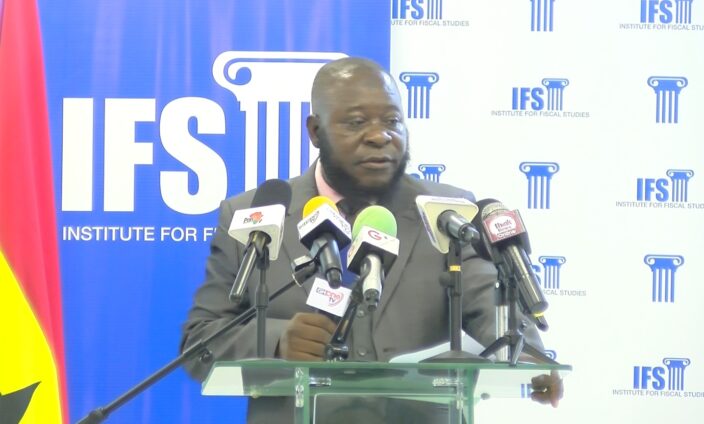
Speaking at a pre-budget press conference, Executive Director of the IFS, Dr Said Boakye, argued that the country’s inability to generate sufficient domestic revenue has contributed to persistent borrowing, inadequate infrastructure and low national income.
His concerns place revenue mobilisation at the centre of the debate surrounding the 2027 Budget, with the Institute insisting that government must address structural weaknesses that continue to deprive the country of resources needed for development.
Ghana’s Revenue Weakness Threatens Development Ambitions
The IFS believes Ghana’s development challenges cannot be addressed effectively without a stronger domestic revenue base.
According to the Institute, insufficient revenue generation has left the country struggling to finance essential projects, forcing government to depend heavily on borrowing to meet development needs.
The consequences extend beyond the government’s fiscal position. Limited resources constrain infrastructure development, weaken the state’s capacity to improve public sector compensation and restrict investments that could raise productivity and household incomes.
Dr Boakye highlighted Ghana’s GDP per capita of $2,419 in 2024 as an indication of the broader development challenges confronting the country.
The Institute’s concern is that without meaningful improvements in revenue mobilisation, Ghana could continue facing difficulties financing its development priorities while accumulating pressure on public finances.
The upcoming 2027 Budget therefore presents an opportunity for government to reconsider how the country generates revenue and whether existing policies are delivering the desired economic benefits.
Mining Sector Under Scrutiny as Ghana Misses Revenue Opportunities
One of the most significant areas identified by the IFS is Ghana’s extractive sector, particularly the limited financial returns the country obtains from its mineral resources.
Despite its considerable mineral wealth, the Institute believes Ghana is not maximising the economic benefits that should accrue to the state from mining activities.
Dr Boakye pointed to Botswana as an example of a country that has secured substantial benefits from its natural resources through significant government participation in the mining sector.
The Botswana model, which allows government to benefit through royalties, dividends and greater involvement in mining operations, offers lessons Ghana could consider as it reviews its approach to managing mineral wealth.
The IFS is consequently urging government to explore more productive resource-sharing agreements and increase its participation in the extractive sector.
Such reforms could help Ghana capture a greater share of the financial returns generated from its mineral resources rather than relying predominantly on conventional revenue arrangements.
The issue is particularly important given the role of mining in Ghana’s economy and the substantial value generated from the country’s natural resources.
A stronger framework for sharing mining profits could provide government with additional revenue to finance infrastructure, social programmes and other national development priorities.
Tax Leakages Continue to Drain Government Coffers
Beyond the extractive sector, the IFS is drawing attention to revenue leakages that continue to undermine domestic resource mobilisation.
Tax evasion, under-reporting and corruption are among the practices identified by the Institute as major obstacles to improving government revenue.
These activities reduce the amount of money entering public coffers, even when businesses and individuals are expected to meet their tax obligations.
The problem creates an uneven tax environment in which compliant taxpayers shoulder their responsibilities while others exploit weaknesses in the system to avoid paying what they owe.
The Institute believes government must strengthen tax administration, improve enforcement and address corruption to ensure that revenue due the state is properly collected.
Closing these loopholes could generate additional resources without necessarily imposing higher tax rates on individuals and businesses already struggling with their financial obligations.
The challenge, therefore, is not simply about introducing new taxes but ensuring that existing revenue sources deliver their full potential.
IFS Targets Excessive Tax Exemptions
Another major concern raised by the Institute is the country’s reliance on tax exemptions as an incentive for attracting foreign investment.
Although tax incentives can encourage businesses to invest and expand operations, the IFS cautions that excessive exemptions could weaken Ghana’s revenue base without delivering sufficient economic benefits.
The Institute is calling for a review of existing tax exemptions to establish whether they are achieving their intended objectives.
Government must ensure that the revenue sacrificed through tax incentives translates into measurable benefits such as increased investment, employment creation, technology transfer and economic expansion.
Where exemptions fail to generate meaningful economic returns, their continued application could represent an unnecessary loss of public revenue.
A comprehensive review would also help government identify incentives that should be retained, redesigned or discontinued.
2027 Budget Faces a Defining Revenue Mobilisation Test
The IFS’s recommendations present government with important choices as preparations for the 2027 Budget gather momentum.
Rather than depending excessively on additional borrowing or continually expanding the tax burden, the Institute wants government to focus on correcting weaknesses within the existing revenue system.
Improving returns from mineral resources, tackling tax evasion, eliminating corruption and reviewing excessive exemptions could collectively strengthen the country’s fiscal position.
These reforms would also create more fiscal space for the government to pursue development priorities without placing additional pressure on public debt.
Ultimately, Ghana’s ability to finance its infrastructure needs, improve public services and raise living standards will depend partly on how effectively it manages the resources already available to the state.
The IFS believes addressing these structural weaknesses is critical to reducing borrowing dependence and strengthening the country’s capacity to finance its own development.
With the 2027 Budget approaching, the government faces growing pressure to turn domestic revenue mobilisation from a recurring fiscal challenge into a sustainable source of national development financing.